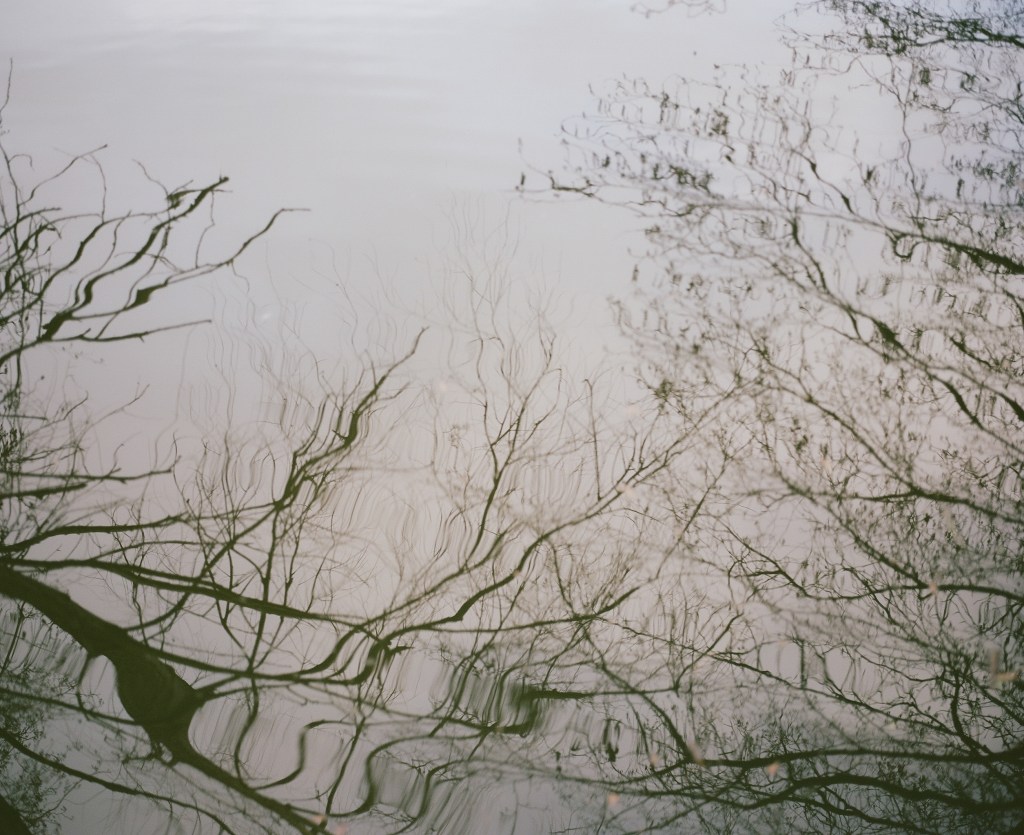
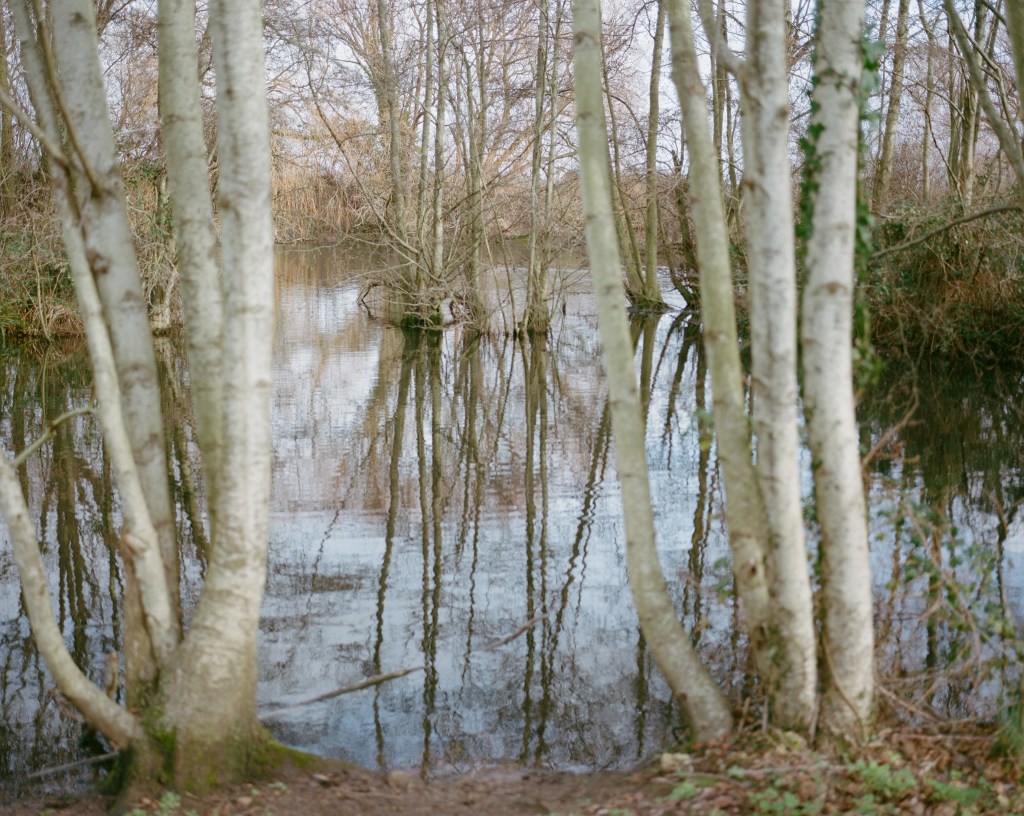
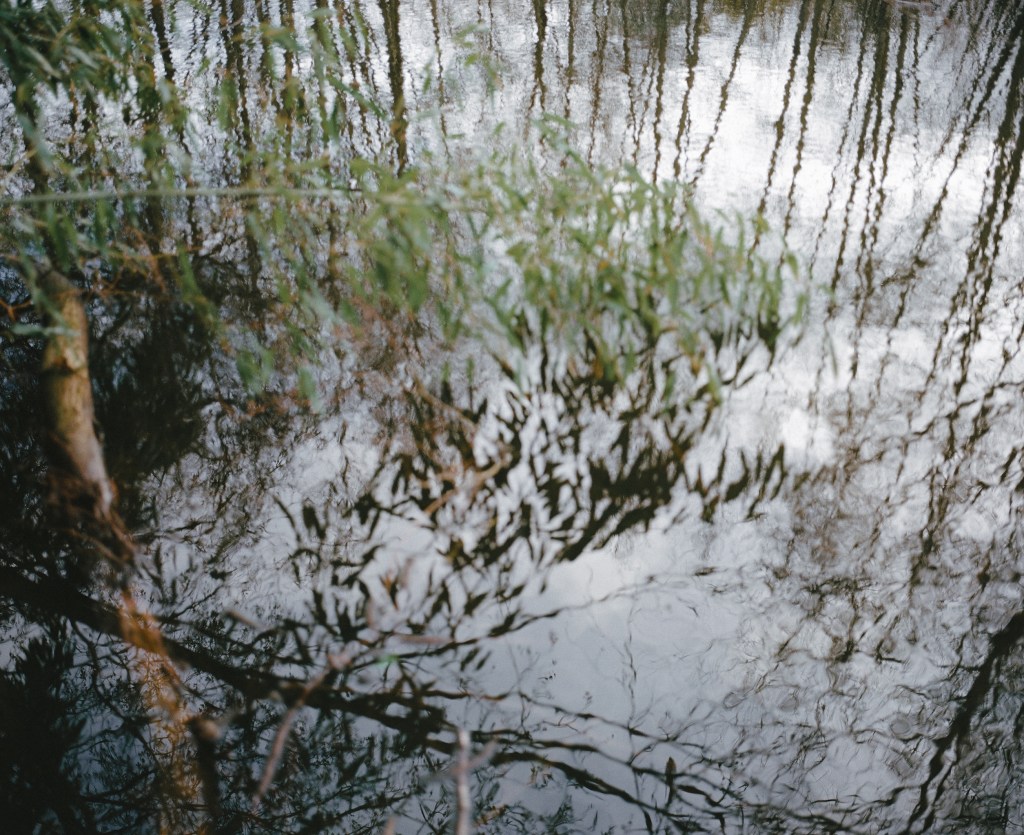
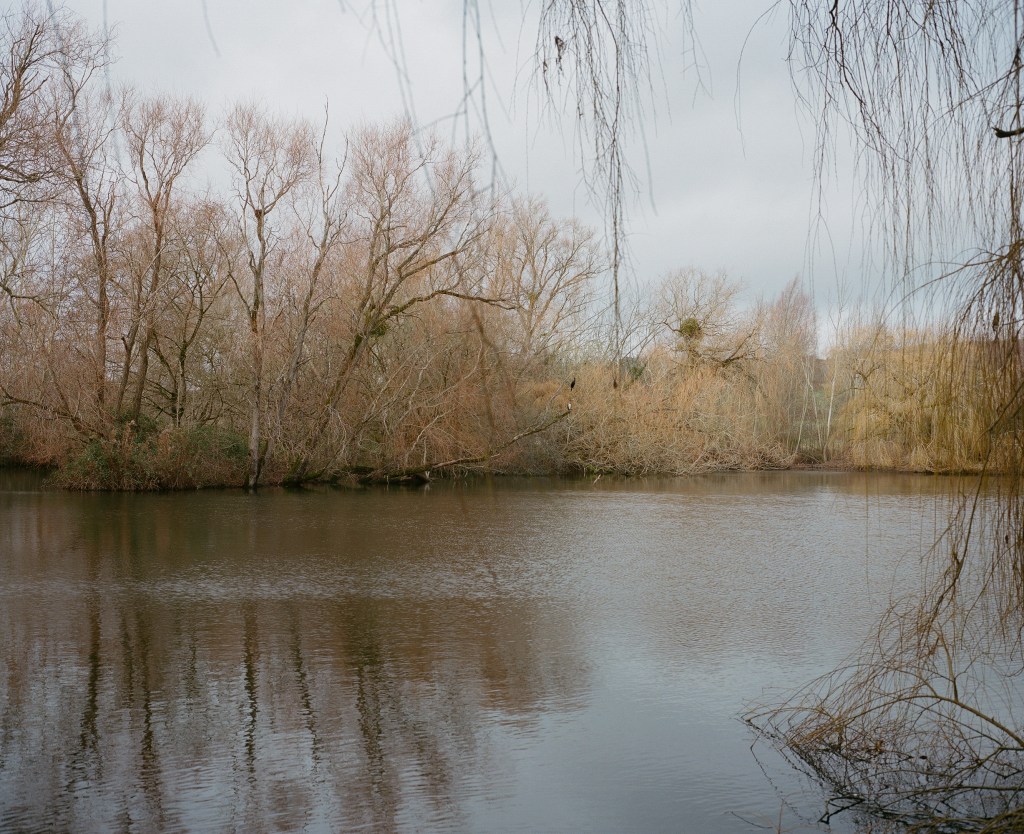
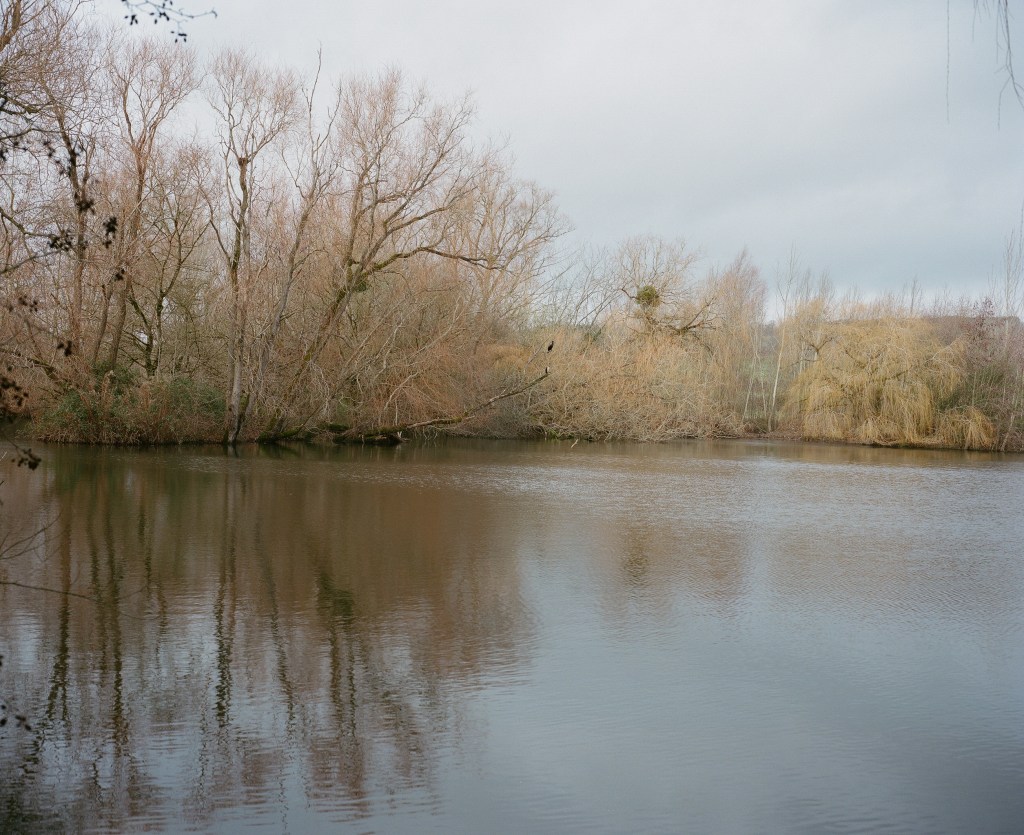
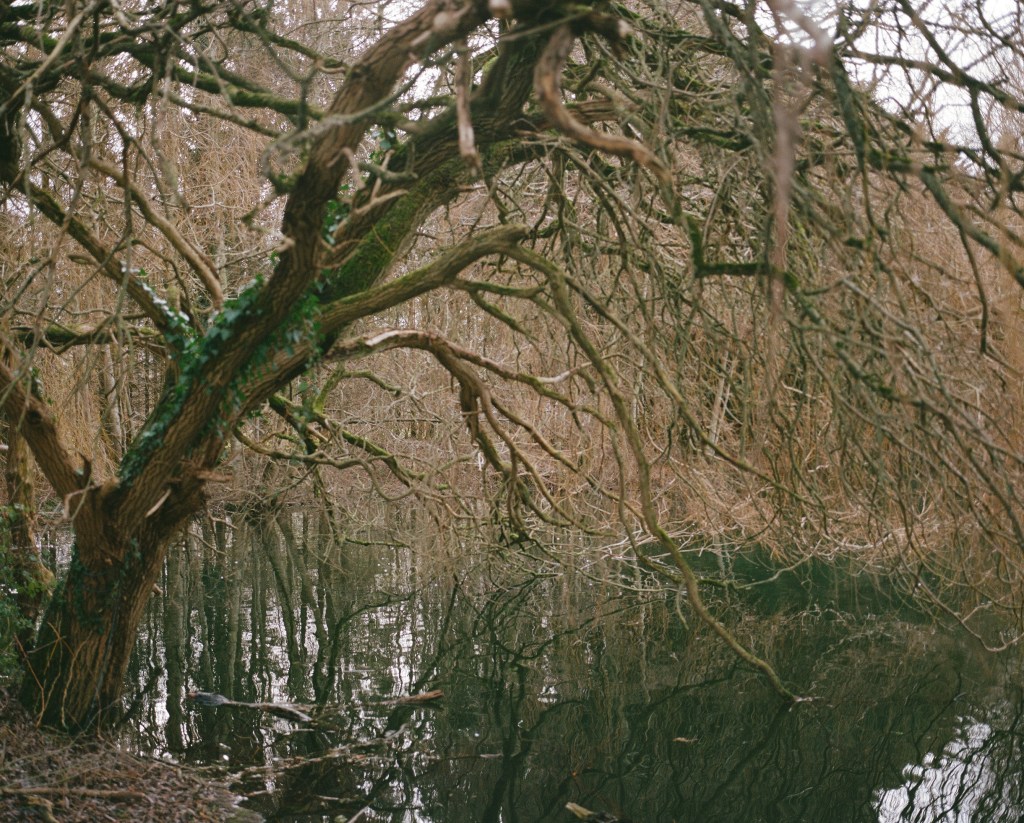
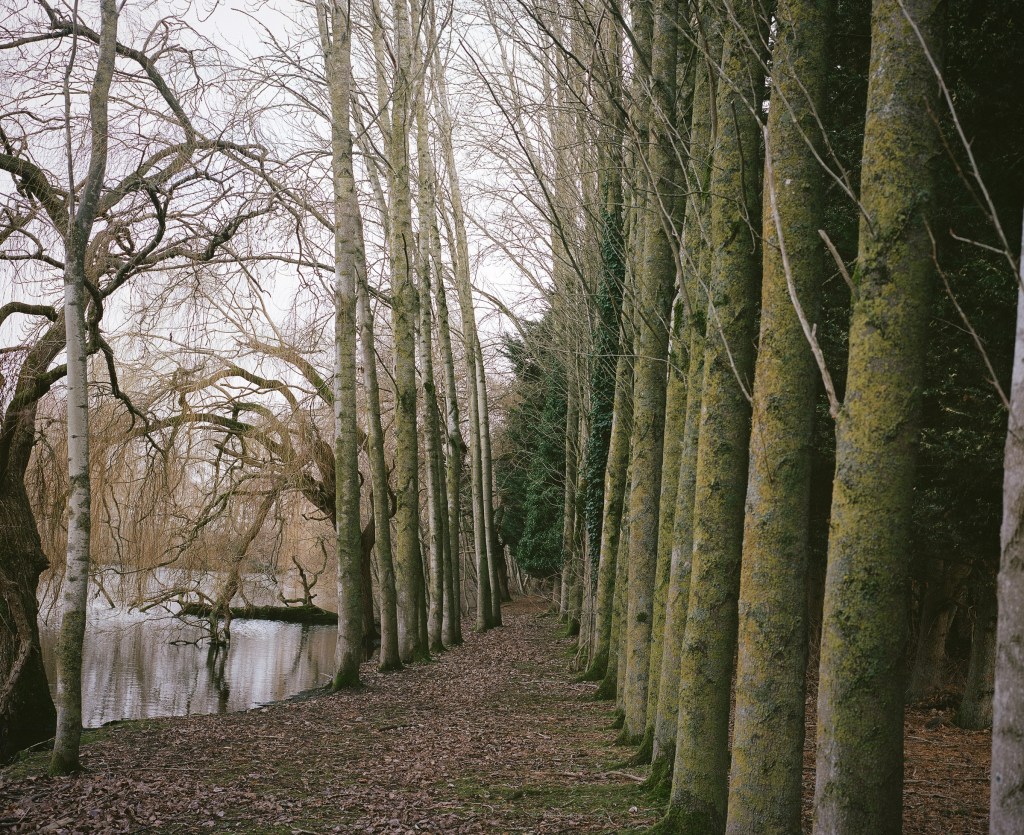
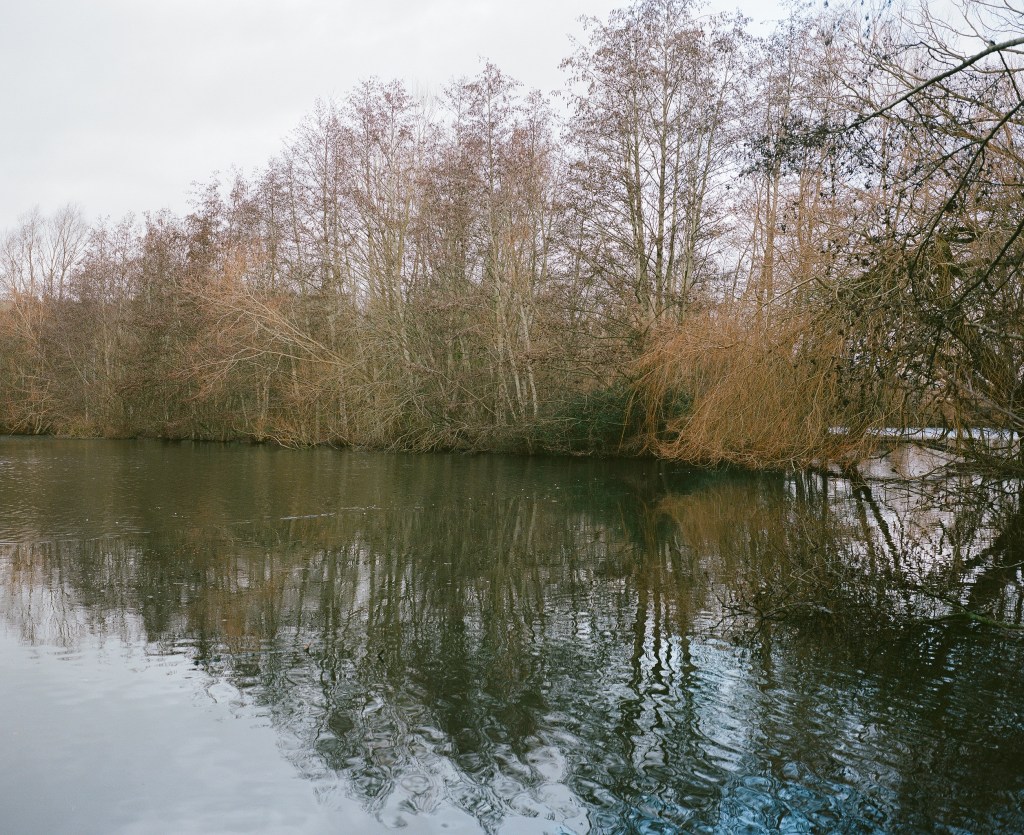
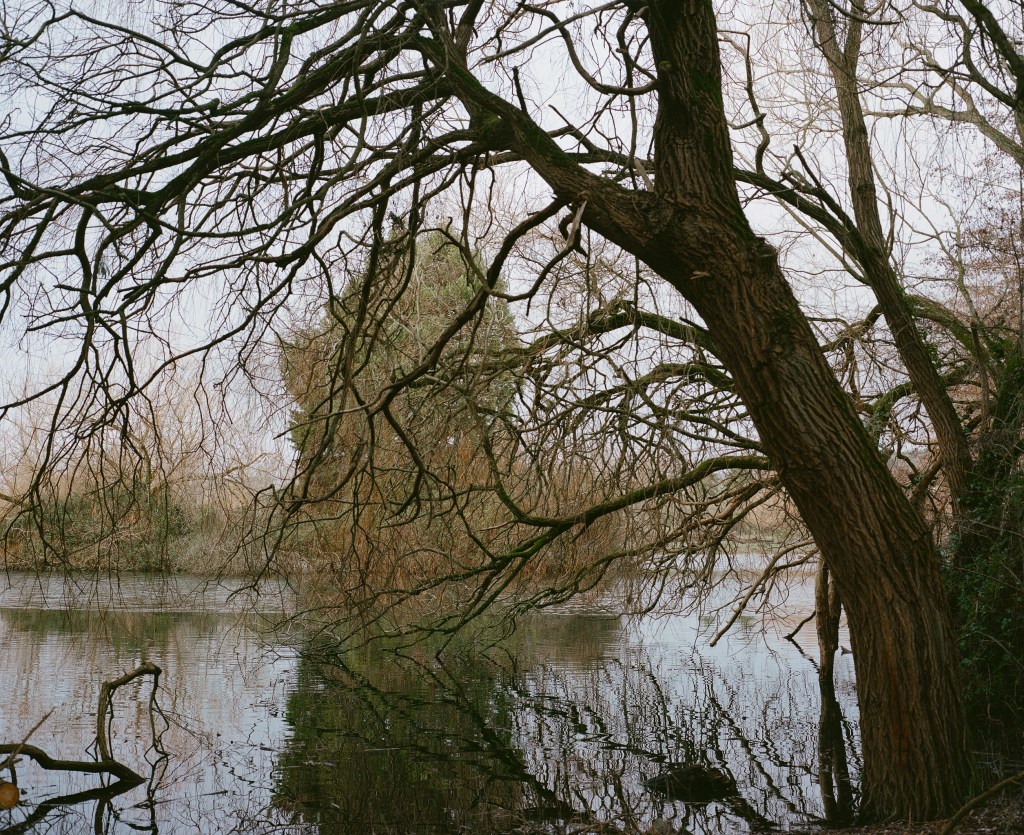
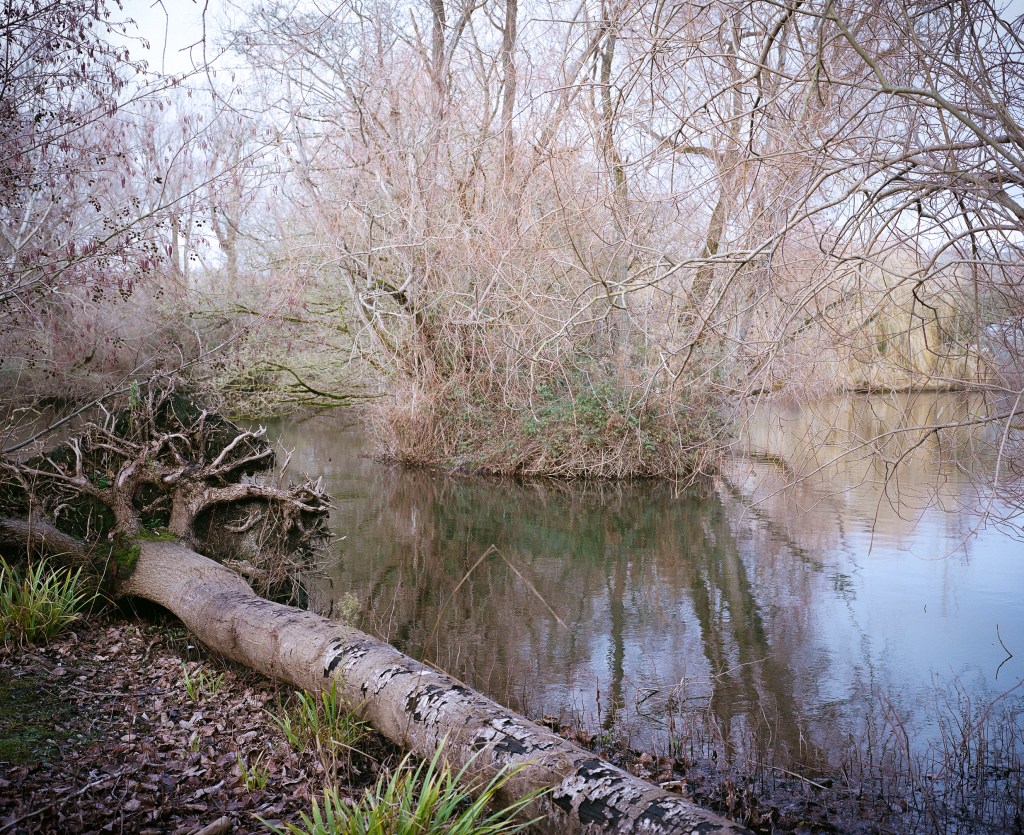
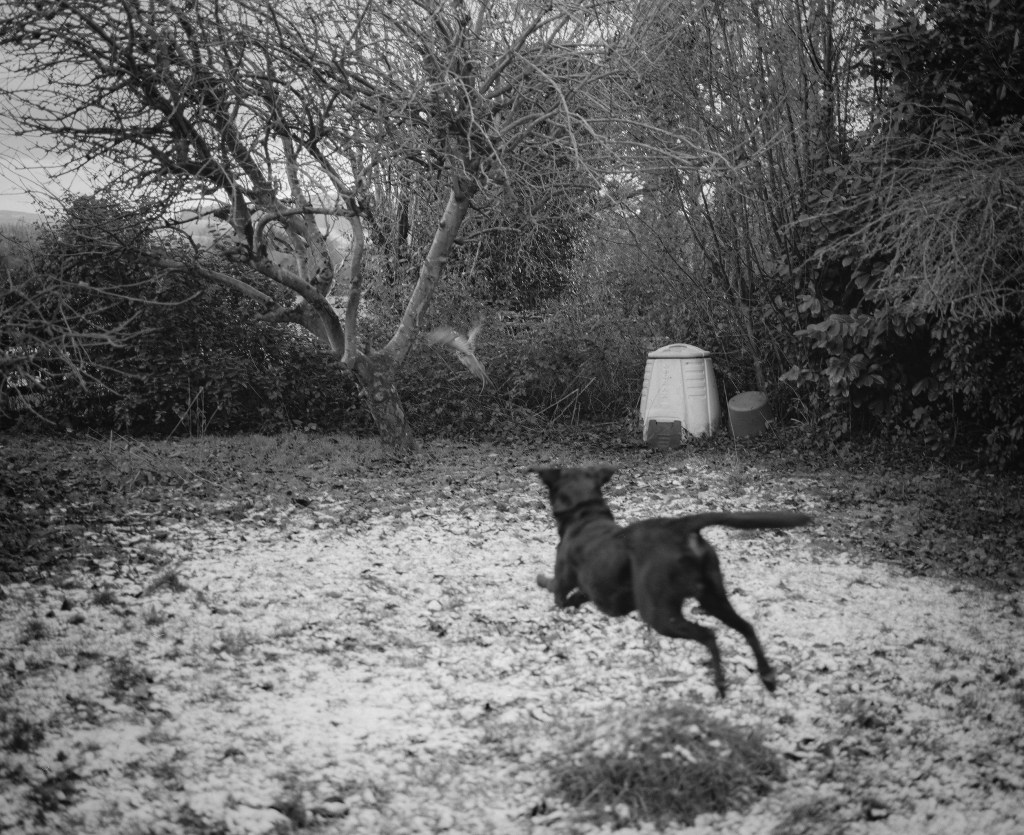
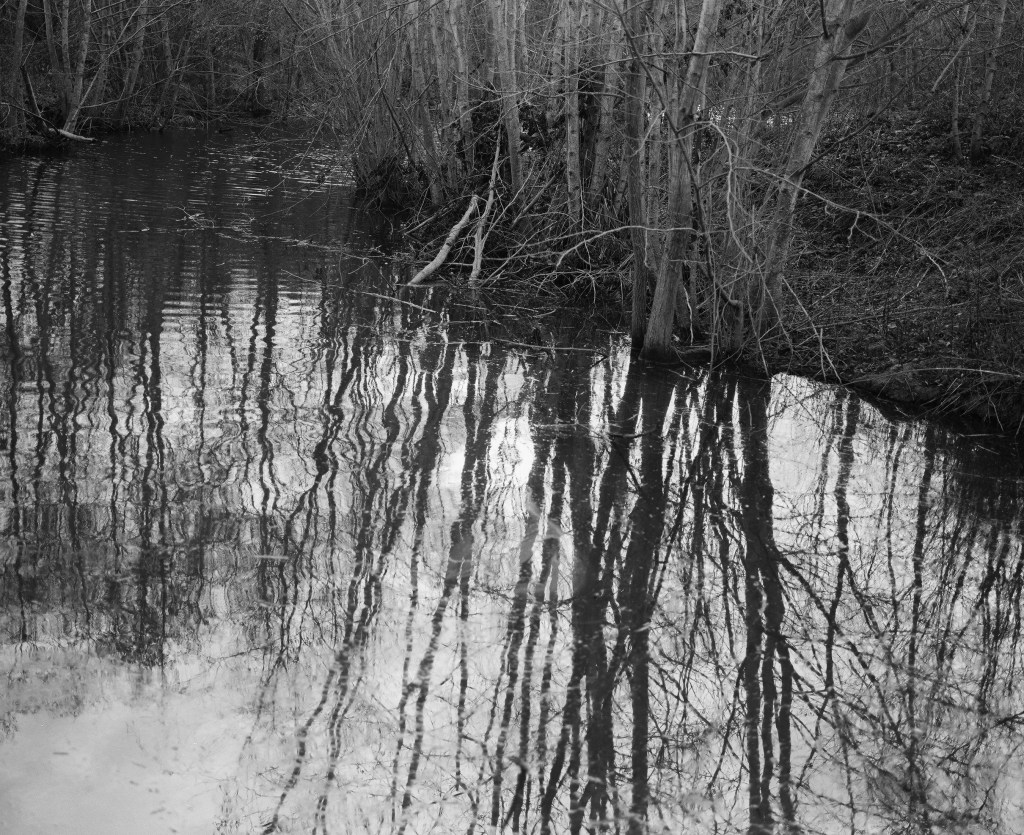
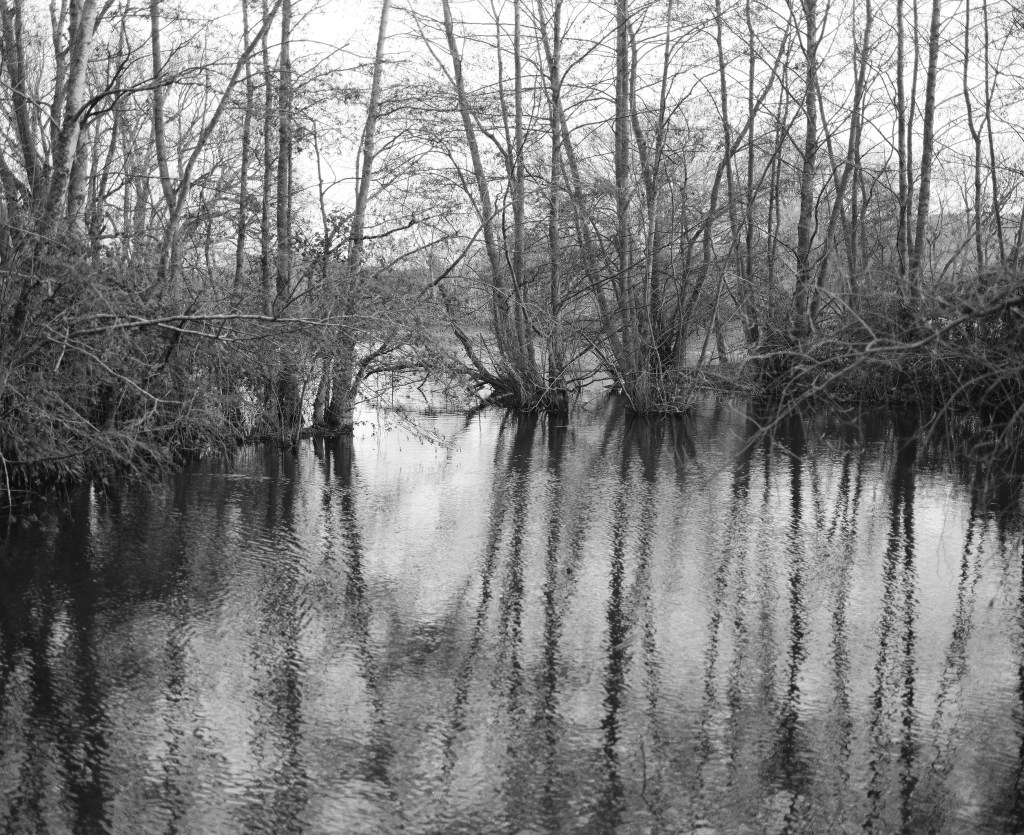
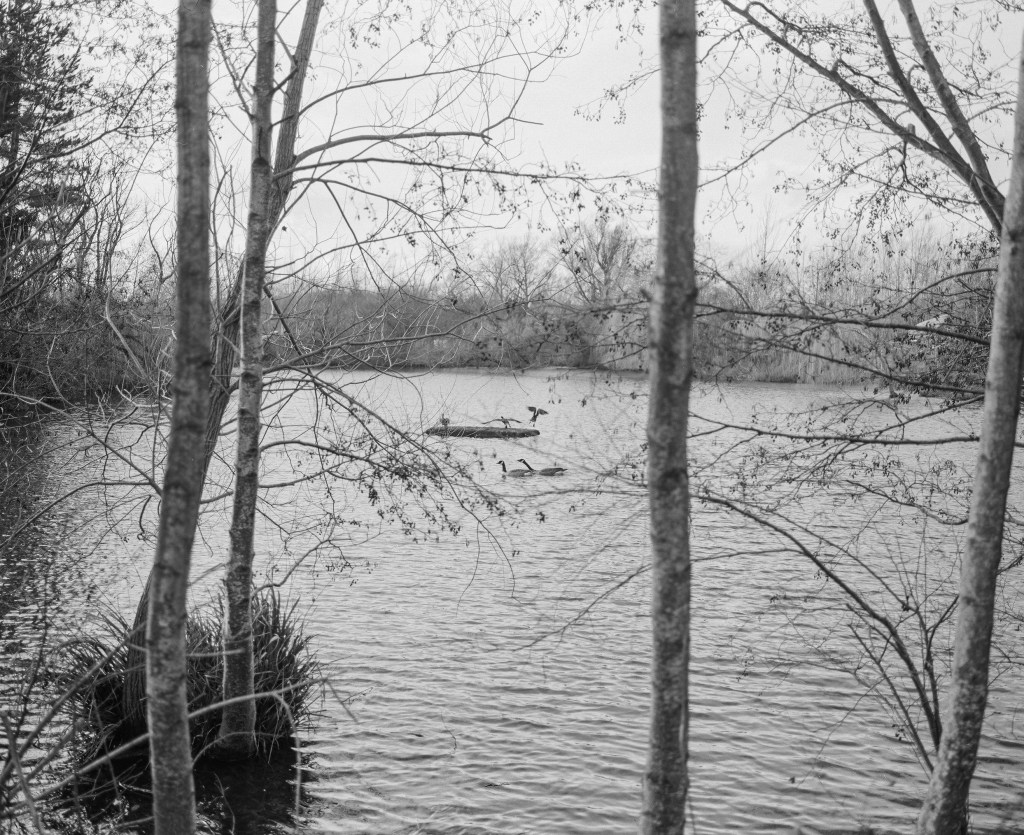
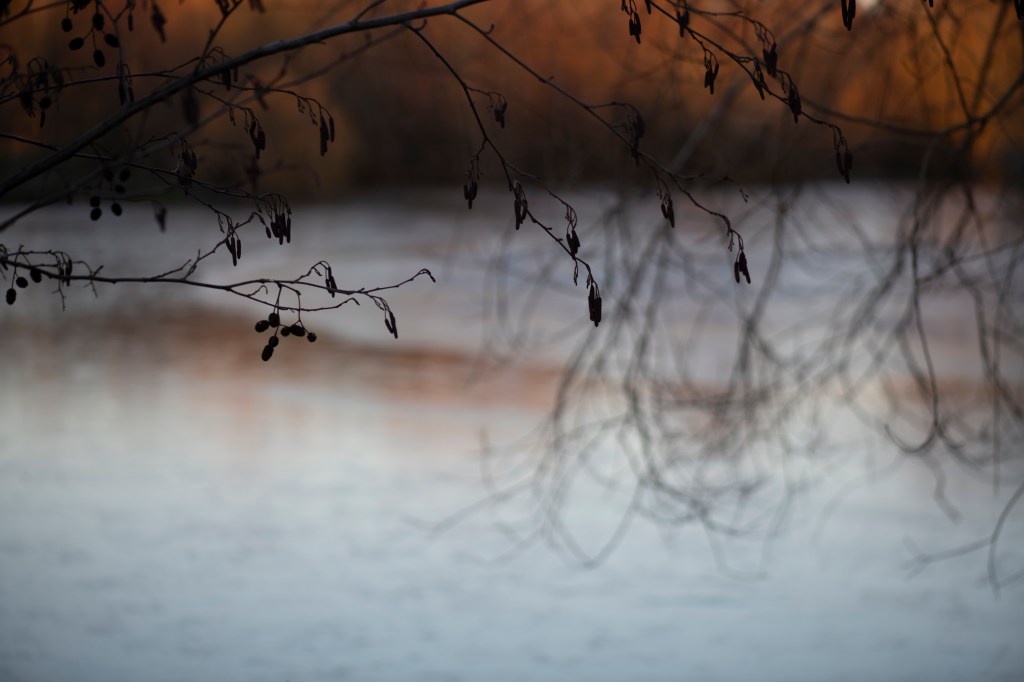
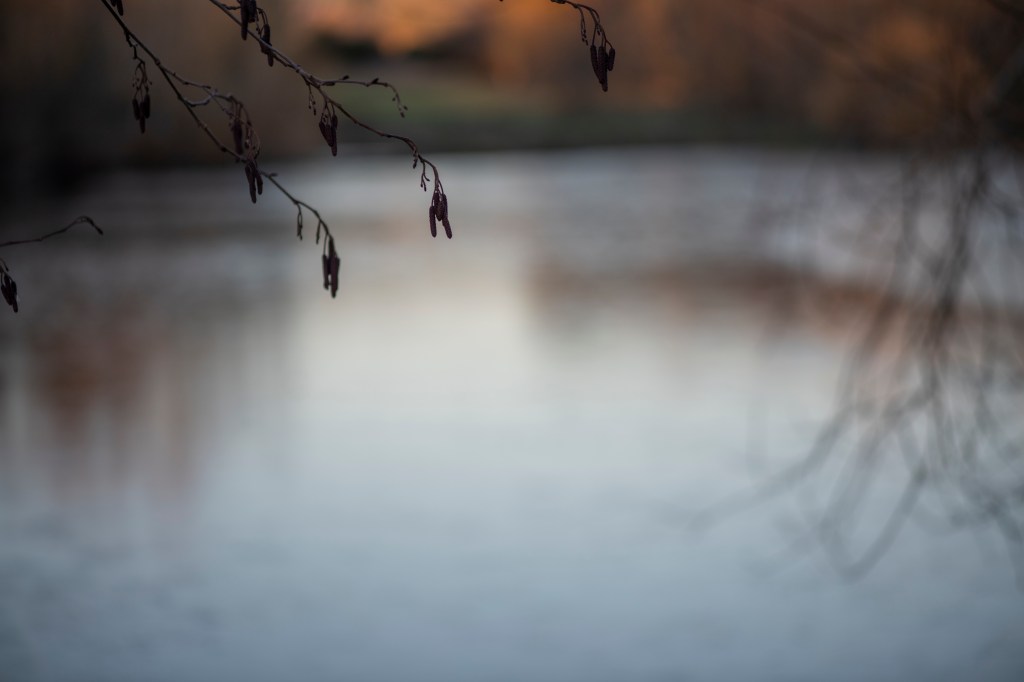
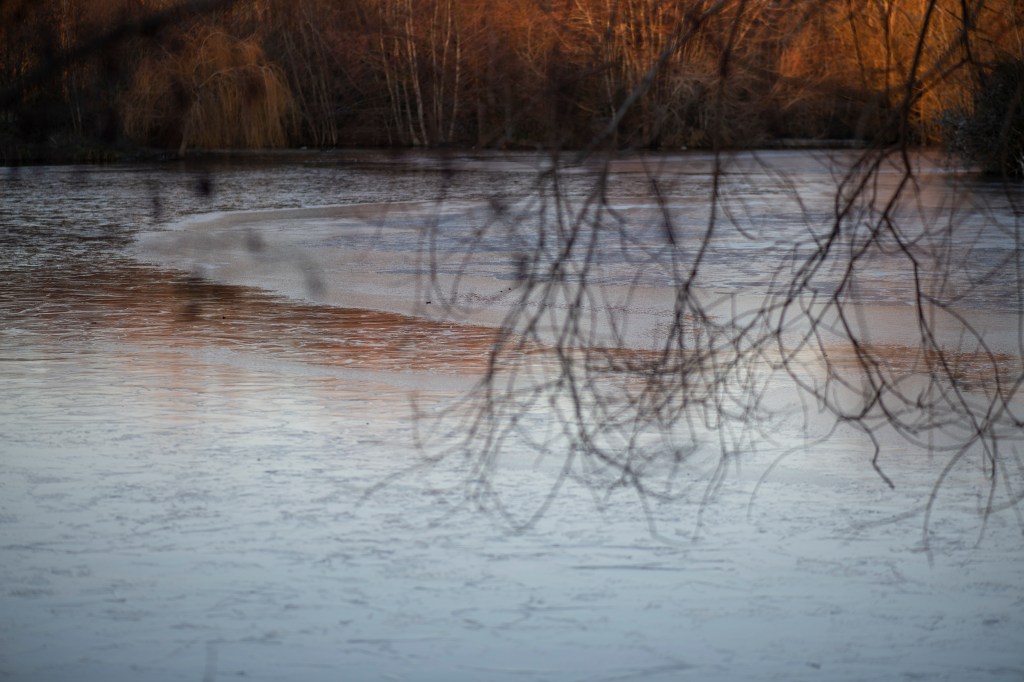
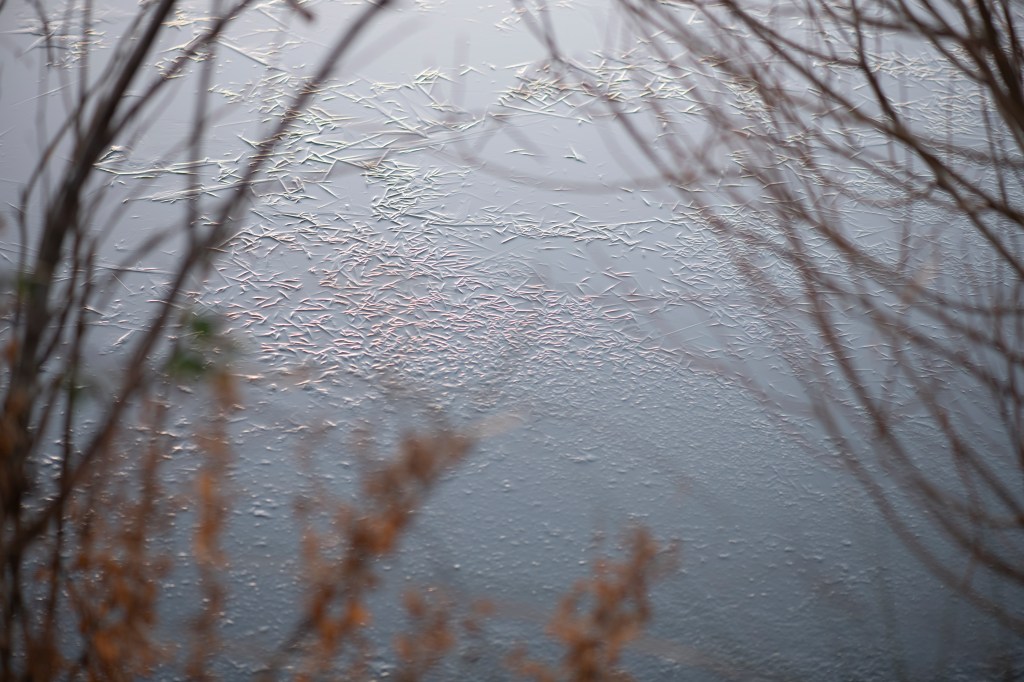
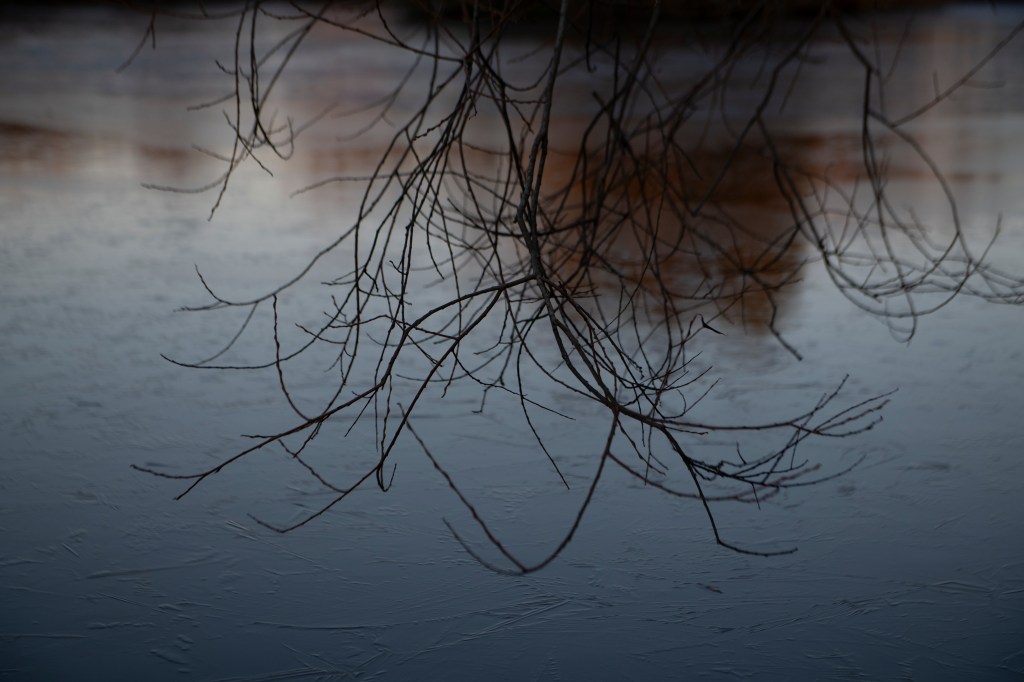
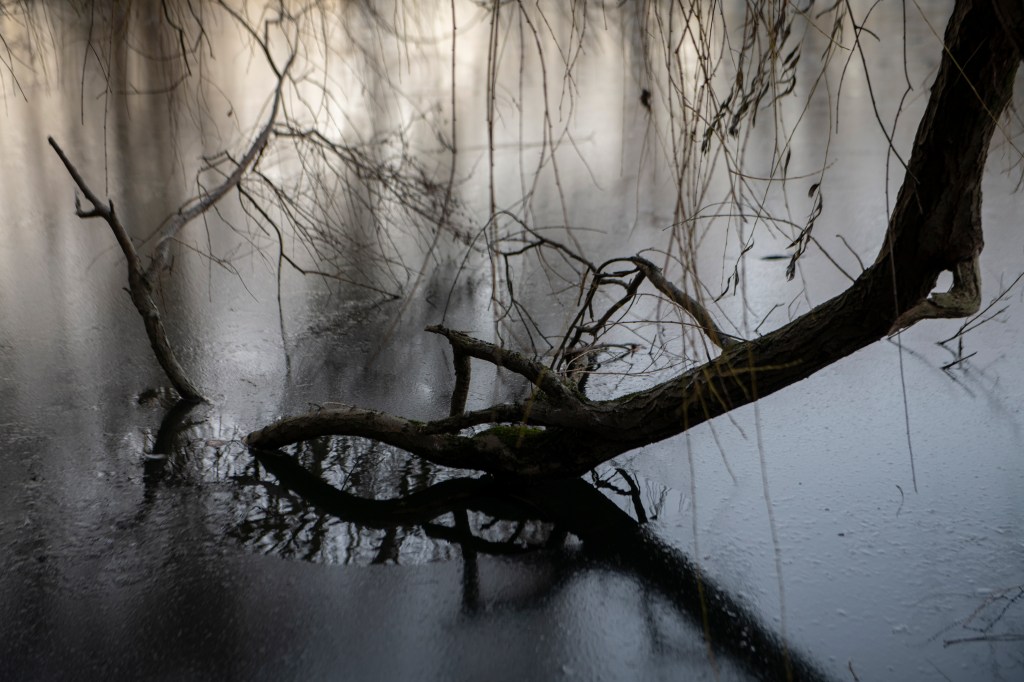
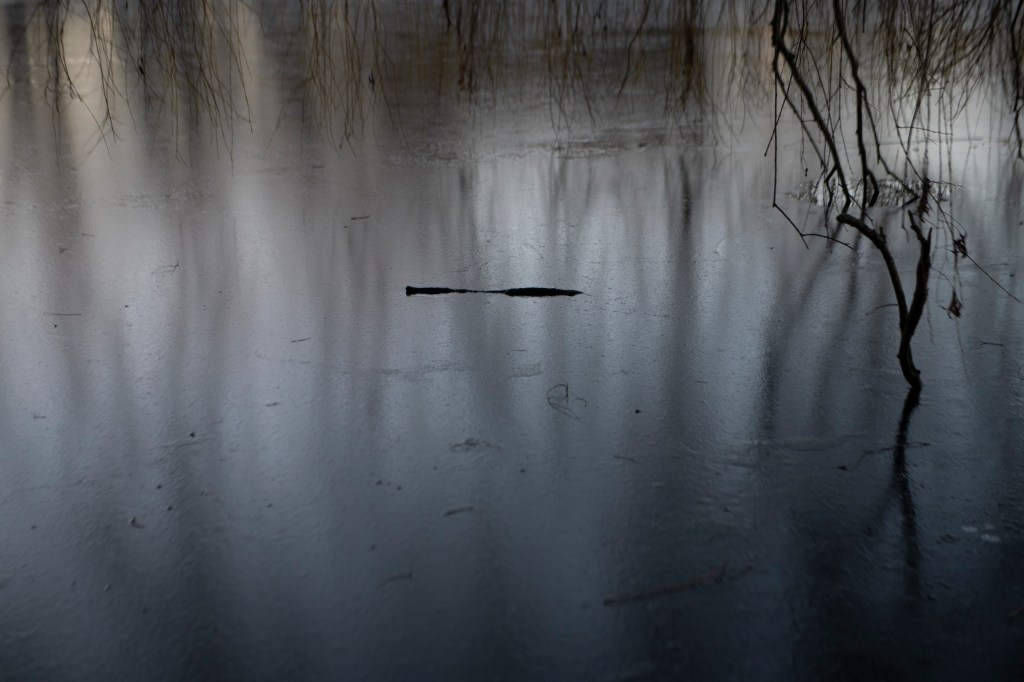
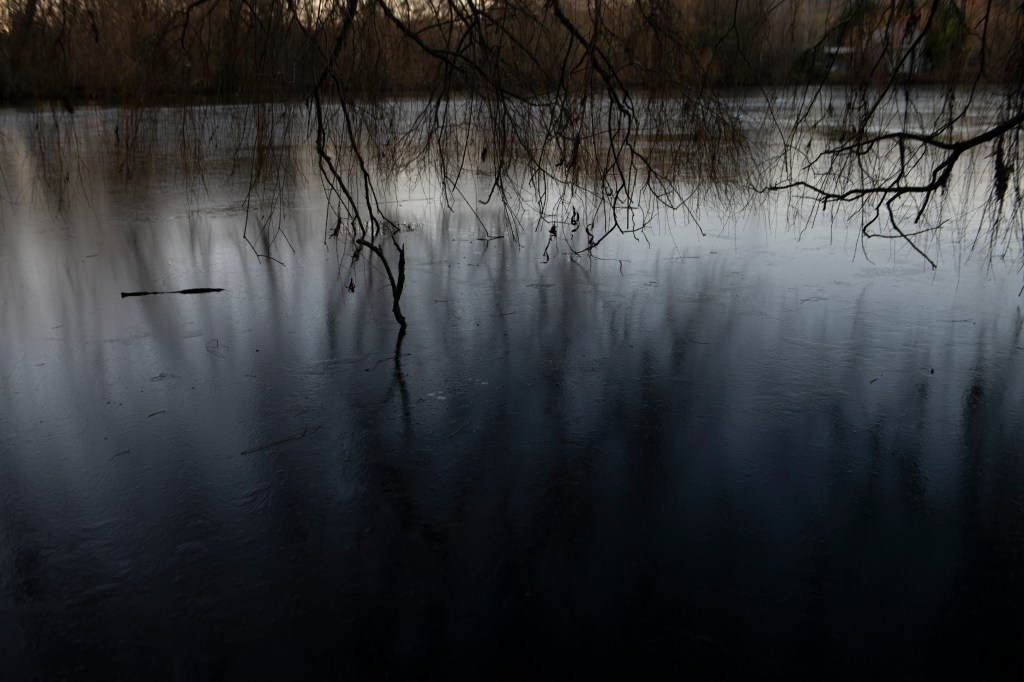
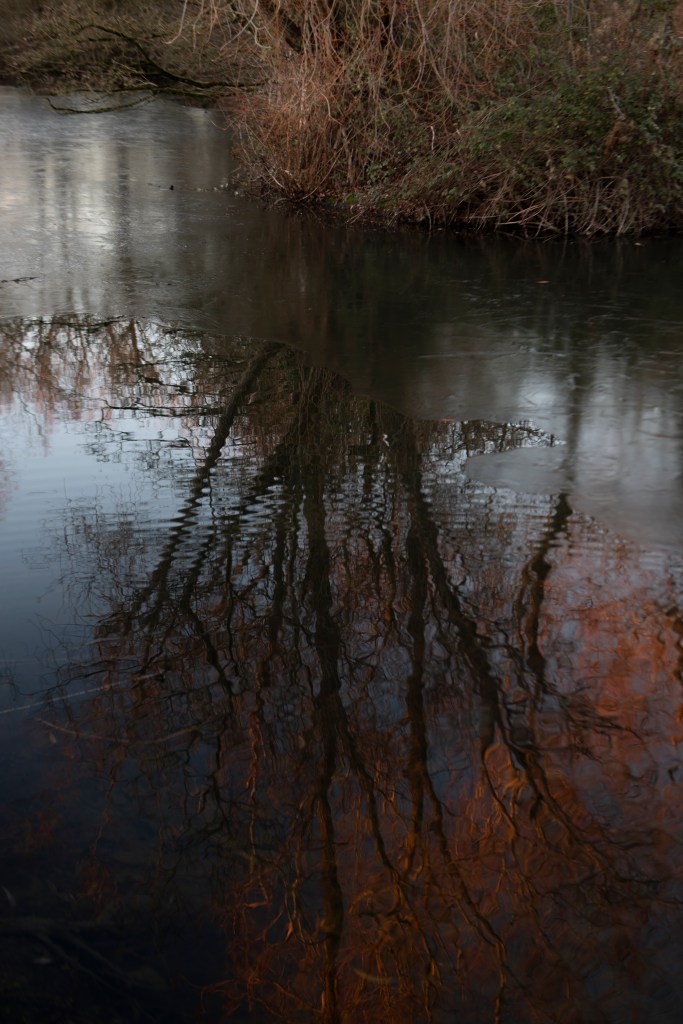
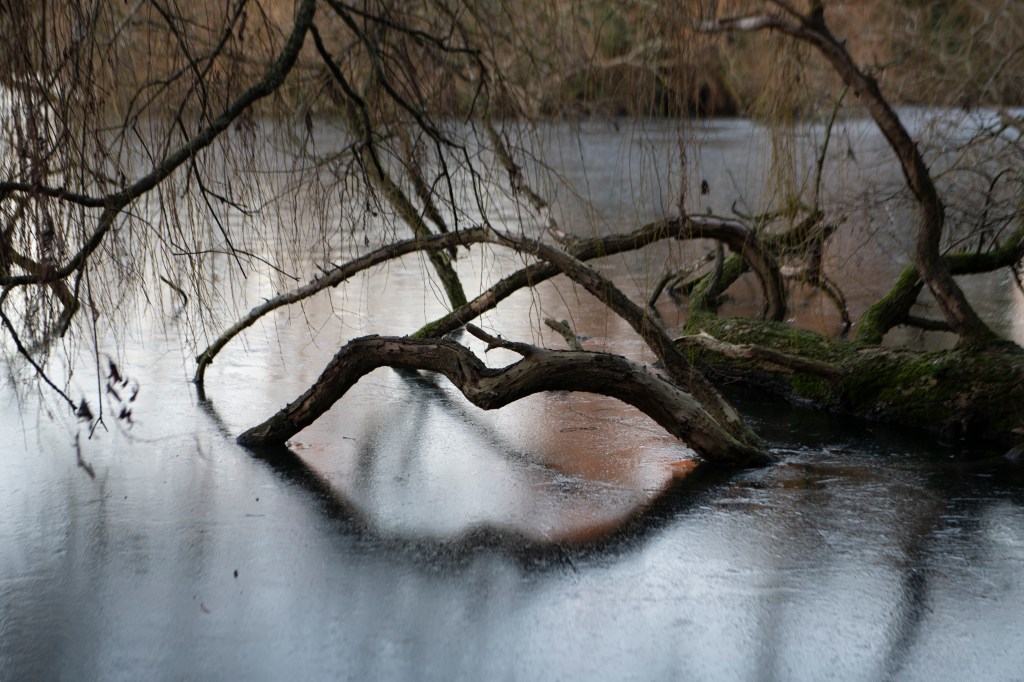
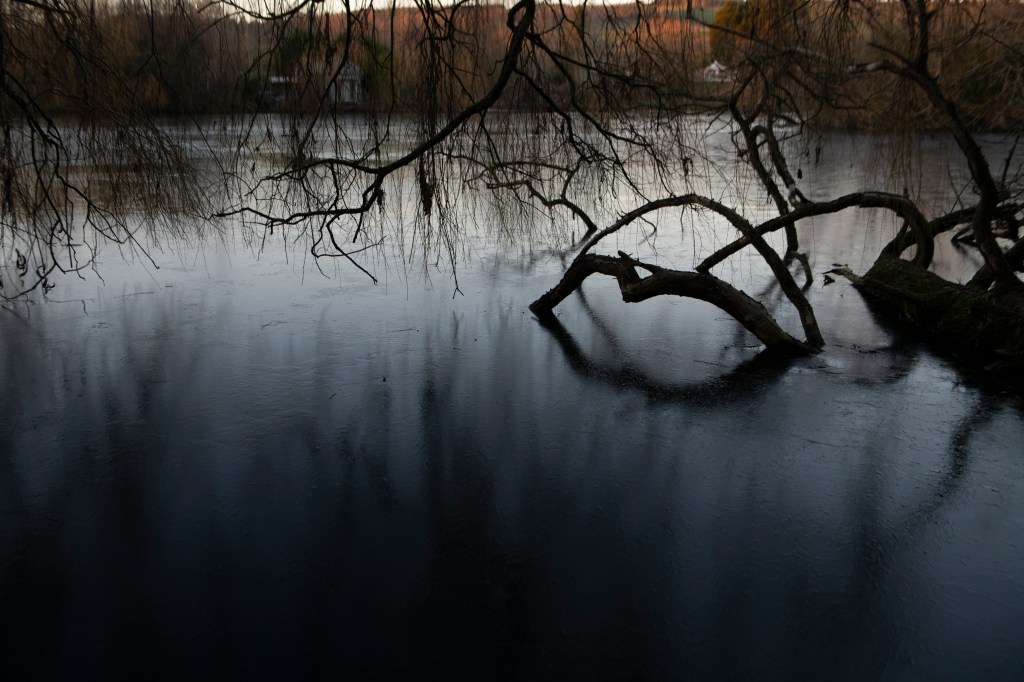
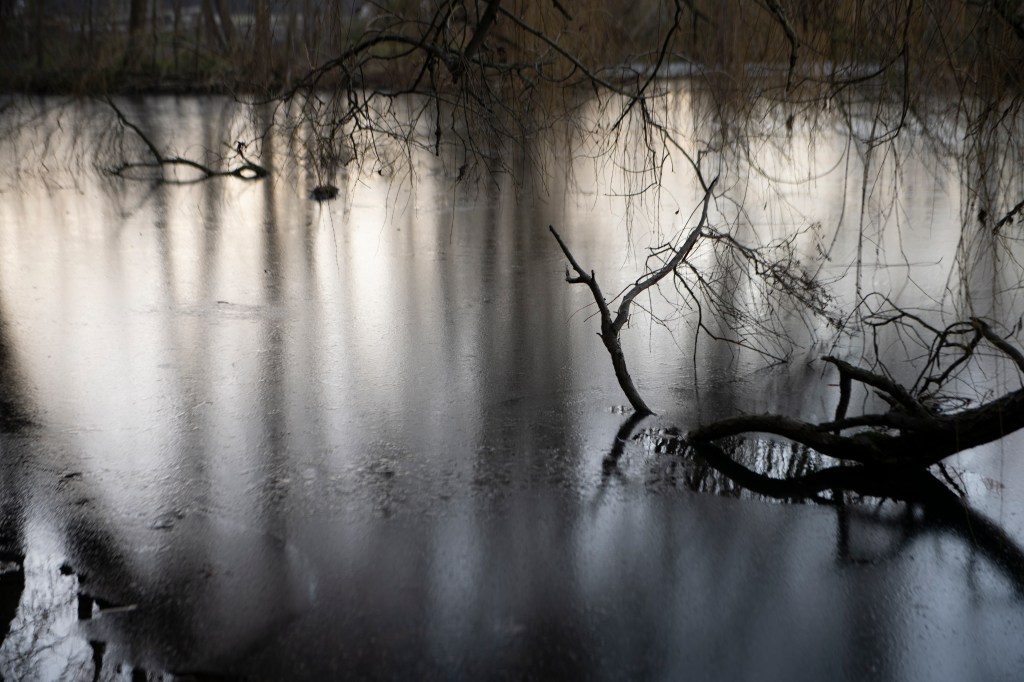
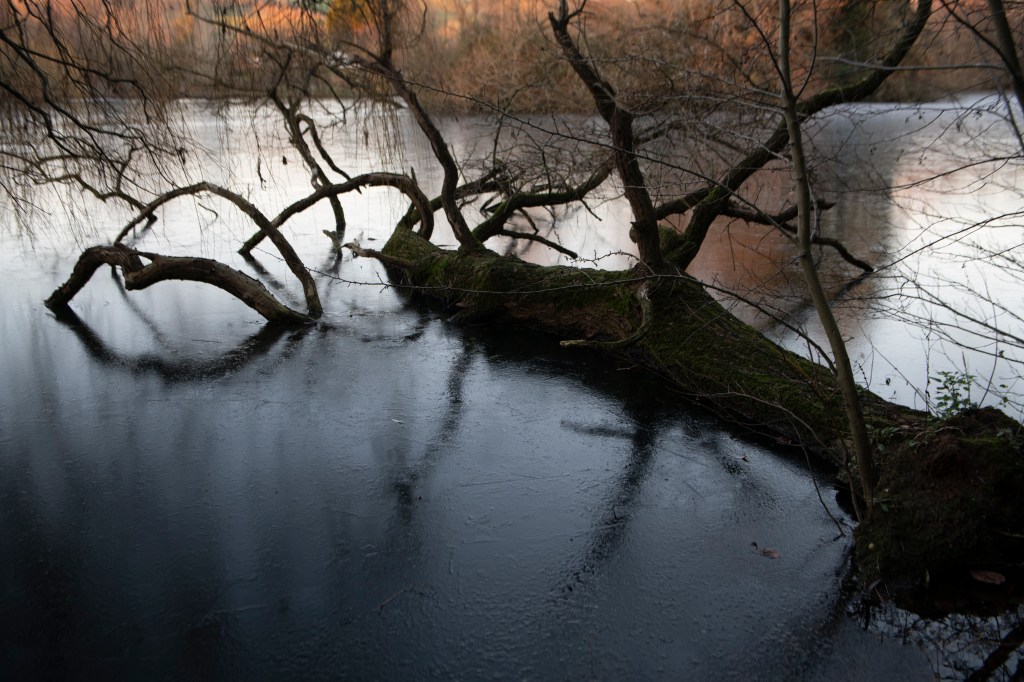
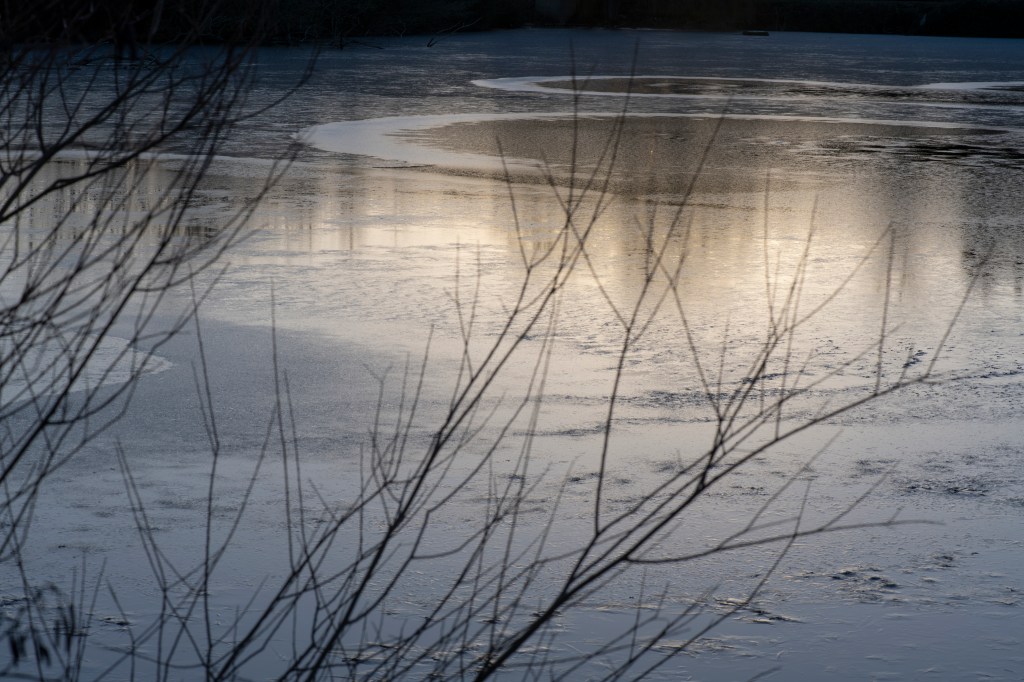
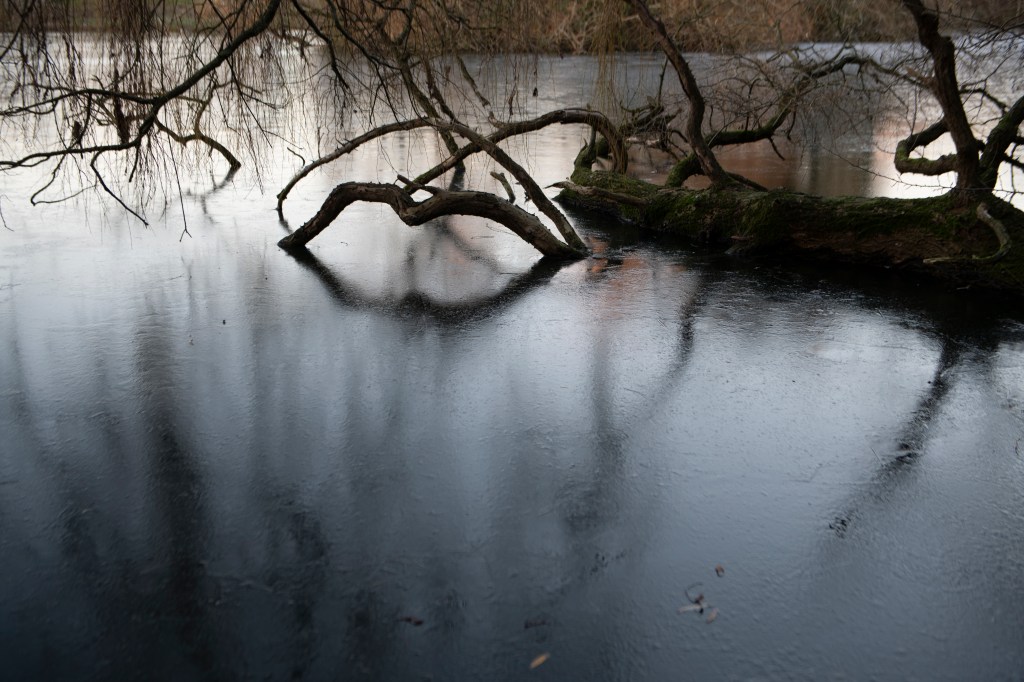
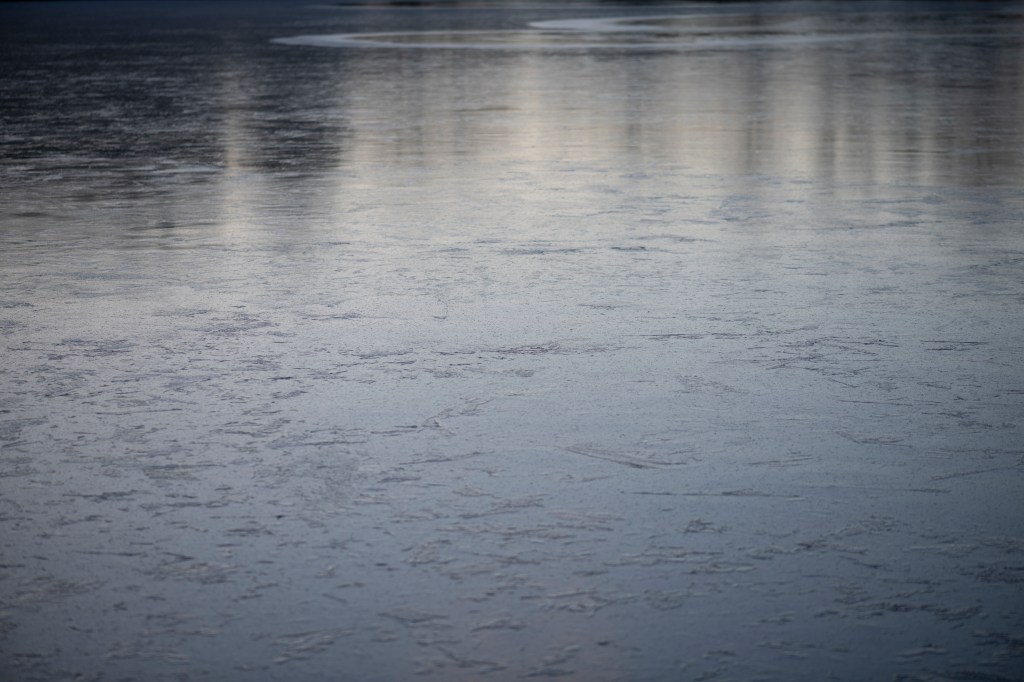
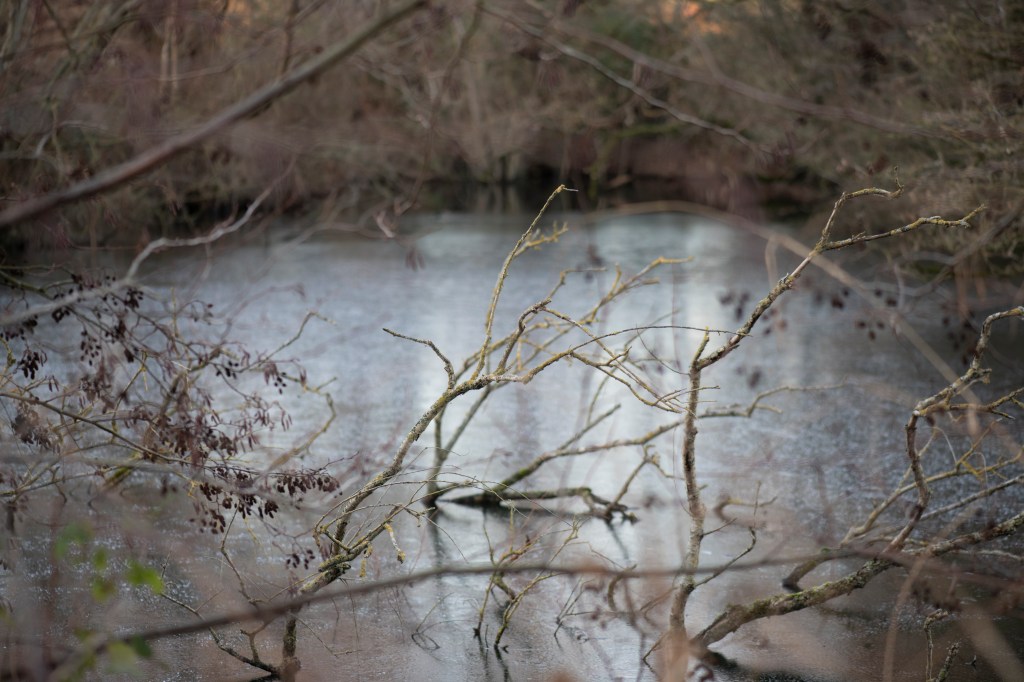
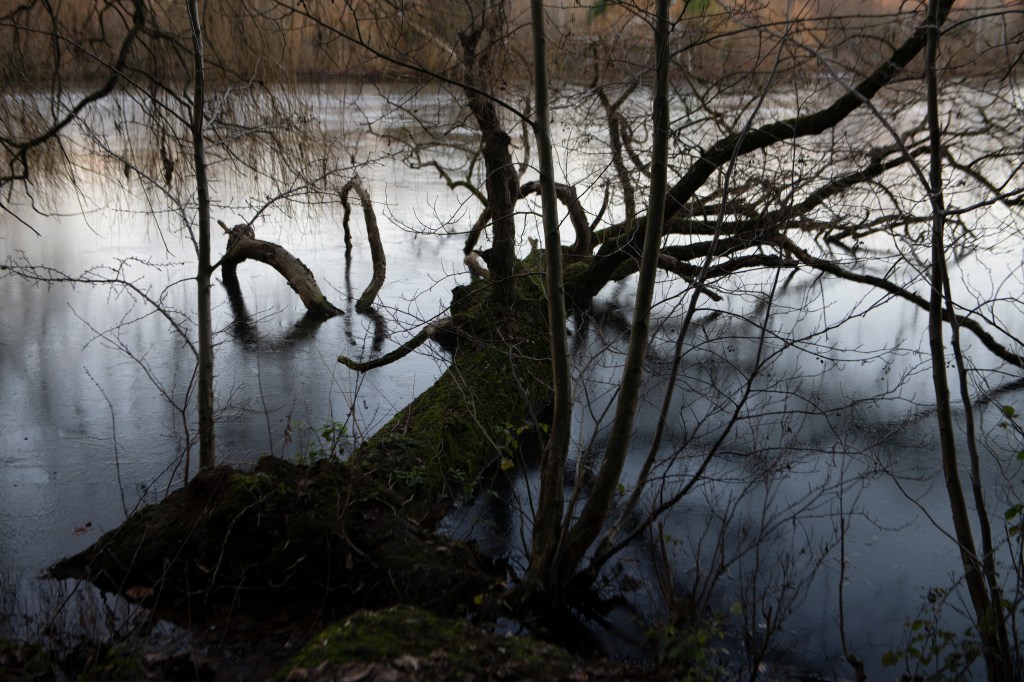
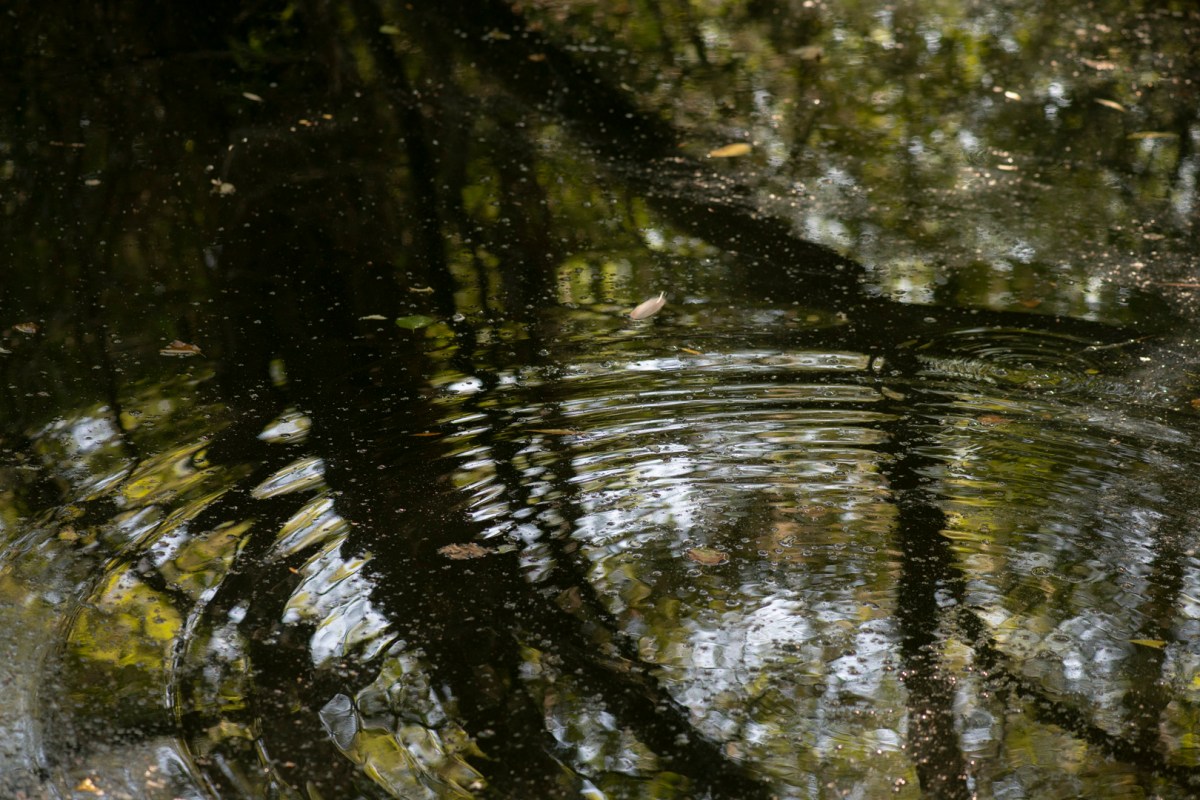
I photographed an area of the lake with 120 kodak portra 400 film, a few days into January just after the ice had thawed. Having decided to focus on using analogue images for my book, I wanted to have a wider selection of images to see whether I could have a balance of colour and black/white photographs to choose from. By this point, I had identified several areas of the lake that I was drawn to, so although I engaged in a walk, I had a preconceived idea about where I was going. I attempted to note down a few words as a sort of poetry. Having been influenced by Mary Oliver’s nature poetry, especially her ability to say as she see’s, I wanted to practice this. I am not sure I want to use words alongside my work, I will most likely make a late decision on this!
These photographs will be included in my book. The first & third photographs (reading top left to right) are particular favourites, I like their abstract nature as this fits with my theme and at the time, I was instinctive in my shooting. I didn’t think too much about framing or outcomes, I just spotted something that appealed to me, somehow carried some meaning for me and took a photograph.
The film itself is ideal for my subject. The colours are soft, a little too green in places but I think there is a good balance of tones throughout. The shoot was earlier in the day, compared to much of my work and it was a flat, dense cloud overhead. The film choice is quite forgiving I think. These could print well, I am excited to see how they will sit alongside my black and white photographs.
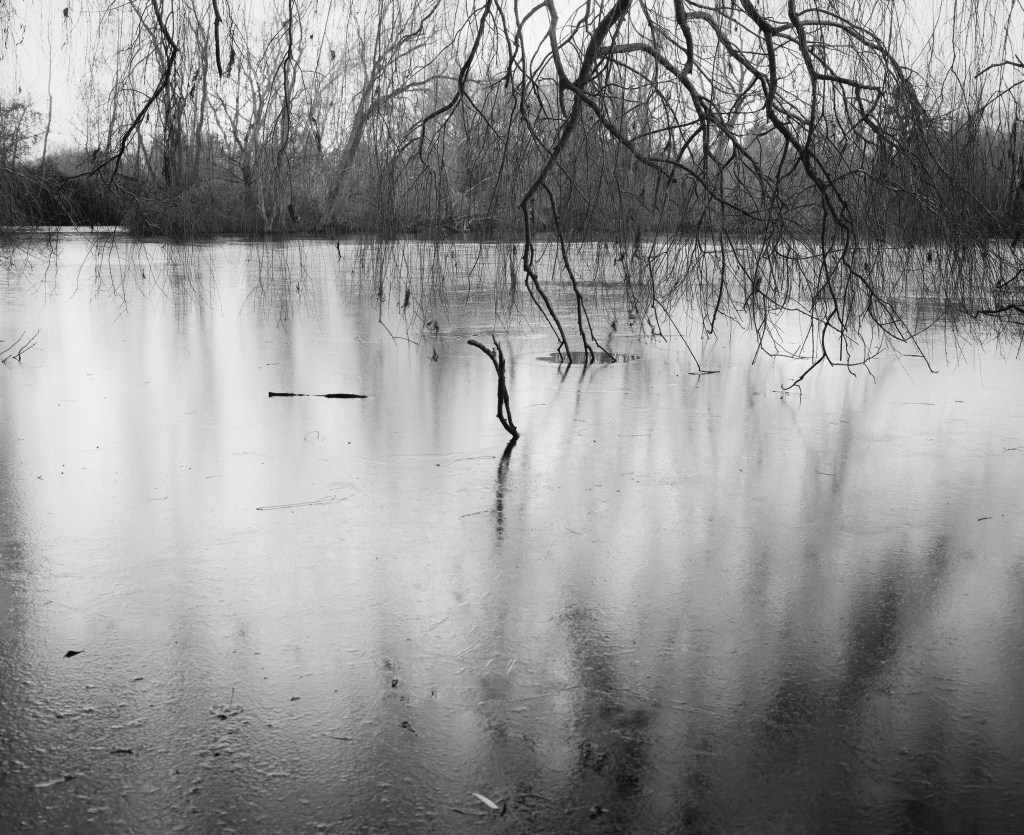
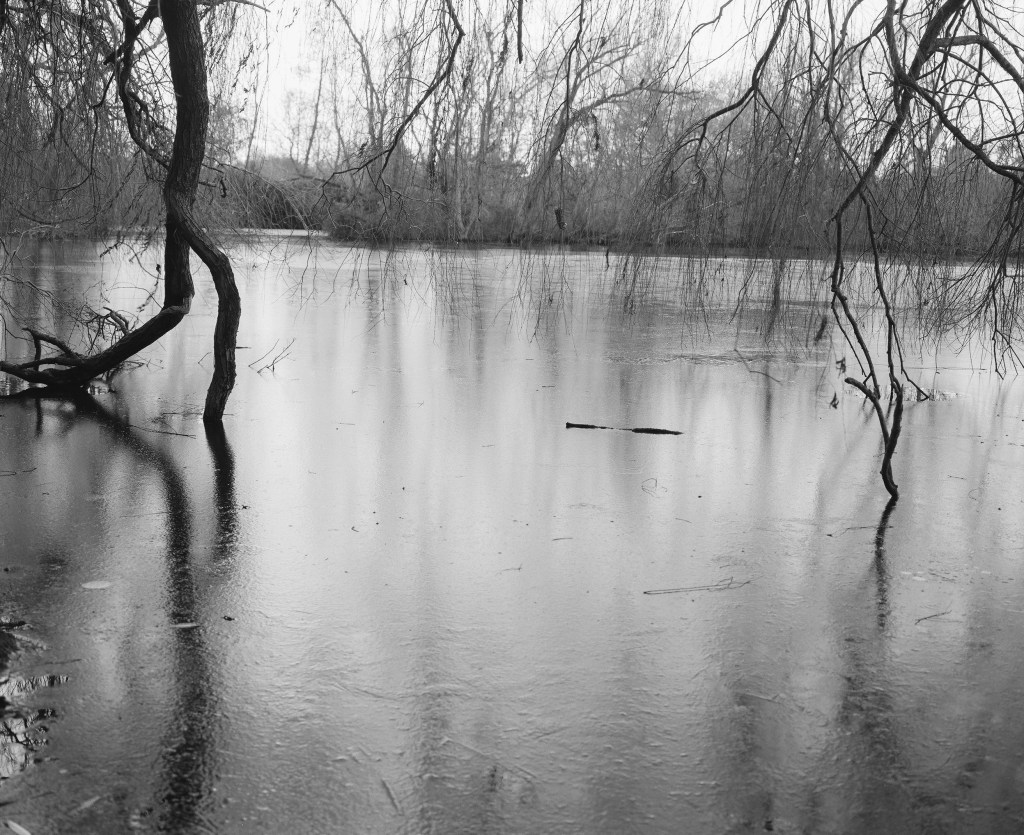
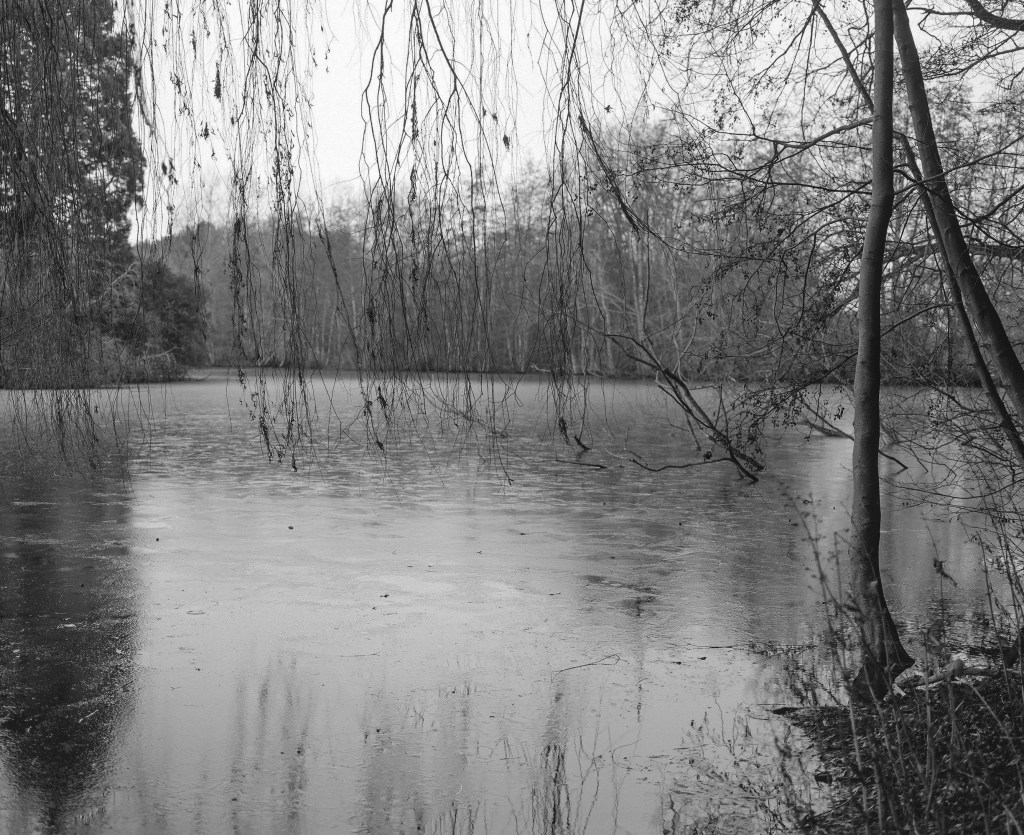
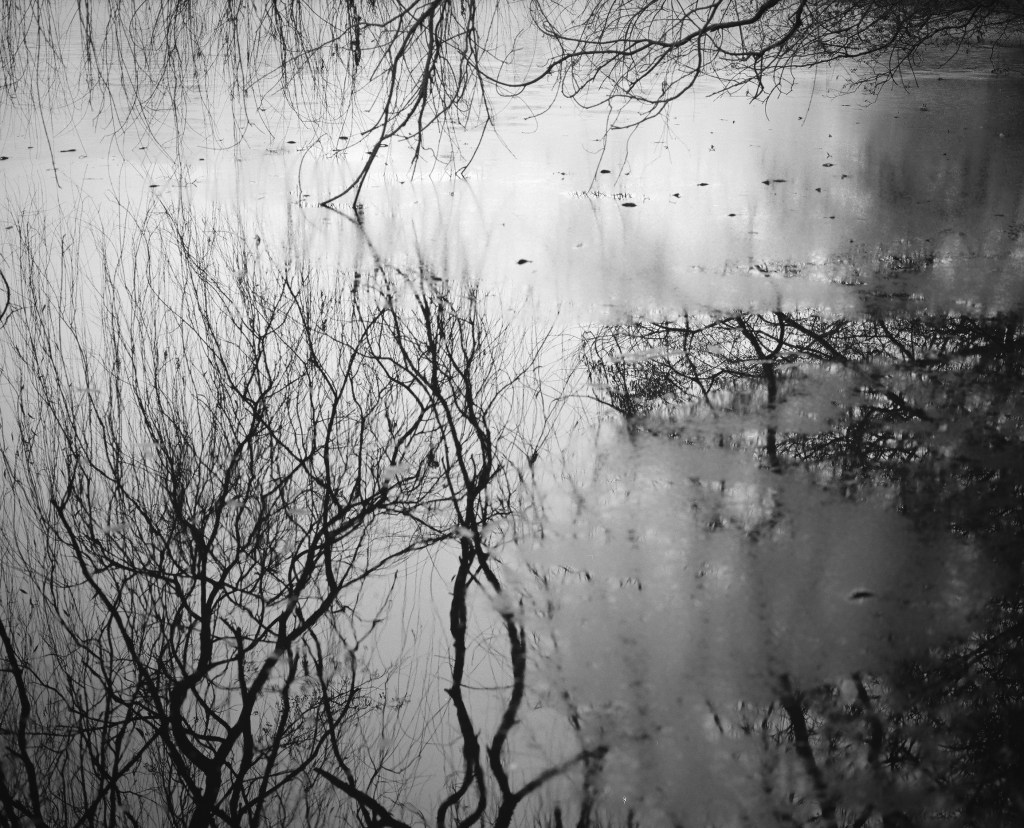
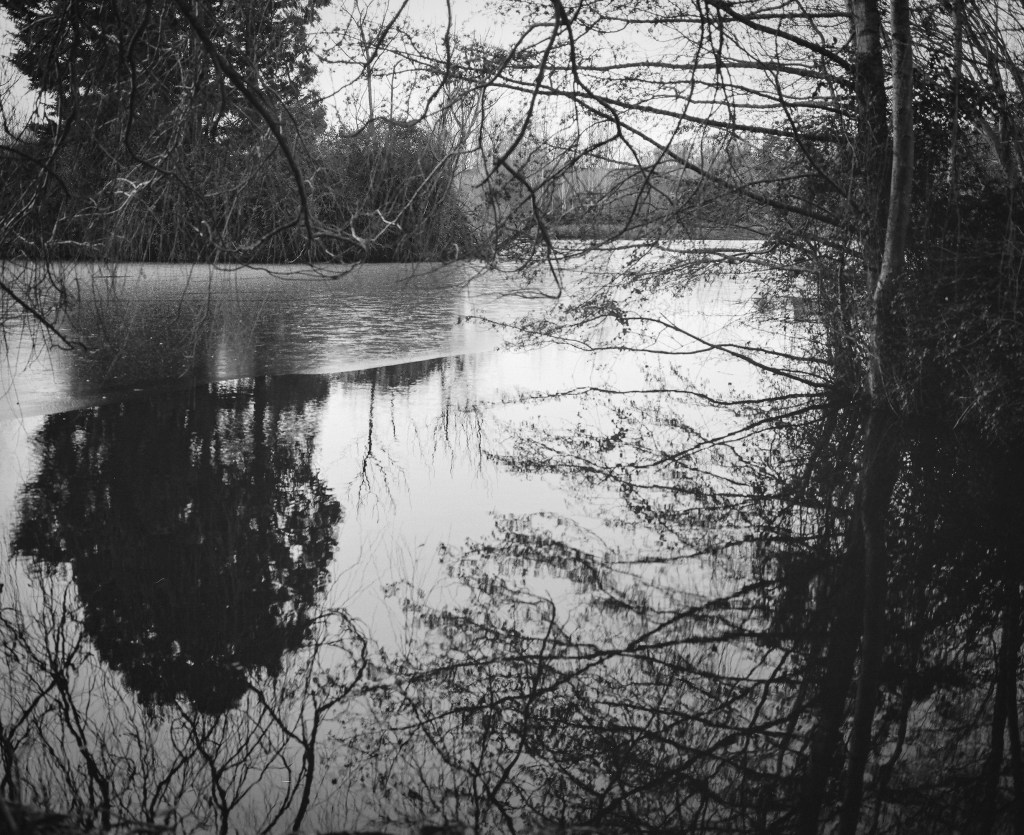
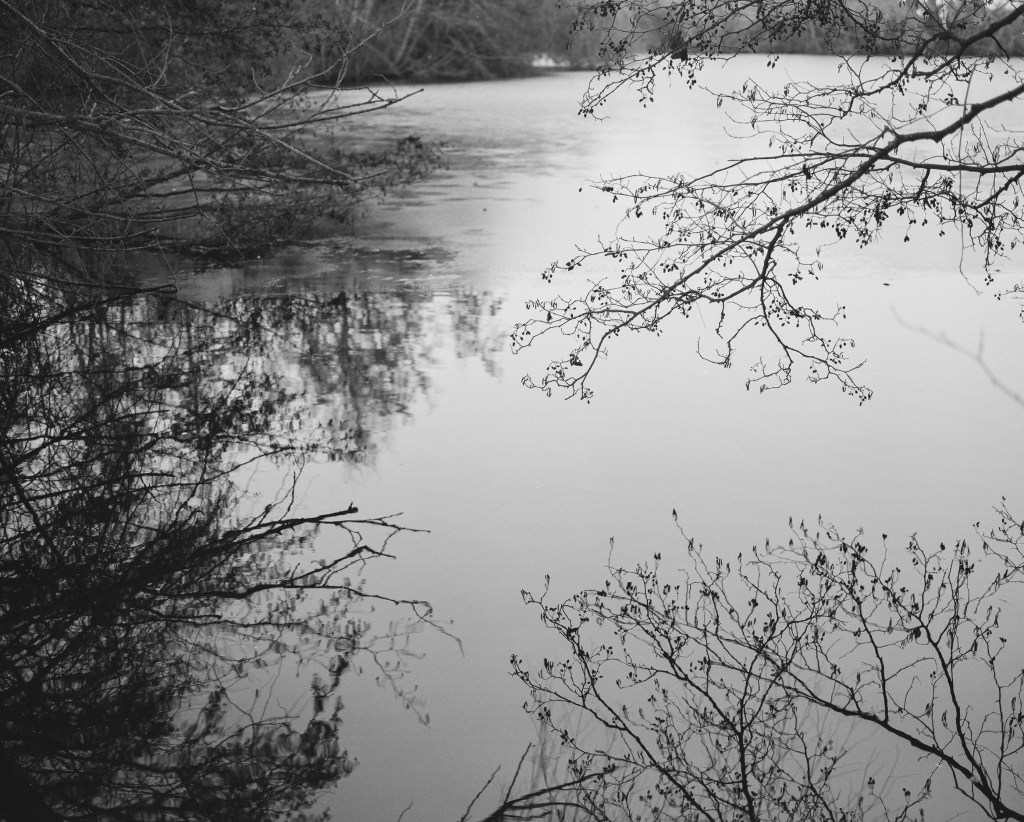
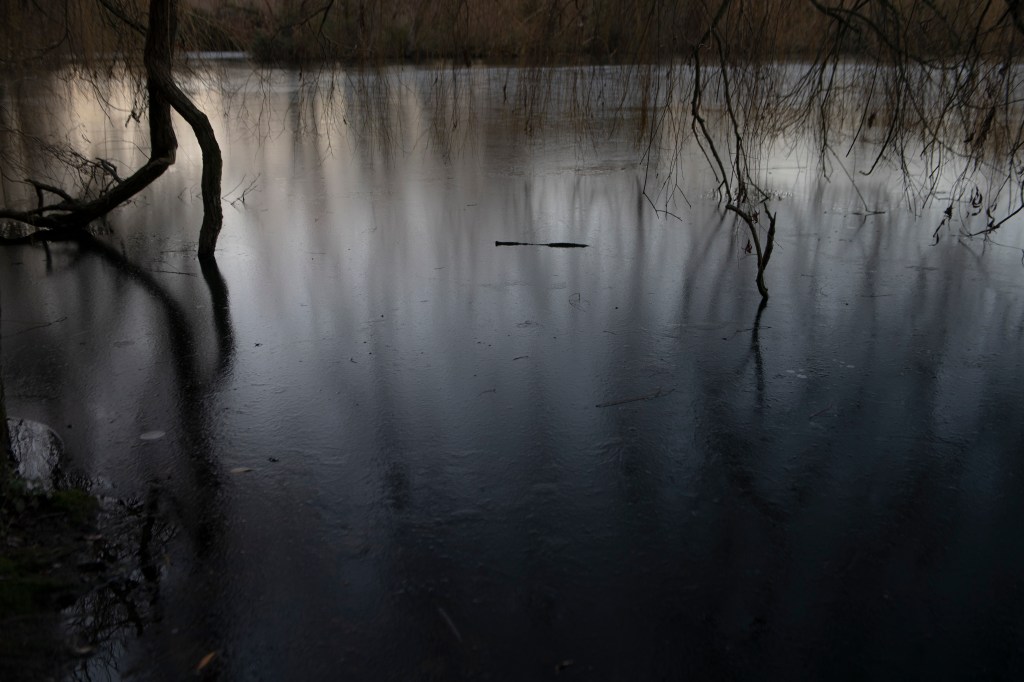
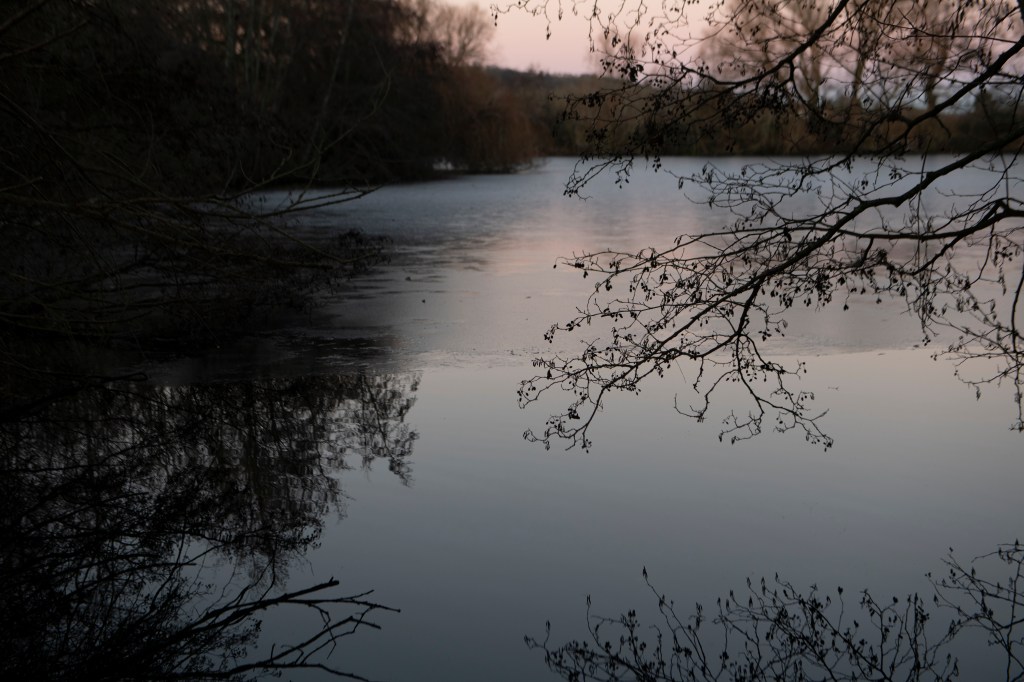
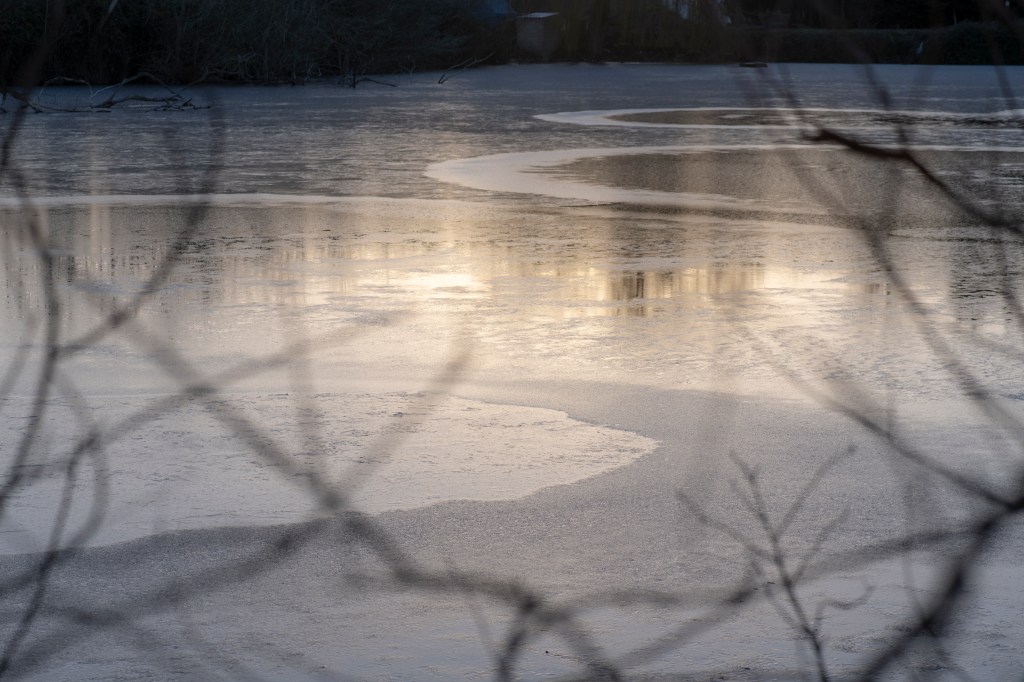
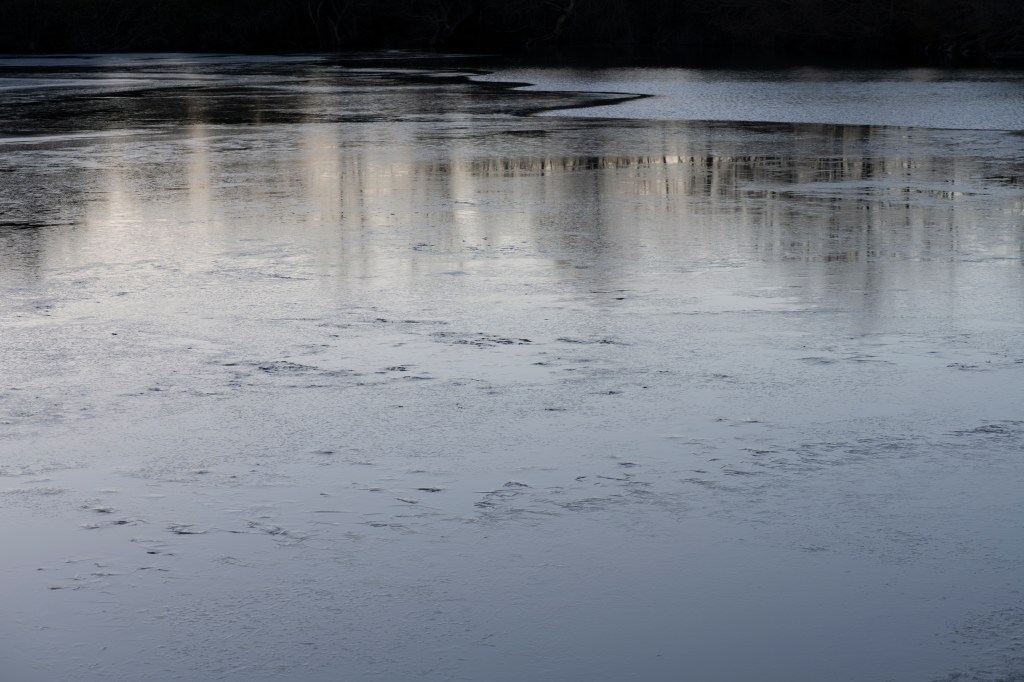
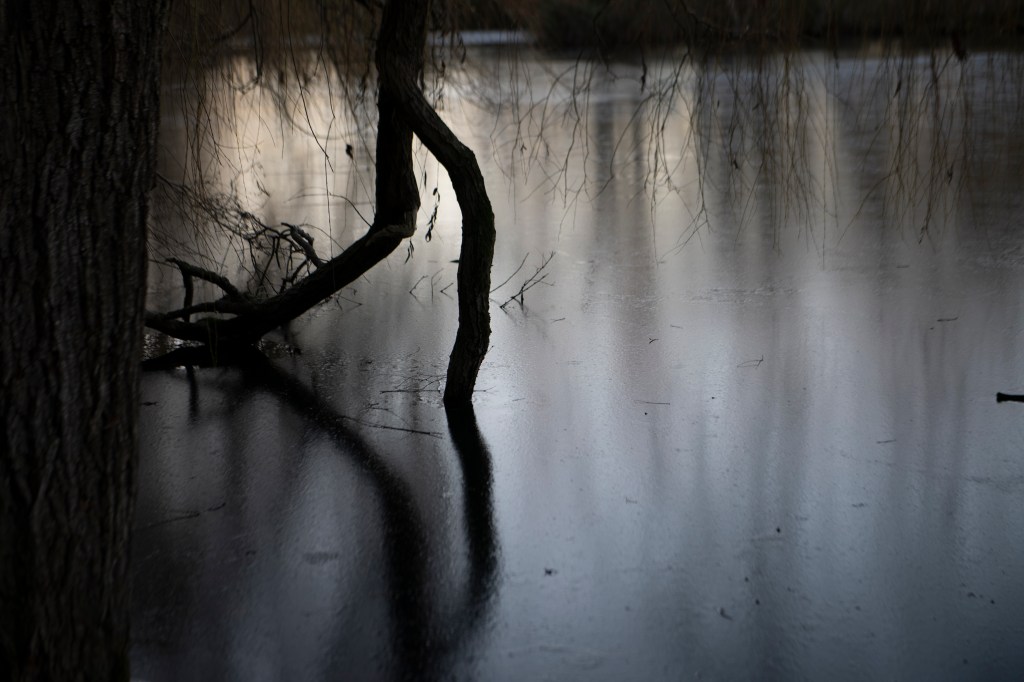
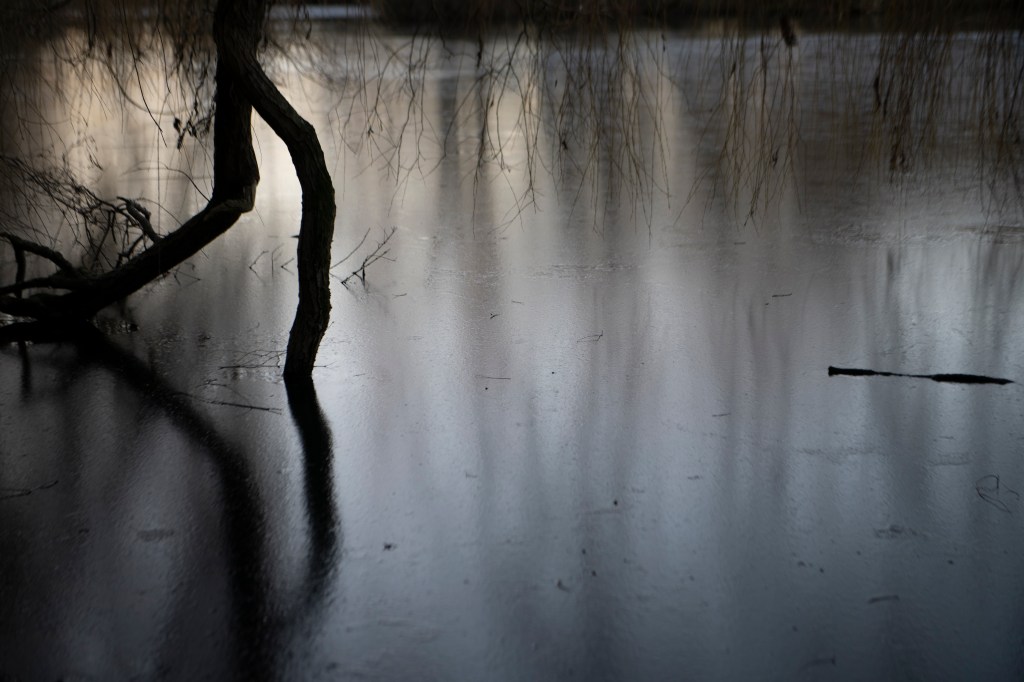
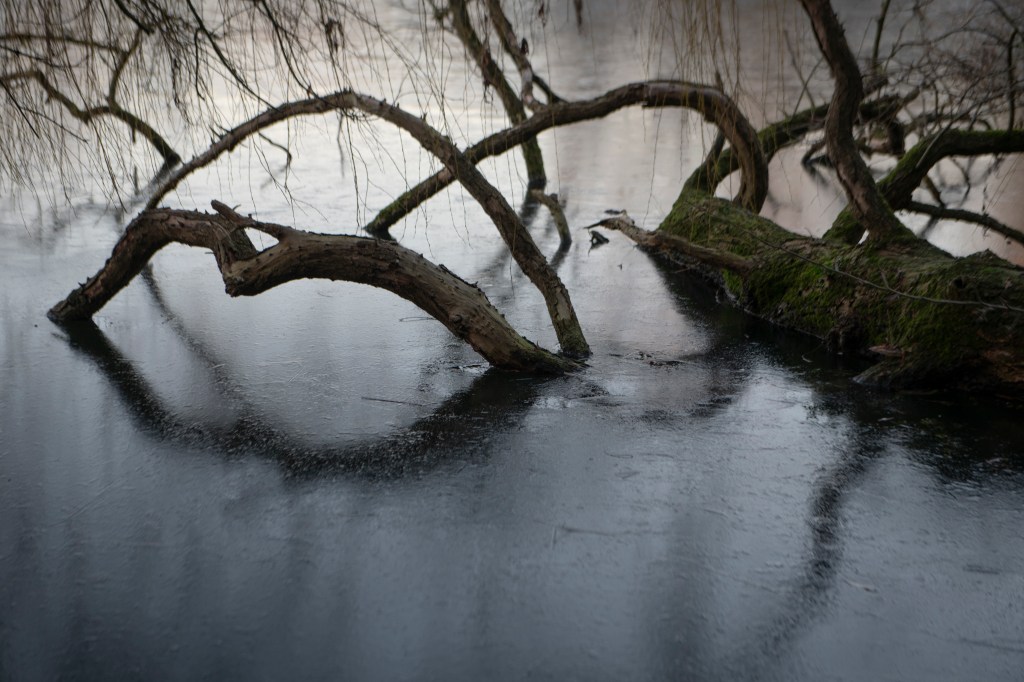
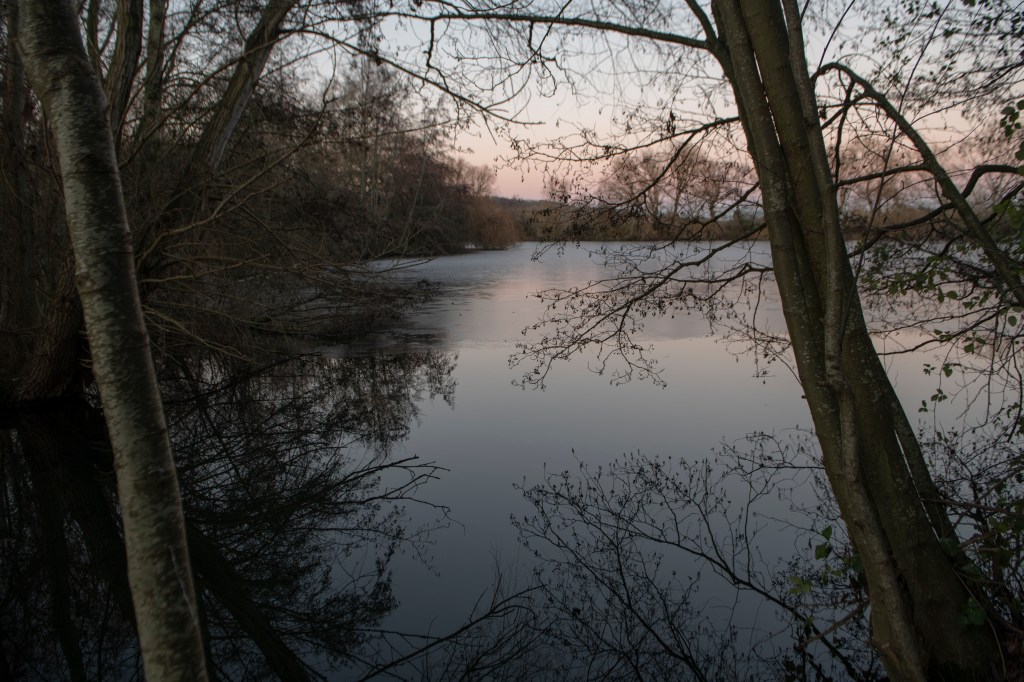
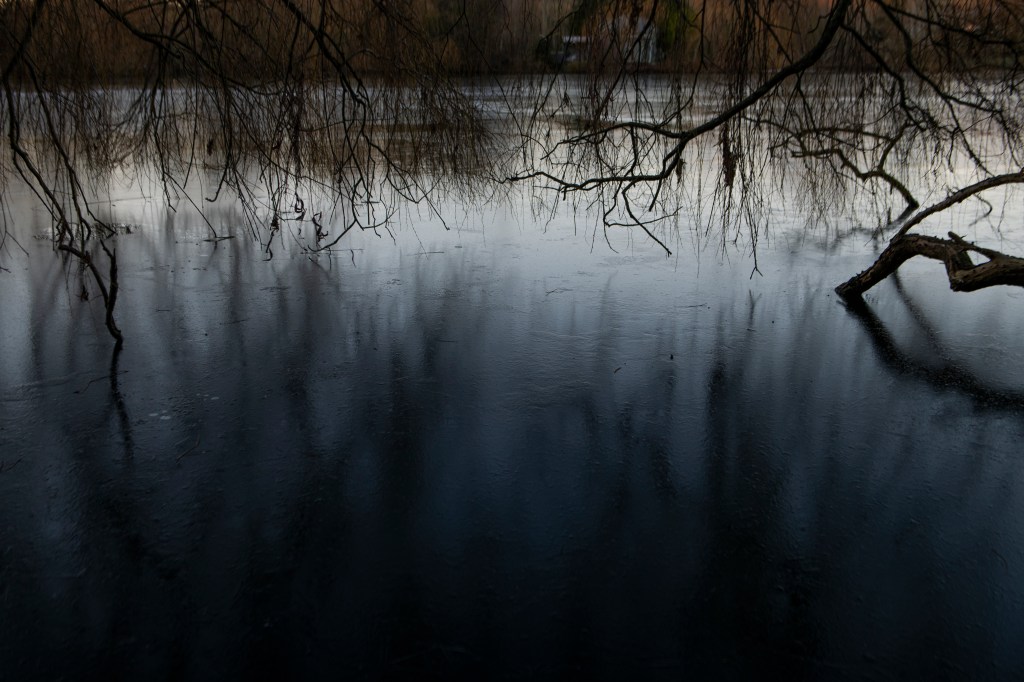
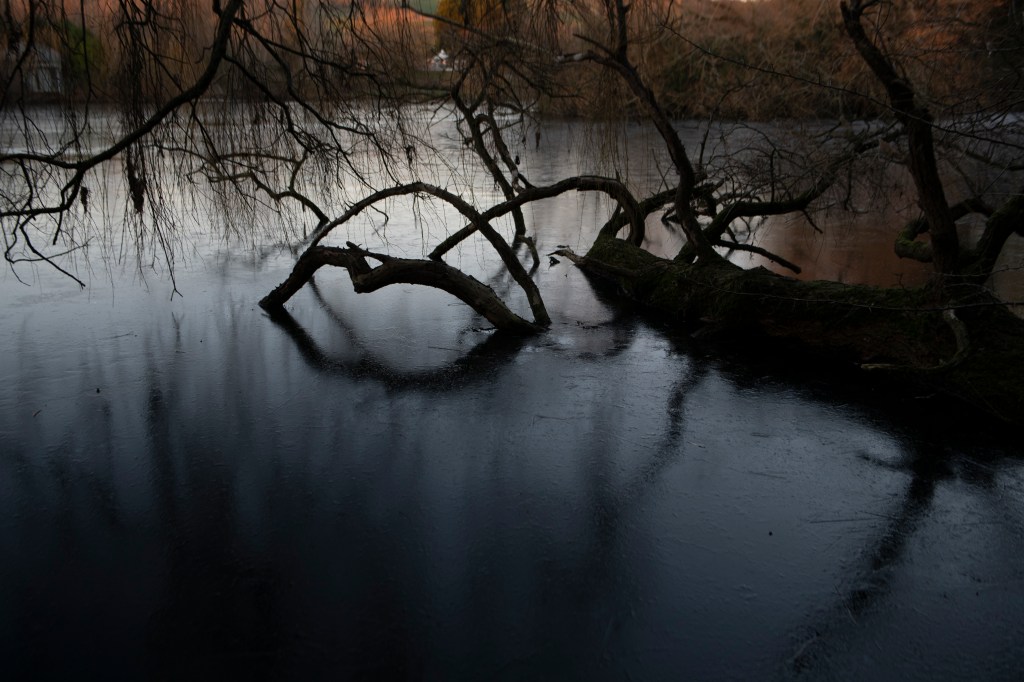
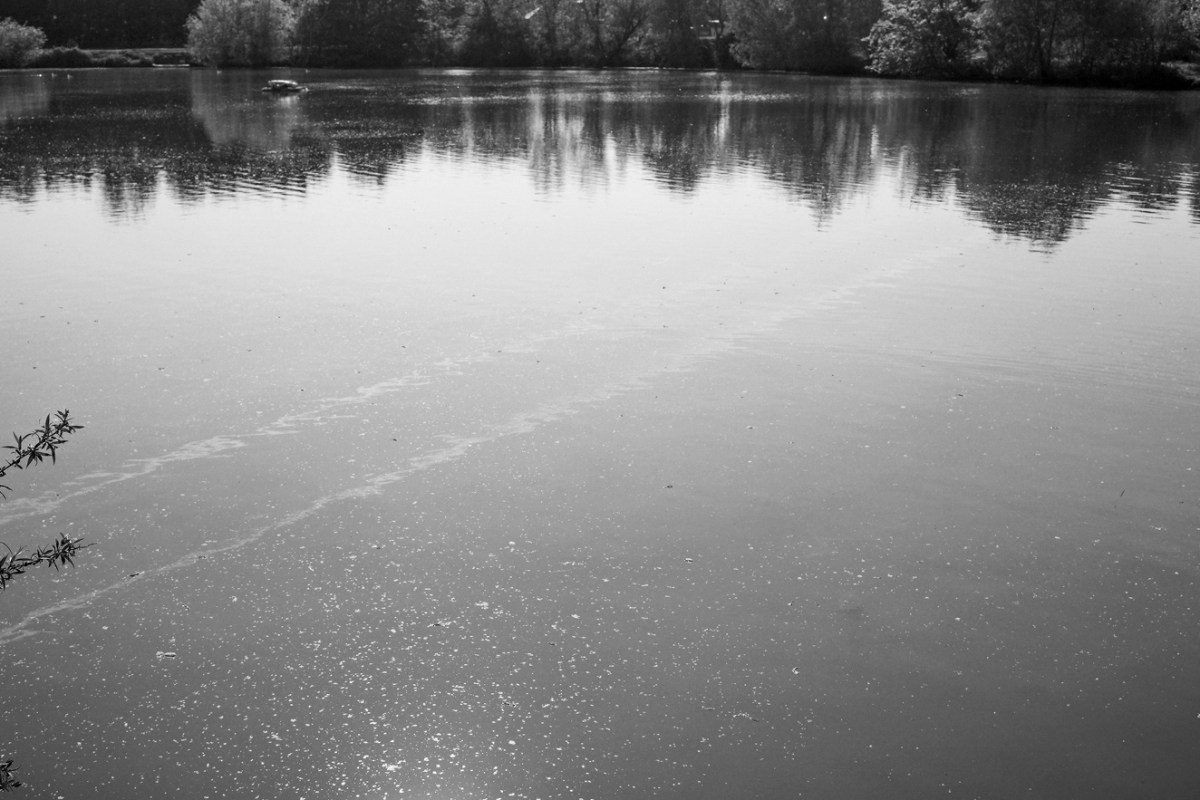
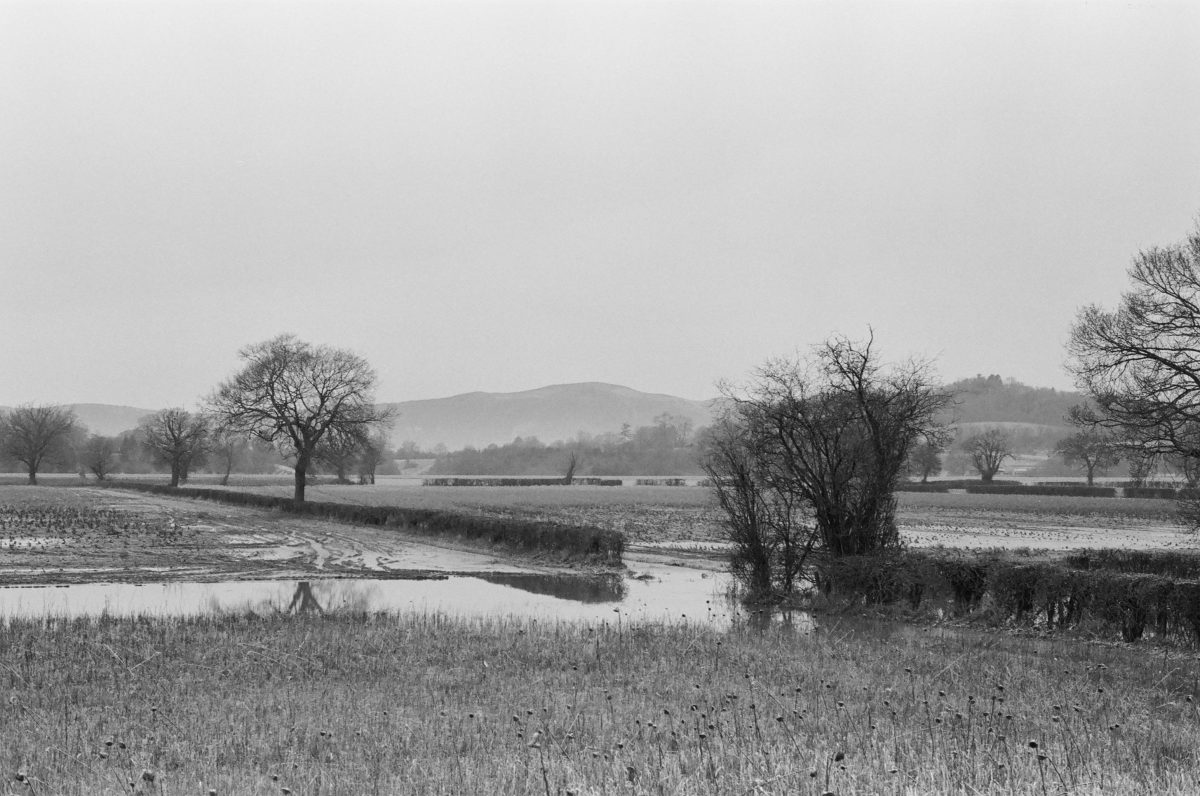
This is the analogue shoot I did alongside the digital one on the same day. I used Ilford 400 film, which has been reliable and forgiving in a broad range of conditions. I had loaded the film before heading to the lake, I wanted to photograph without having to think too much.. however, this did become tricky at times when I couldn’t feel my hands! I moved slowly around the lake, listening and feeling the environment. I studied the places I have walked many times before but noted how they were almost unrecognisable in this new, icy world. An entiurely different atmosphere exists, it was both eerie and intriguing. My curiosity meant I stayed much longer than planned, fascinated by the images frozen on the lake surface. I literally couldn’t stop watching. Nothing moved. It was silent and as the sun went down, a pink, orange, winter sky cast its image across the ice. It was so beautiful. I wrote a short poem in response:
winter spreads its cloak across the lake frozen images, as though printed on satin, hold soft light silence reigns, I just hear myself, living, breathing in place. Trees are looking down at me, their branches hiding the tiny spies who watch my every move.
I plan to use several images from this shoot in my final book. I love the texture in the images and the light, I keep reflecting on how easily I could have stayed at home in the warm! I would have missed out on an experience, let alone th opportunity for some photographs.
This is a slide show of my most recent shoot, this was during a frozen spell at the turn of the year, this turned the lake at Dacha into a whole other world. I spent a few late afternoons walking through here as the light faded, it had a completely different feel to it. There was no wind and it was eerily still you can see from several of the images that even with a slow shutter, there is little movement in the trees branches. There is a satin effect on the surface of the middle lake, I love how the fading light makes it shine silver, and the tree branches frozen in time poking out from the ice. There is a stillness to the photographs that signifies a sort of solitude and silence, which is as I have been trying to portray in my subject.
I was quite excited at the results of this shoot, Being able to view them immediately once I returned home, I could easily identify those which I would like to add to my list of potential images for my submission. I had also taken photographs in tandem, with my analogue camera. I was hopeful I might have some images from this that I could use in my book or for my final exhibition piece. I am still undecided on how I will separate my images from analogue / digital and colour / black and white. Or even, whether its necessary to have this as a concern at all.
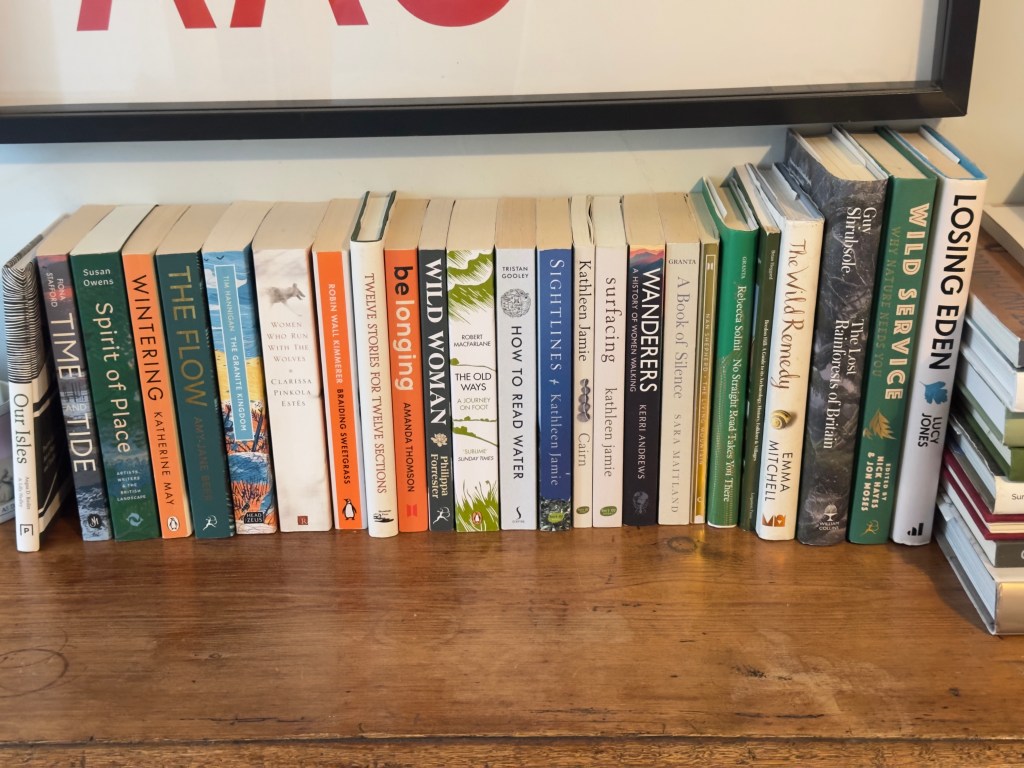
A significant part of my project, is how I execute the plan for creating a mindful situation. The research I have found discusses the physical act of mindfulness, in so far as learning how to focus and concentrate on immediate surroundings, using my senses to notice everything in real time, trying not to let my mind wander off into usual thought spaces. Whilst I have identified some key peer reviewed research which examines these themes, a significant part of my knowledge comes from my passion for reading nature writing. I listen to audiobooks & podcasts on the subject and also have paper books that I read and re-read. From the essayists (Jamie) to the adventurer / scientists (Macfarlane) and lifestyle writers, there is the common thread of an appreciation of the natural world and a slowness to their writing which indicates a deeper, more mindful understanding of our world. The photo above shows just a few that I have and which have contributed to my love of nature. I feel very fortunate to live in an area where there is an abundance of inspiration on my own doorstep. To understand my own subject, this immersion and commitment to my environment, must be practiced. Using quiet observation, contemplation and patience I have faith that I can create meaningful work.
Alyson Agar
I was pleased to find this very recent study, ‘Creating Wellbeing’ (Lemon, N et al, 2025) is a collection of essays which aims to show how creative practices “can revolutionise wellbeing and resilience in higher education, this groundbreaking collection brings together 25 academics who reveal how engaging with creative processes – from visual arts and crafts to performance and digital media – can serve as powerful tools for self-care and professional flourishing” (p1) within this is an essay by lecturer Alyson Agar, senior lecturer in Art and Design at The Northern School of Art. “Embodied Connections‘ (p75) is an essay derived from a study for her PHD. Alyson’s research explores the relationship between photography and film and the landscape, looking at how these activities can inspire connections to nature. This specific study is a result of her concerns, when during Covid-19 she considered how engaging with nature, through physical activity, e.g. nature walks, could have benefits to students and colleagues alike. She outlines her project here: “In 2024, I developed Embodied Connections Conversation Series: Women’s Conversations in Landscape and Climate through Collaborative Nature-based Photographic Practices, a year-long art-based research project based in Hartlepool, a coastal town in the northeast of England. The study consists of 12 walking and moving conversations with women and women-identifying artists, photographers and creative practitioners focused on creating participatory nature-based photographic imagery within the Hartlepool landscape” (p76) The key principle of the project was for groups of women artist participants to engage with the landscape as a group, walking through it in a sort of ‘tag team’ approach, as each person met up with the next, they would gift something from the natural environment, as a way to acknowledge the place and its ‘gifts’ this could be anything from a stone to a leaf, but this act likely instilled a sense of gratitude and appreciation for the place. Along the way participants would engage with their environment by creating art using natural materials (often anthotypes) in place. In her conclusion, Agar says “at the heart of the project is the formalised orbital structure, which encourages participation, reflection, and connection by creating nature-based photographic practice within the natural landscape as a mindful practice to improve wellbeing” (p85)
This study has been published at a perfect time for me. I have an ongoing interest in how women engage with the land and combined with creative practices, this seems to be a full circle event. It is an area of study or work that I would like to explore beyond university, as I strongly believe that mindfully engaging with landscape utilising creative practices, has significant potential in wellbeing.
Liz Wells – Land Matters: Landscape Photography, Culture and Identity
There are several examples given by Wells of the differences between a women’s approach to landscape photography and the approach from men. I have focussed on her chapter ”Women, Land and The Gaze’ (Wells, 2011: p185:203) She discusses how women tend to focus on relation between people and place rather than the land as vista. Also, rather than looking at the vast, sublime landscape, women have a tendency to explore more natural forms, looking closely and the scale of imaging would be more of a close up scrutiny, such as in botanical illustration. In other words, tending to look at the details. This is particularly relevant when I consider what I am drawn to in my own landscapes. I think about how I approach a shoot (I note here that the term shoot sounds too prescribed, I think it is more a walking, immersive experience that might provide an opportunity to take a photograph) and I consider whether the last 17 years as a parent has been the instigator of my foray into landscape photography. I think it probably has, although I focus a lot on history, I don’t know if I would have had the same instinctive response had I continued on a different path. Wells offers some explanation here, suggesting that women’s landscape photography is often ecological (a term she notes is unlikely to have been used 20 years ago, with climate having not been so central to landscape debates) although she asserts that this is most likely historically, socially, and culturally situated, rather than any biological trait; their work often foregrounds care, memory, connection and lived experience. It will be interesting to see how this changes over time, as men and women’s cultural experiences hopefully become less divided. Nowadays, there are more men taking on caregiving roles in Western society and I would like to see research on the impact of this in creative practices in the future. I personally believe that there are some biological influences, but I would rather avoid being too essentialist, instead considering that perhaps this would be too insignificant to make any obvious difference.
Wells writing links into the work of various nature writers that I have had an interest in for many years. I am drawn to the works of these writers, because of the richly detailed descriptions of their surroundings, the natural environments that they walk in and immerse themselves in. The evocative descriptions are phenomenological and akin to mindful practice in that they describe in great sensory detail. Although those listed here are women, I have also read essays by nature journalist Robert MacFarlane & Right to Roam activists like Guy Shrubshole.
Nan Shepherd
Arguably, the best known example of women’s nature writing in the UK is The Living Mountain, by Nan Shepherd (2014). Her ability to describe her surroundings in such infinite detail means the reader is transported to a seemingly magical place, with the promise of an overwhelming, sensory experience which I feel could pin you down. It is a short book but the joy for me in this, is that I can read and reread it when ever I feel I need a ‘Living Mountain tonic’ There are many paragraphs and quotes which I could show as examples that inspire me, one that comes to mind though is this one, because it is predominantly about using her hearing sense over sound and sight: In reference to the moving water on the mountain, she says “One hears it without listening as one breathes without thinking. But to a listening ear the sound disintegrates into many different notes – the slow slap of a loch, the high clear trill of a rivulet, the roar of spate. On one short stretch of burn the ear may distinguish a dozen different notes at once” (p26) Shepherds writing reiterates for me that understanding place means to have embodied attention and authentic lived experience. Her walking was the vehicle for a way of thinking and feeling, as she transforms the Cairngorms into a living, breathing thing.
Kathleen Jamie
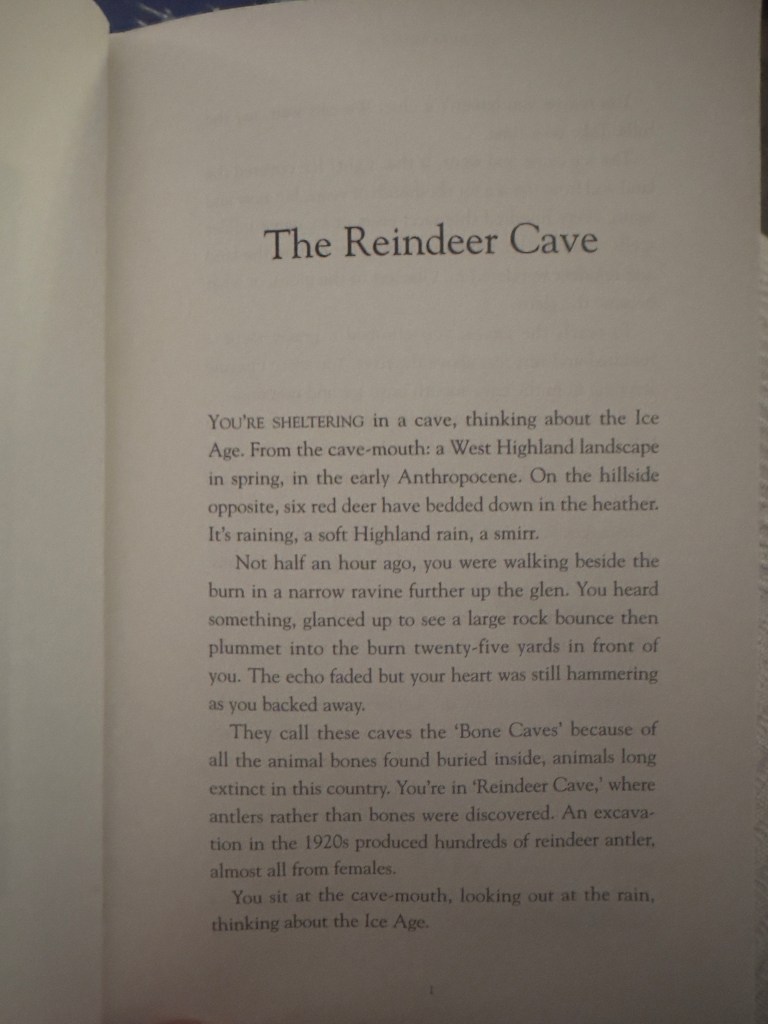
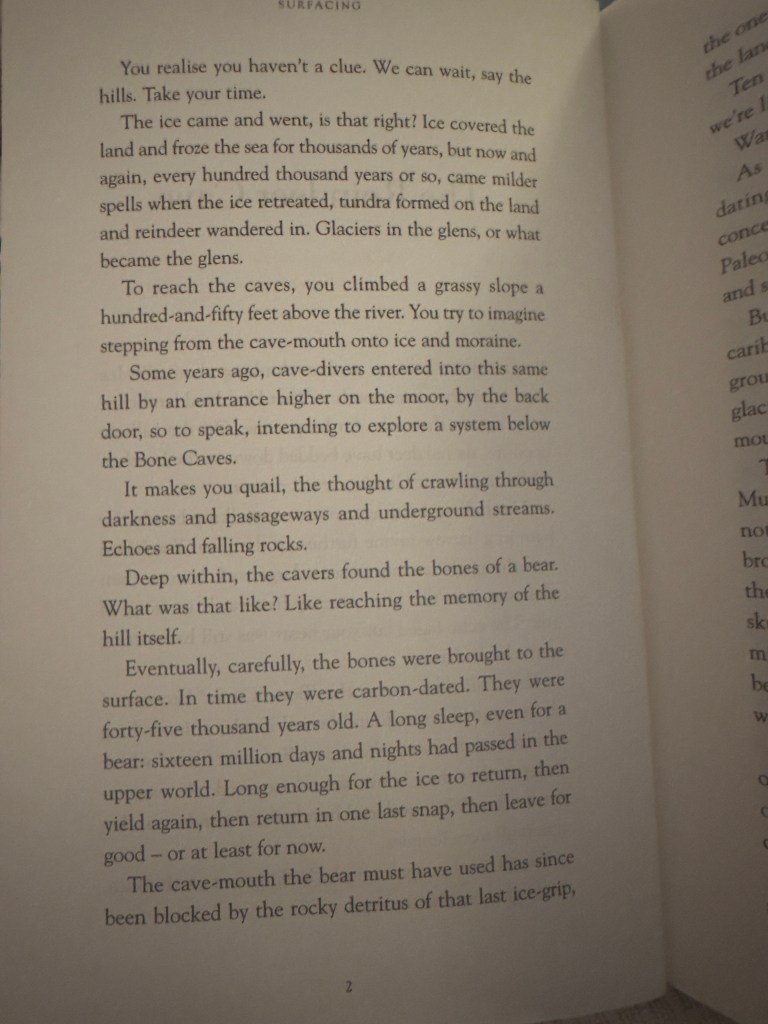
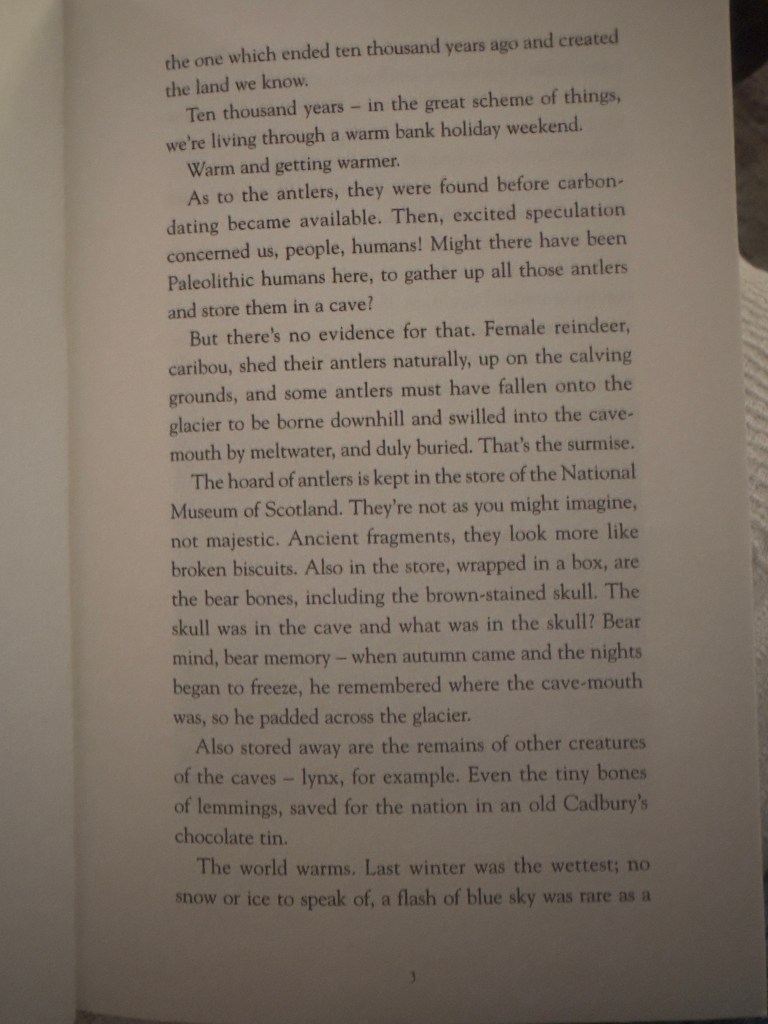
I have several books by Kathleen Jamie. I find her essays are perfect to calm a busy mind and as it intersects with phenomenology and topophilia, which I briefly discuss elsewhere, her writing has influenced my thinking around landscapes and attention to the environment. She addresses issues of place, culture and belonging as well as highlighting broader issues, relatying to land use and community. Her writing is almost like a sort of mindful recording. Landscape and nature are woven into human life as an embodied experience. and she reflects on the human experience. One of the most memorable essays for me was in her book ‘Surfacing’ (2022, p1) when she describes having walked up to sit at the mouth of a cave, the ‘bone caves’ so called because of the discovery of some 40,000 year old bones of a bear. She narrates as second person, the perceived view from the ‘cave mouth’ in the early Anthropocene, whilst foregrounding it against the Ice Age. Its an interesting way of perceiving the landscape and it carries the themes of temporality and dwelling, in a more lyrical narrative than the academic theory that I’ve read a lot of over the last few years. The text is below:
Kerri Andrews
Wanderers: A history of women walking (2020) is a brilliant collection of essays by Kerri Andrews. Spanning over 300 years, the essays are focussed on the following women: Elizabeth Carter, Dorothy Wordsworth, Ellen Weeton, Sarah Hoddart Hazlitt, Harriet Martineau, Virginia Woolf, Nan Shepherd, Cheryl Strayed and Linda Cracknell. Each chapter details the experiences and writings of these women as they’ve engaged with their chosen pass time, in different areas of the UK and abroad.
Dorothy Wordsworth walked a huge number of miles every day, from her cottage in Grasmere, which she shared with her brother William. She was orphaned at 12 after her mothers death and separated from her brothers as they were sent to boarding school and she was sent to live with relatives, never staying in any one place for too long. They were reunited as adults and had an incredibly close bond, especially after their brother Johns death. Although William is most well known for his writing, Dorothy’s diary’s and notes are full of incredible detail and are a arguably a tribute to the act of sensing ones surroundings. She would frequently walk huge distances, from dawn until dusk, as if unable to be still and at ease. As she retrod the same paths over and over, “memories began to accumulate along the way, lending new and powerful meaning to her favourite walks” (p62) Similarly, Linda Cracknell says “By virtue of walking a path that endures beyond the limits of human lifespans, we can inhabit the same space that our selves-that-were, and keep the path oepn for the selves-to-come” (p249) For Cracknell, the act of walking the same route over and over is to reconnect with a past version of herself, as well as to connect with those before her and to leave an impression as guide, for those of the future. She can see “a clear pathway between that 17 year old who was learning to draw and paint and the woman who writes in 2008” (p250). For Dorothy Wordsworth, these memories would prove to be hugely comforting, when after 30 plus years of walking her beloved Lake District, she developed a debilitating illness which prevented her from leaving home. For her, walking had been the stabilising factor in her emotional wellbeing, so when she also developed what we’d now assume was a dementia, it came as an extra blow. Although her short term memory was affected, the earlier events of her life persisted and so she could tap into her mind and recall the walks she had been on. This is one of the last poems she wrote (p84):
“No prisoner in this lonely room, I saw the green Banks of the Wye, Recalling thy Prophetic words, Bard, Brother, Friend from infancy!
No need of motion, or of strength, Or even the breathing air; -I thought of Nature’s loveliest scenes; And with memory I was there”
The idea of recalling memory and connecting through landscape reminds me of a walk I’ve made several times, from Ford near Temple Guiting, to Bourton on the Water. The route leads through several trails’ The Diamond Way, Windrush Way and Wardens Way. My grandmother used to walk daily along the section near Bourton from Lower Slaughter, when she was 14, to get to work. I always think of this when I am covering that particular section and sense her footsteps, realising how much of the same view we would be looking at. Andrews says that “for…women walkers, the pedestrian body becomes a conduit through which past, present and future are connected” (p251) which really does resonate for me. My reasons to walk and absorb myself in the landscapes I am most connected to are because I feel a great sense of comfort and reassurance there, I feel close to my ancestors and to my own childhood.
These are just a few examples of the inspirational women that have contributed to inform my practice, it is difficult to identify exact moments or passages in their writing as they’ve almost become part of some subconscious knowledge now but I know that collectively these works have seen my work change and become more meaningful as a result.
The FMP process is a module which enables the opportunity to begin relying on my own experience and instinct when it comes to direction and analysis of work and ideas. As the transition from the secure and supportive environment of university into creative independence begins, it is necessary to build a separate network of people that can provide the critical feedback and support as I embark on my professional career. In light of this, I had a meeting with friends, both of who are creative, talented business owners and importantly, able to be professionally critical. These women, among others, have contributed greatly to my creative practice since its inception at BA level. Thanks to Julie Birch and Sally Guibert
The purpose of the session was to discuss ideas beyond university, to look at my current work for my FMP and to ascertain how best to provide ongoing support and ensure accountability.
We talked about the importance and relevance of galleries, entering competitions and collaborative opportunities. Additionally, we discussed the merits of a gallery style website as a priority to remove over reliance on social media platforms, thus stepping into a more ‘professional’ practitioner role.
Key points:
Examples of places to contact for selling work include the Curated Store in Stow on the Wold, they have a strong social media presence and strong brand appeal (aligned with my own creative style)
Blockely Art collective – shared exhibition space
Spring and Sixteen gallery in Cheltenham. Ask for 12 month schedule to see if any opportunities
Wilson Gallery. Contact friend who is now CEO of Cheltenham Trust to discuss potential opportunities to develop a themed exhibition, collaborating with other artists / photographers.
Momentum. Meet monthly to share ideas and to stay accountable. Consider workspace opportunities for collaborative working.
Have a large roll of paper or flip chart in my workspace so that I can detail tasks and ideas, then they are clearly visible and act as reminders.
Target fixed number of hours per week to stay on task. I find unless I do this, the week can become overwhelming with other non-creative tasks and I stop making it a priority. This is hugely frustrating and stifles my progress. Prioritising my creative ambitions over a very busy homelife is psychologically difficult as it isn’t a paid 9-5 job. This mindset is something I am challenging as I realise its a key barrier to my future success.
We have planned to meet quarterly to discuss these ideas (my friends have creative projects of their own) so that we can offer support and feedback to one another. Working independently can be quite a lonely scenario and it is usefel to have feedback from people who are honest and critical.
Here I give more information about the key texts I have read during my MA, those which have had the most influence and given me the change of direction I needed, with which to help me identify my true interests in my practice. Although there is a lot of critical theory that I have studied over the course of this MA, these contemporary writers and experts combine many of the older philosophical views that I’ve researched already, therefore, I have chosen to expand on these, rather than unnecessarily repeat myself. I have listed other key influences on my page, to demonstrate my knowledge and sources in my post titled ‘Landscape Mindfulness & Photography‘
Tim Ingold
Landscape as seen as a temporal ‘taskscape’ by Tim Ingold. Regarded as ‘the familiar domain of our dwelling…and through living in it, the landscape becomes a part of us, just as we are a part of it. His book The Perception of The Environment (Ingold, 2022) has been essential reading in helping me to understand the concepts of landscape, dwelling, space and place. Ingold adopts the dwelling perspective, having been influenced by the philosophy of Martin Heidigger (p190) Like Heidigger, Ingold argues that humans are not simply detached observers of the world but are already deeply involved in it.
This reminds me of a book I read called Braiding Sweetgrass, written by Robin Wall Kimmerer (2013) She is a member of Citizen Potawatomi Nation, an indigenous tribe, originally from the Great Lakes area of the USA, and who are well known for their cultural resilience. The book demonstrates a culture of reciprocity and of being ‘in’ nature, not separate to it. In doing so, there is no objectification, just an unquestionable sense of being part of the land, alongside all the other elements. Her work is predominantly focussed on “restoration of ecological communities and restoration of our relationships to land“. I recognise aspects of this culture running through the ideas presented by Ingold/ Heidigger. They both reject the idea that people first think about the world and then act on it, instead emphasising lived experience and practical engagement. For both, meaning comes from dwelling in the world through everyday activities rather than from abstract thinking or viewing the world from a distance. This research does emphasise how the Potawatomi relationship to land and nature is much more connected and instinctive than our own.
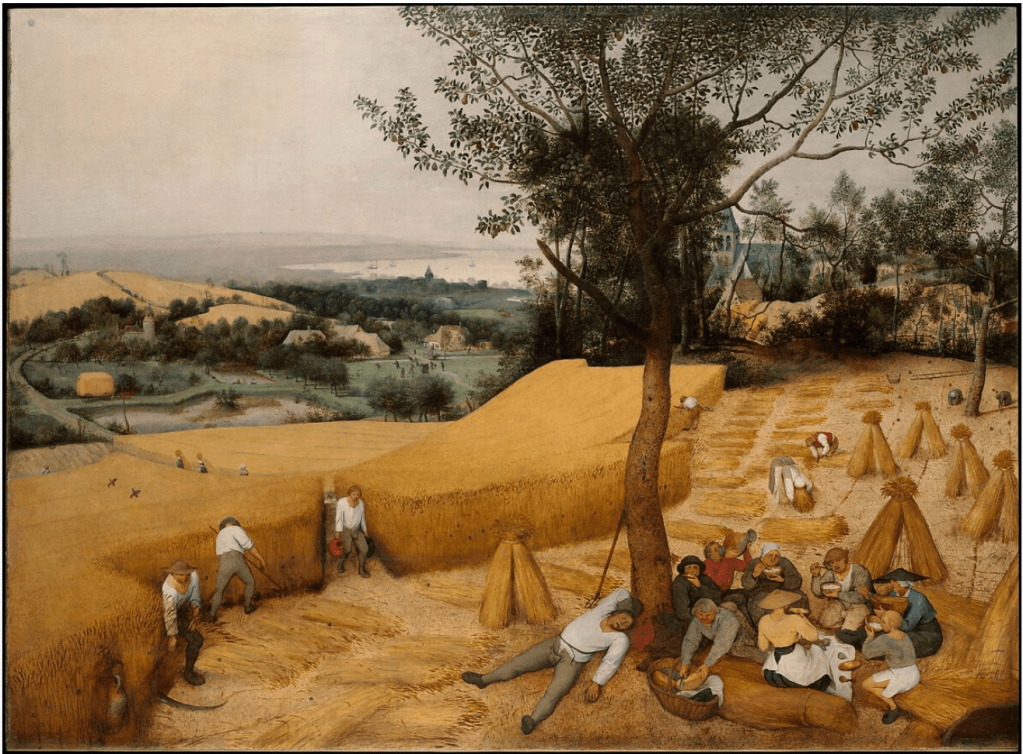
In the chapter ‘The Temporality of the Landscape’ (p234:258) Ingold uses the example of a painting, ‘The Harvesters’ by Pieter Bruegel the Elder (fig 1), to illustrate his views in the essay (p250) This was especially useful to visualise his key points. He dissects each landscape element into their individual components; the hills and valley, paths and tracks, the tree, the corn, the church and, the people. He demonstrates how each of these elements is measured by time and has been shaped by the lives present and past.
Fig 1. ‘The Harvesters’ Pieter Bruegal the Elder, 1565
Key points to be made about the painting:
The land is not an abstract surface or property but a worked ‘lived’ ground
It has evidence of historical labour – paths, hedgerows etc
shaped by repeated human engagement
Trees show a different temporal rhythm to humans and coexist, they are not background scenery but active elements of the landscapes becoming
grain represents seasonal growth and the rhythms of agriculture, they show the interdependence of labour and natural cycles
The painting shows a specific moment within the year (late summer harvest)
The church indicates long term habitation and along with other buildings signal ongoing dwelling
The harvesters are shown working, resting and eating, in different phases of carrying out their tasks, which forms the basis of the ‘taskscape’
People are not separate but part of the landscape
Ingolds book altered the way I understand my surroundings, in so far as I could validate my personal response to it. I have used his method of describing the painting below when I initially try to immerse myself in my environment, as a way to distract myself from my usual thoughts. I sense the lives before me embedded in the landscapes I document, especially related to Ingold’s concept of taskscape; my grandfathers work in Guiting and surrounding area is particular resonant here, plus the stories I’ve heard and photographs I’ve seen relating to my stepfathers ancestors and the gradual creation of their personal landscape at Dacha. In seeking to understand my visceral response to significant places, his writing is probably most significant.
Christopher Tilley
In his book ‘A Phenomenology of Landscape: places paths and monuments’ (Tilley, 1994) Tilley argues for landscape being an embodied experience – our body is the primary way that we engage with the world. Slightly differing from Ingold’s perspective, who emphasises more of a ‘doing over sensing’ approach. Tilley’s philosophy proposes we engage with it through being in it; through perception (seeing, hearing, touching), bodily actions and movements, and intentionality, emotion and awareness residing in systems of belief and decision making, remembrance and evaluation’ (p12) So, landscape then, is an experience, not just an observation, as far as Tilley is concerned. It becomes known through sequences of movement and memory with its past shaping its present and future in our minds. Tilleys arguments mirror the philosophy of Merleau-Ponty , whose emphasis is on perception, movement and being in the world.
To show my understanding of his book, I have included my entry for the annotated bibliography I completed for 7802, to view in its original context, refer to p32 in my Notions of Home Essay:
“This book by Professor of Anthropology, Christopher Tilley, combines insights from phenomenological discourse in ‘philosophy, ..anthropology, human geography and..archaeology’ (Tilley, 1994, p1) At the starting point of the book he interrogates ‘theoretical perspective on the significance of spaces, places and landscapes’(Tilley, 1994, p1) referencing well established phenomenological research (Heidegger, Merleau-Ponty) to establish the significance of the topic, then for the second half of the book Tilley examines an ancestral relationship & perception of place within landscape, using evidence from civilisations in Wales and Southern England. He illustrates with examples of Mesolithic material finds as evidence of those ancestors identifying with place in relation to its setting and conversely, the Neolithic understanding of landscape was in terms of relationship, shown with the setting of monuments. The spatial relationships and topographical aspects discussed in this book, offer rational explanation of my own interest and sense of place within the area I work. It is an area that is rich with cultural heritage and an informed understanding of these sites will provide a fundamental aspect of understanding my own practice in relation to landscape photography” (Taylor, 2024: p32)
There is an overwhelming amount of information and inspiration relating to mindful practices, online and in print. I have tried to be specific in my research. The key readings, terms, critical theory listed here, have all influenced my work and offer some explanation for how I have arrived at this point for my final major project. My hope is that the project will be a clear culmination of all my research and practice so far. Much of the critical theory I have researched and written about before and therefore I won’t repeat myself, although I have detailed my previous essays and blog entries where relevant below, as these writings continue to inform my practice.
Key readings and terms:
Miksang: Tibetan term, meaning ‘pure eye’ in relation to contemplative photography – to see without overlays of meaning and value. Without judgement or opinion, ie no association or preconception
Epoché – Edmund Husserls word for a suspension of judgment, a pause in our habitual thinking, the aim being to see things just as they are. This term is often debated but regardless, it serves me well in trying to remove the thoughts crowding my mind
John Berger Ways of Seeing (in relation to Magritte’s Key of Dreams) ‘Cultural Construction’ Sense of sight: seeing comes before words. We are culturally conditioned to see the world with descriptions. I have used this to demonstrate what I am trying to push back against.
Wabi Sabi – Japanese philosophy that celebrates the beauty and simplicity of imperfection and transcience
Henri Cartier Bresson – The Decisive moment. described the act of photographing as an intuitive and contemplative gesture.
Jon Kabat Zin – Mindfulness based stress reduction (he introduced mindfulness practices into medical, educational and personal conexts in the West)
Herman Hesse ‘Siddhartha’ – a novel about a man on a spiritual journey of self discovery, themes of religion (buddhism) and mindfulness throughout.
Notions of Home – Lucinda Taylor. (see file below and also in seperate post) This is my autoethnographic essay for Research and Context. I have added it here as it contains much of the critical theory that has informed my practice to this point. Although I have referenced some of this theory again (below, in other areas of the blog and in my reflective essay) I’ve avoided repeating too much of what I have done previously.
Critical writings (ongoing study and analysis) essential reading for my theme
The Perception of the Environment – Tim Ingold – Previously studied for 7801 and 7803, section on The Temporality of the Landscape – he determines that Landscapes are not things we look at but worlds we live in. They are shaped by movement, memory, work, and natural processes over time. To understand a landscape, we must attend to its temporality—the rhythms and practices through which it continually comes into being.
Christopher Tilley – A Phenomenology of Landscape: places paths and monuments – Tilleys work aligns with the views of Ingold, in so far as he argues for landscape being an emodied experience – we engage with it through being in it; walking, seeing, sensing & hearing. Landscape is an experience, not just an observation, it becomes known through sequences of movement and memory with its past shaping its present and future in our minds. These ideas validate my own experiences and I know that the photographs I am making, are my attempt to convey this view.
Martin Heidigger
Buttimer and Seamon
Edwards Relph
Yi Fu Tuan
Maurice Merleau-Ponty – phenomenological idea that we perceive the world not from a detached point of view but from the centre of it, through our moving, sensing, breathing selves (it is clear to see where Tilley has been inspired) The body is simply a bridge between self and world.
In relation to how an otherwise unconnected space becomes something more personal, Yi Fu Tuan states that space becomes place through experience, memory, and attachment (ref). By understanding that identity is created through repeated encounters of places, i.e. the landscape that I grew up in, I have some explanation for my initial question of why I am so drawn to the landscapes described above.
Landscape is an ideal construct in which to analyse the self. ‘…the most optimal occasion for meditating on the unity of the self . . . Landscape, in this way of thinking, is an exemplary encounter with subjectivity’ (DeLue and Elkins 2008:103)
To further this, in ‘Place and Placelessness’ Edward Relphs writes ‘Home is the foundation of our identity as individuals and members of a community, the dwelling-place of being. Home is not just the house you happen to live in, but an irreplaceable centre of significance’ (Relphs online)
Using simple but well known methods to ground ourselves in a subject, utilising the well know Buddhist philosophy of a ‘beginners mind’ enables us to notice beauty and close out the world around and be authentically present, recognising the simplicity.
Example of Phenomenological writing – ‘I sat on a rock and ate cheese sandwiches – and thought I was perfectly happy, It was so huge. And so wild and so empty and so free.…And there, quite suddenly and unexpectedly, I slipped a gear, or something like that. There was not me and the landscape, but a kind of oneness; a connection as though my skin had been blown off. More than that – as though the molecules and atoms that the rest of the world is made of. I felt absolutely connected to everything. It was very brief, but it was a total moment…. This ‘gift’ is experienced as both integrative – the whole self engaged and known to itself, to the subject, in quite a new way – and as connecting that self to something larger’ (Maitland: 2008, p63)
Nikon D850 with 105mm fixed lens, 24-70mm wide and 50mm prime.
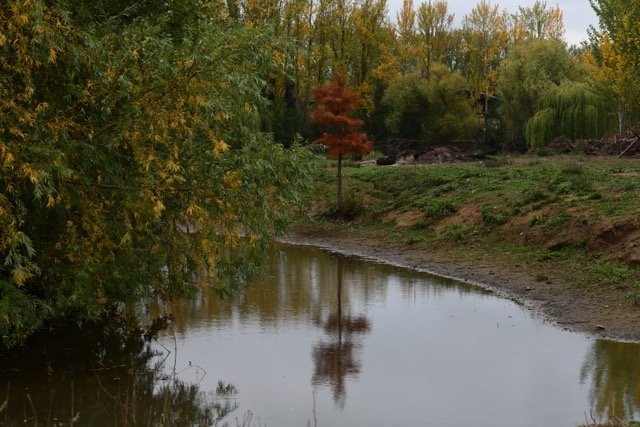
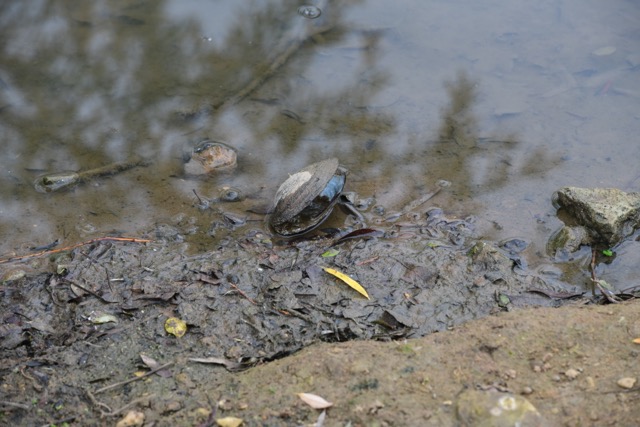
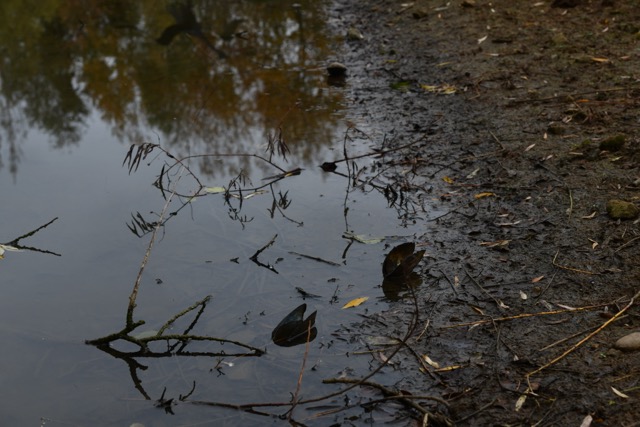
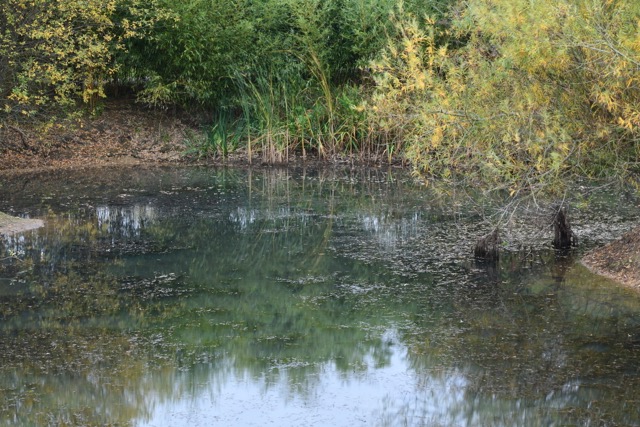
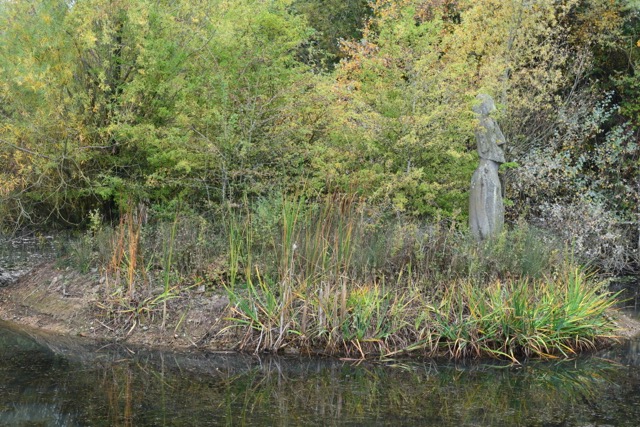
As Autumn creeps in, the landscape was beginning to change. I paid close attention to the water levels here because they had not recovered after such a long dry summer. It is the first time my step father remembers it being so low for so long. Interestingly, the swan mussels presence indicate good water quality, I would have assumed that the lack of rain might have contributed to its decline but I wonder if with there being no agricultural run off from the hill it has actually given the environment chance to recover. I admit, this is unscientific on my part but it is a passing thought as I watch the water.
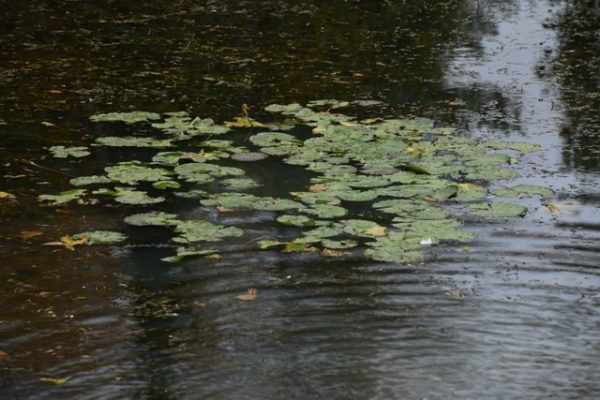
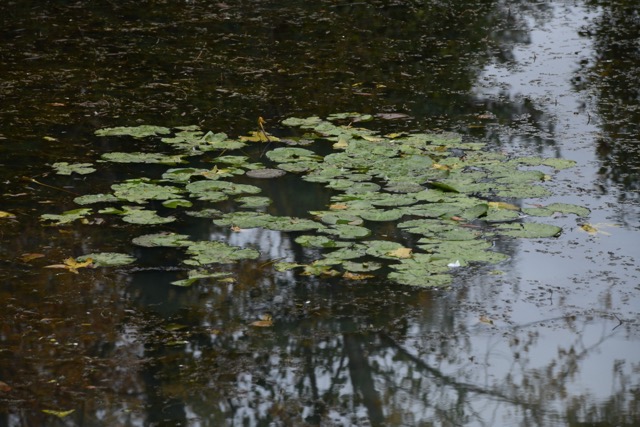
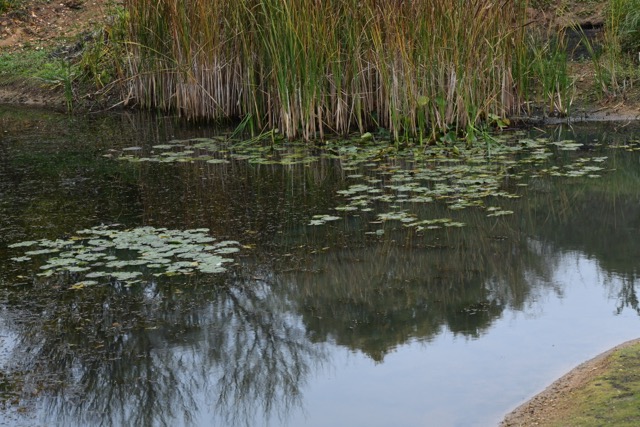
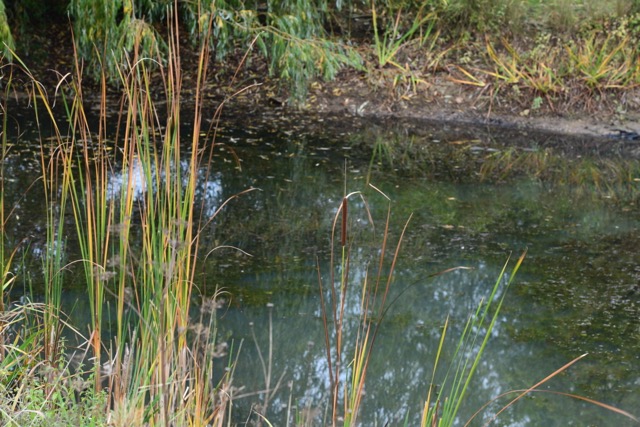
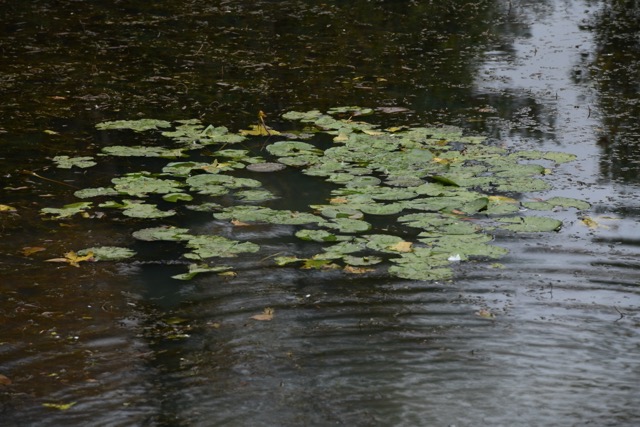
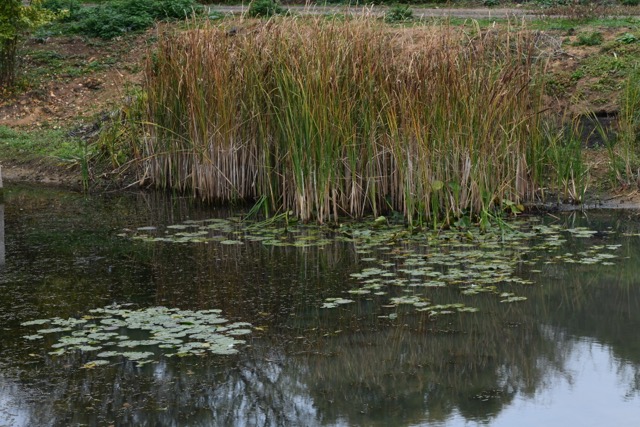
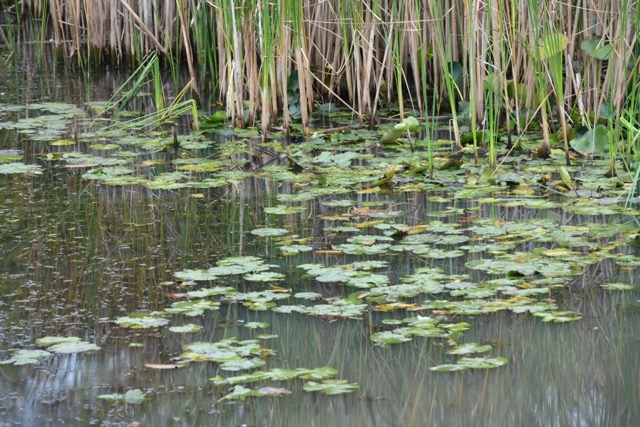
I am working in the open space today. I feel quite exposed, as ordinarily I am hidden under the tree canopy but I feel I need to invest time in the other areas of the landscape which I usually pass up. The sky feels heavy with rain and it does come but not enough. I tried to catch it in the pond with lillypads, it only just breaks the surface, seeming to almost evaporate before it arrives. Its still warm.
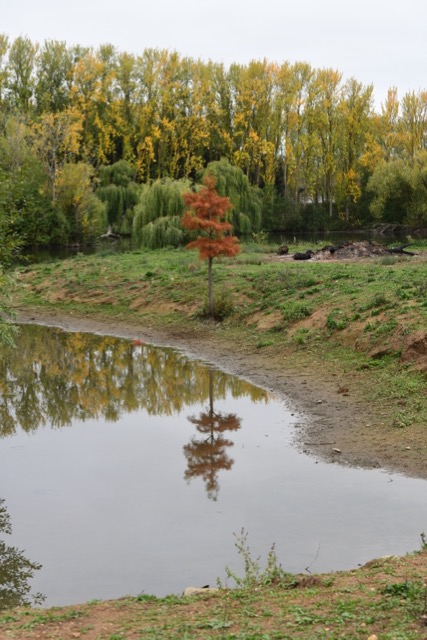
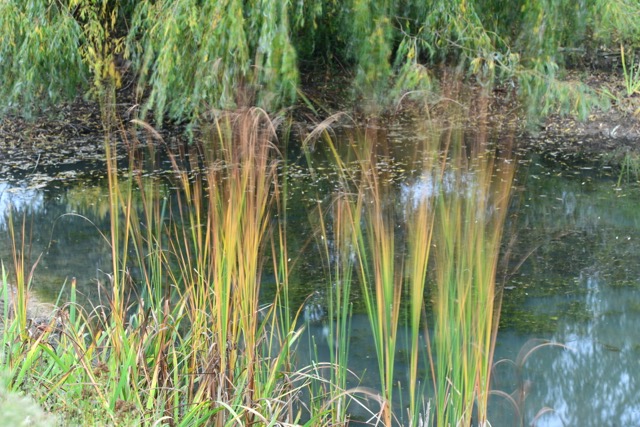
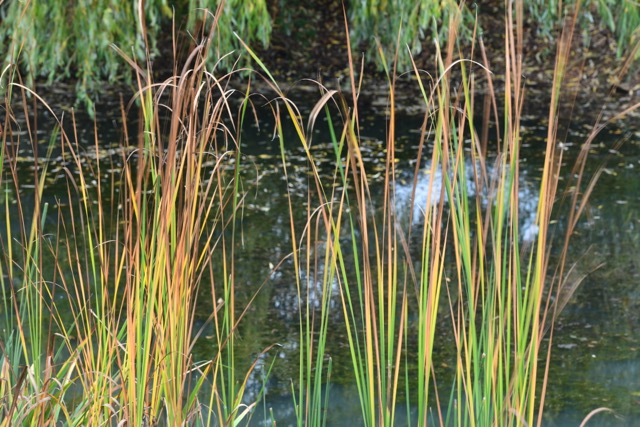
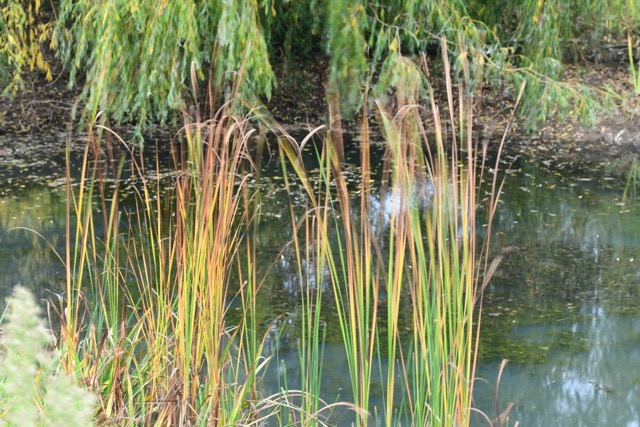
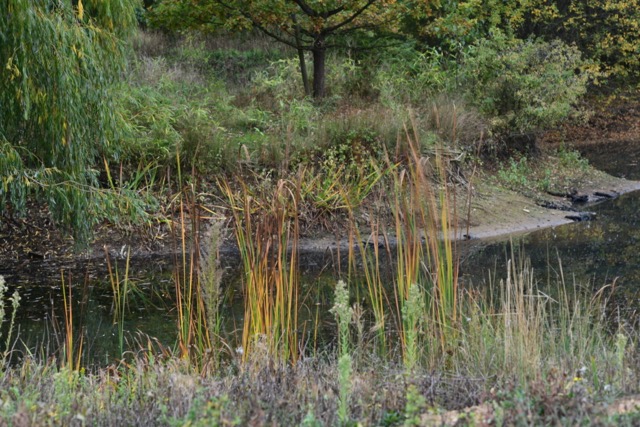
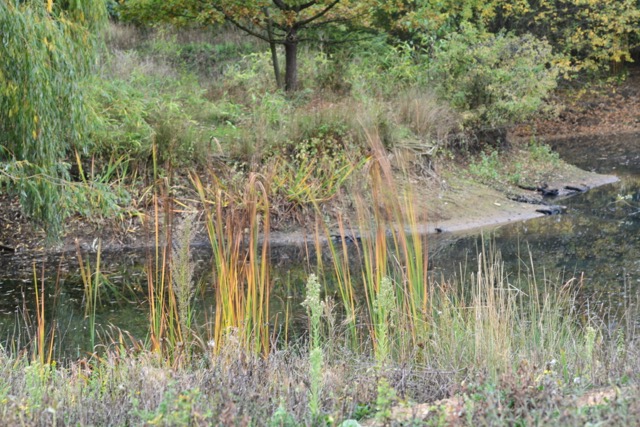
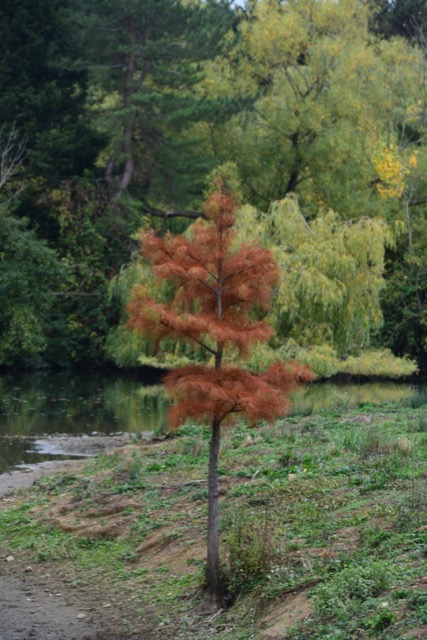
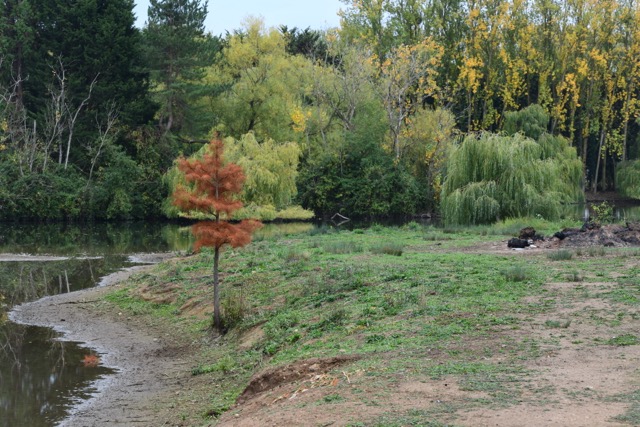
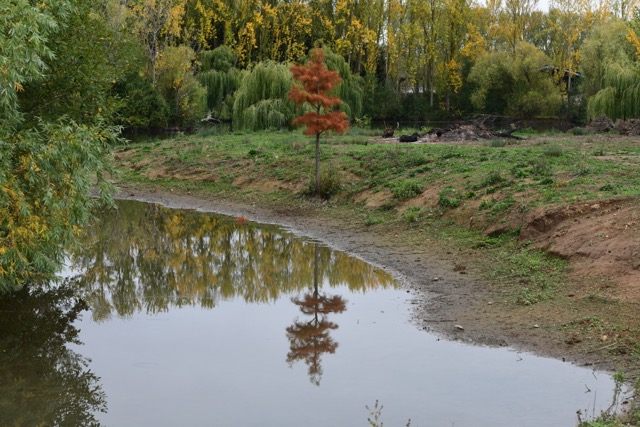
The wind has picked up a little and I notice the reeds moving back and forth in unison. The red and yellow appears flame like, they are striking against the otherwise green and brown landscape. The same is true of the orange spruce. I don’t know the story of this young tree but it stands as though watching me, its strangely comforting. Its bright colour is bold against the rest of the scene. Most of the water birds are nowhere to be seen, I did spy a small group of ducks under the canopy but they all made their escape as they heard my approach. I liked how they had found a shallow area of rock and shingle just peeking above the water line under the trees, there was also a small patch of light coming through which seemed to illuminate them as they sat. I tried to photograph them but in my clumsy attempt, I disturbed them all.
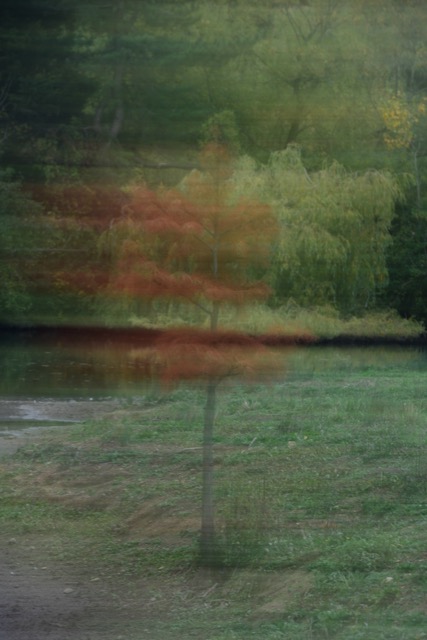
I experimented with movement, for the orange spruce, I panned the camera slightly to create a painted effect. It feels too contrived though and not in the spirit of mindful practice. I like the movement in the reeds though, they move themselves as I leave a slightly longer exposure. I did spend a good couple of hours here, absorbed in my surroundings and practicing just ‘being’. It feels odd at the moment and I hope that this will change. It is meant to be a ‘practice’ after all.
As I’ve outlined, I have consistently explored themes around family, memory, sense of place but I’ve yet to fully realise my potential in this area. I think that in employing this approach, I’d be able to manifest clearly my thoughts and feelings about ‘place’ beyond representation, providing deeper meaning around an image and in turn, creating a more emotional body of work.
The problem. With the daily busyness of life in general; the pressures and stresses of tasks and deadlines, messy calendars and unexpected changes to routines and schedules, I find it extremely difficult to sit in a space and observe, quietly and patiently, my surroundings. All too often, those places aren’t fully seen by me, as the never ending task list works its way like a ticker tape parade through my mind, I can barely tell you what I looked at, after the event. My biggest successes have tended to be the result of dedicating more time and thought to my observations. To solve this problem, I needed to learn about mindful practice and so searched for relevant materials on the subject.
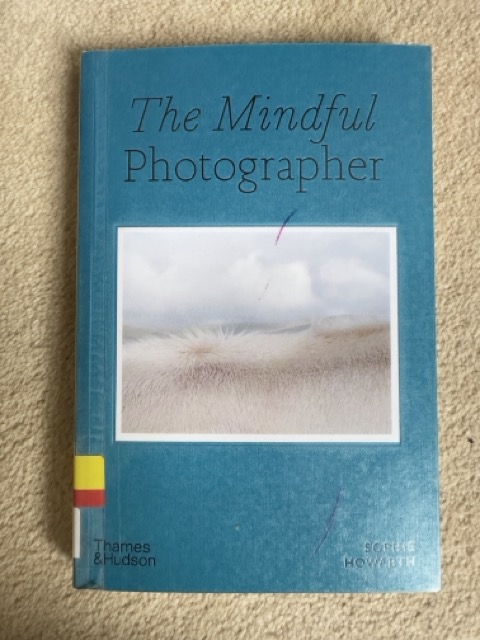
The most useful source I came across, is The Mindful Photographer by Sophie Howarth (2023) in the university library. (I have now bought myself a copy) It has been a key guide to this process, although its ideas are broad, the principles are applicable in any specific scenario and it also revealed to me how the wider uses of this therapeutic method could offer benefits beyond just my own immediate concerns. For example, Howarth refers to The New Economics Foundation, stating that “[NEF] is a think tank focussed on redesigning the economy to work better for both people and planet, they identify 5 evidence based actions that are foundational for individual health and wellbeing, Paying mindful attention to our surroundings, is one of them” (p8) She goes on to say that while improving personal wellbeing is a good reason to develop the skills of mindful practice, there is also a case for larger social value. The world and us are more distracted than ever, as I’ve stated elsewhere, there are immense challenges faced across the world and with our attention being pulled in all directions, we are rarely looking closely or attentively at anything. Many credible sources, including the mental health charity MIND , show there is a significant mental health crisis in the UK, which continues to decline and although there are many explanations as to why that might be, whatever the reason, mindful creative acts have the potential to offer some relief. “…mindfulness has gained widespread interest precisely because states of distraction, anxiety, suffering, and lack of connection are so common and detrimental. As society veers toward more chaotic, techno-centric, globally connected and distracted modes, mindfulness offers an antidote to internalised unrest —particularly for learners who face ever expanding sources of difficulty from stress and distraction”.(Henrikson et al, 2020: p2)
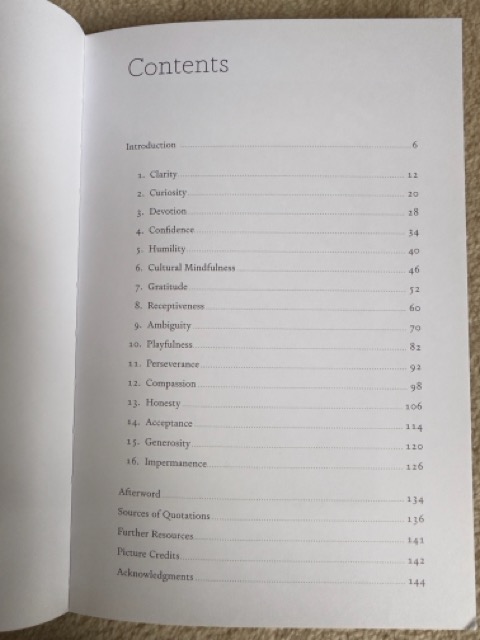
The book is split into chapters as follows:
There are practices throughout each chapter which has served to guide me in establishing mindful techniques. Small tasks are set for each chapter. My experience of the most useful of these are listed below, these form the basis of the physical aspects of my project:
Basic meditation. The foundational practice for mindfulness, where I simply found a comfortable space to just sit and be, without any interruptions, for 10 minutes. Although it is a requirement to be comfortable and relaxed, the discipline of sitting straight is at first difficult! I realise how much time I spend in terrible posture. Strangely, by reminding myself to ‘sit up straight’ my mind wonders back to my ballet classes during my earlier years and so I take this thought and literally, dance my way through the next few minutes. Its a strangely blissful moment. Then I bring my mind back to the here and now, trying to stay focussed, my thoughts keep wondering but Howarth says, not to push them away or engage. I just let them wonder through my mind. I focus on breath as much as possible, this seems to stop my mind veering off all over the place. After the allotted ten minutes, I do feel centred and relaxed, I am less anxious and my mind seems to be calmer.
Being Like Water. “the mind that is too full of effort, desire and expectation leaves little space for creative response“(p78) explains the barriers to mindful creativity very well I think. I am absolutely guilty of overthinking my practical work and outcomes. I think this is why learning a more mindful approach will ultimately revolutionise my practice. Practicing feeling, thinking and seeing over doing can only serve to bring about a more authentic body of work. I accept that I will make judgements on composition and will even choose favourable conditions but I believe there can be a balance. The ‘being like water’ comes from Taoism ‘wu-wei’ which is translated as ‘effortless action’ or ‘going with the flow’ and was a term made popular in Western cultures by Bruce Lee, when he says to a fictional character “Empty your mind, be formless. Shapeless, like water. If you put water into a cup, it becomes the cup. You put water into a bottle and it becomes the bottle. You put it in a teapot, it becomes the teapot. Now, water can flow or it can crash. Be water, my friend.” (online) I found the practices I tried for AD7803 to be useful in this, by allowing nature to guide instead of being controlled by me.. for example, in making cyanotypes and photograms I am giving up control to the elements to a great extent. Moving around the pathways and following the shape of the land, all come into play here. I think about this a lot now when I am walking and immersing myself in the landscape.
The Beginners Eye. Howarth uses the ‘childs eye’ to break habitual ways of viewing. She talks about games such as ‘I Spy’ except with variations, rather than something beginning with a letter, use ‘things in pairs, broken things, two circles together… etc’ where you need to ask questions and look at everything around you in much more detail. It gives new perspectives on familiar things. Using different perspectives is another aspect to adopting a beginners eye, looking from the ground up: ‘How many colours are there in a field of grass to the crawling baby unaware of green”? Stan Brakhage so to imagine things without labels, although challenging when we can’t help but name everything, is a start to seeing without preconceptions. Without a camera, I practiced by looking closely at a plant, I stared for a while (I notice that after a while I stop labelling it) and then looked at it from table level, then upside down. I let my vision blur (awkward with contact lenses!) and tried to think of how else this ‘object’ might be presented, other than the conventional. To reset from each time I kept judging or thinking, I used my eyes like a slow shutter and blinked.
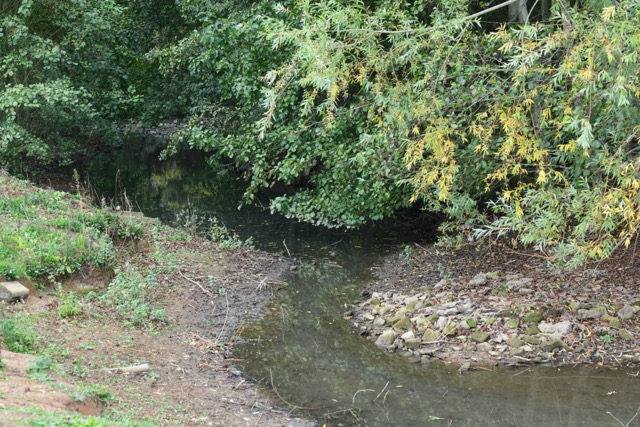
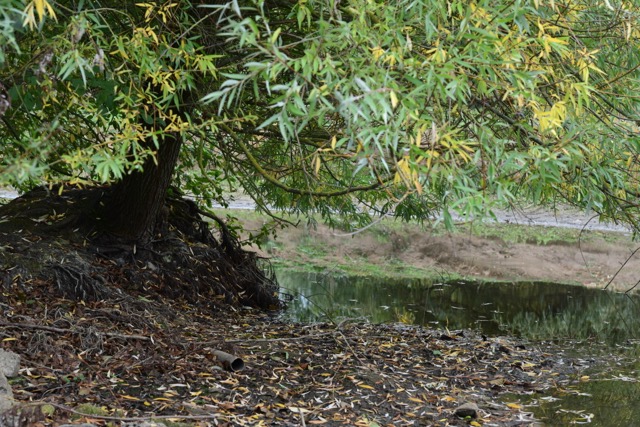
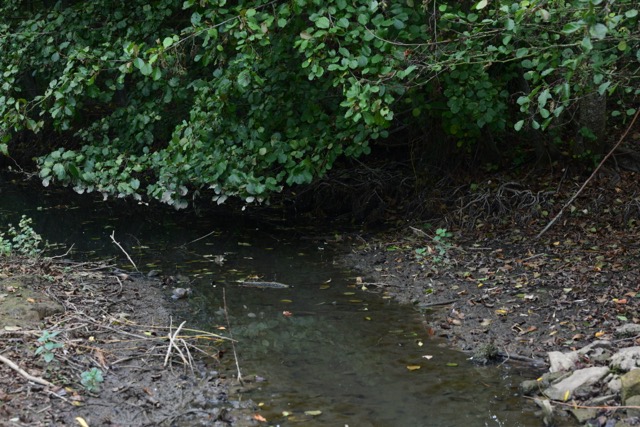
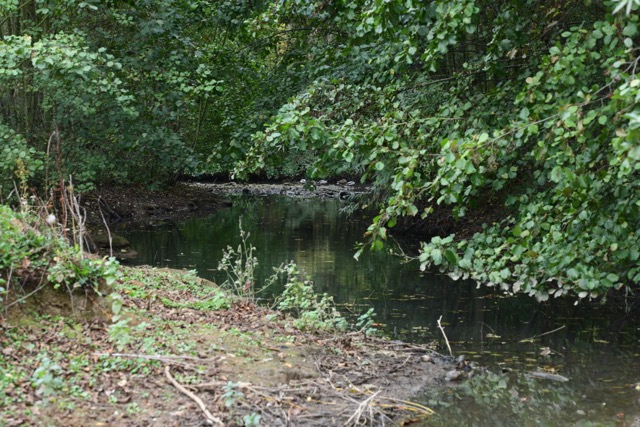
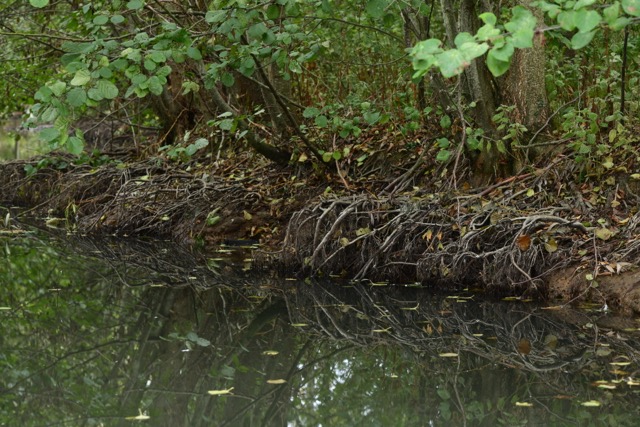
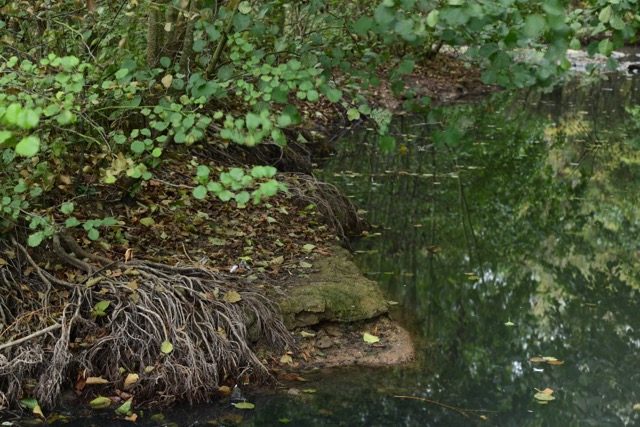
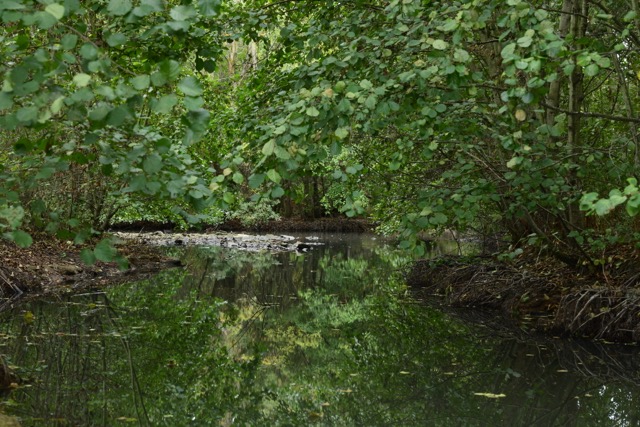
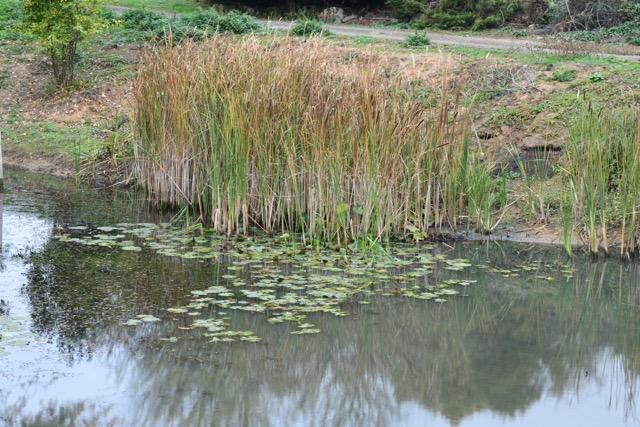
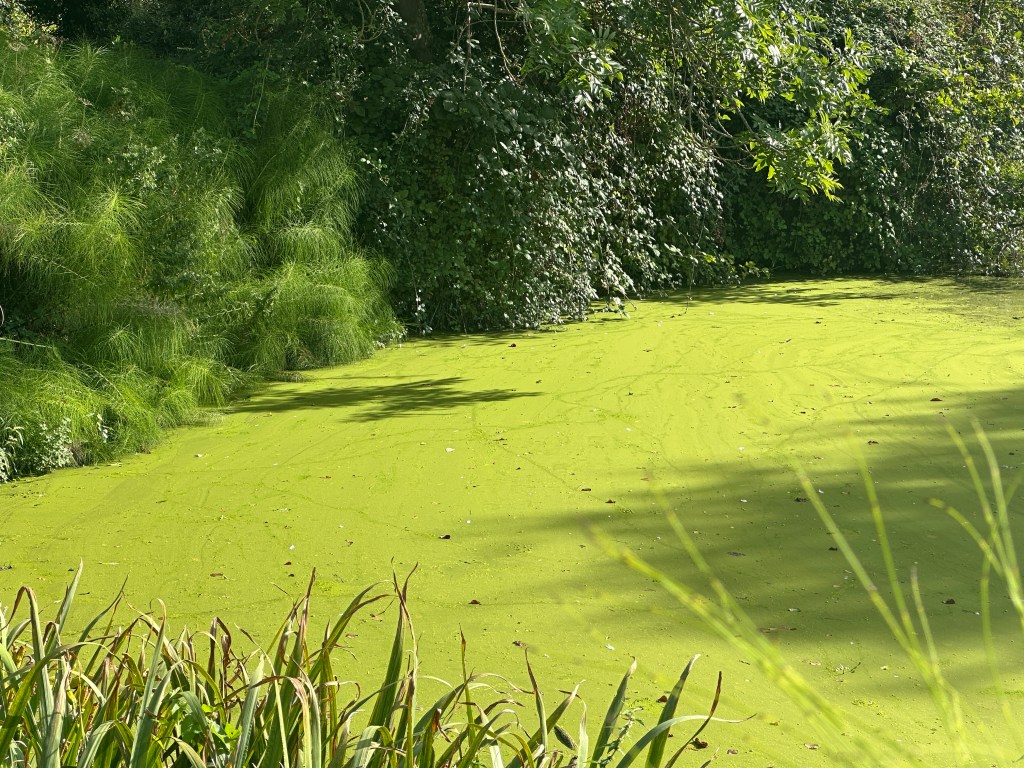
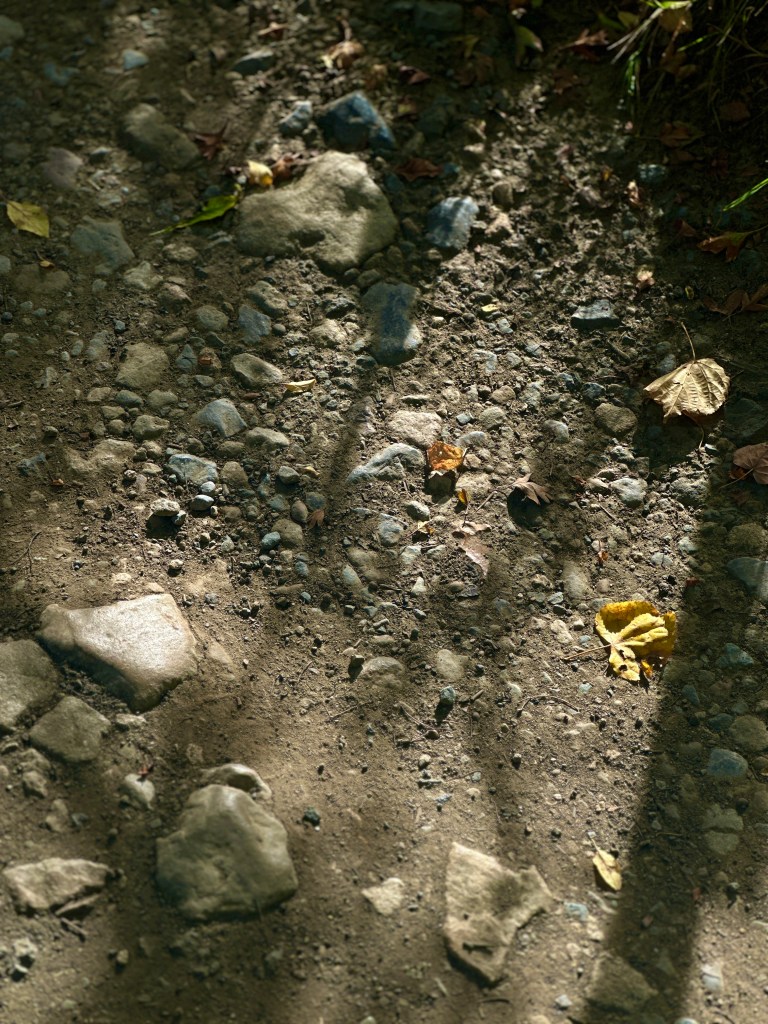
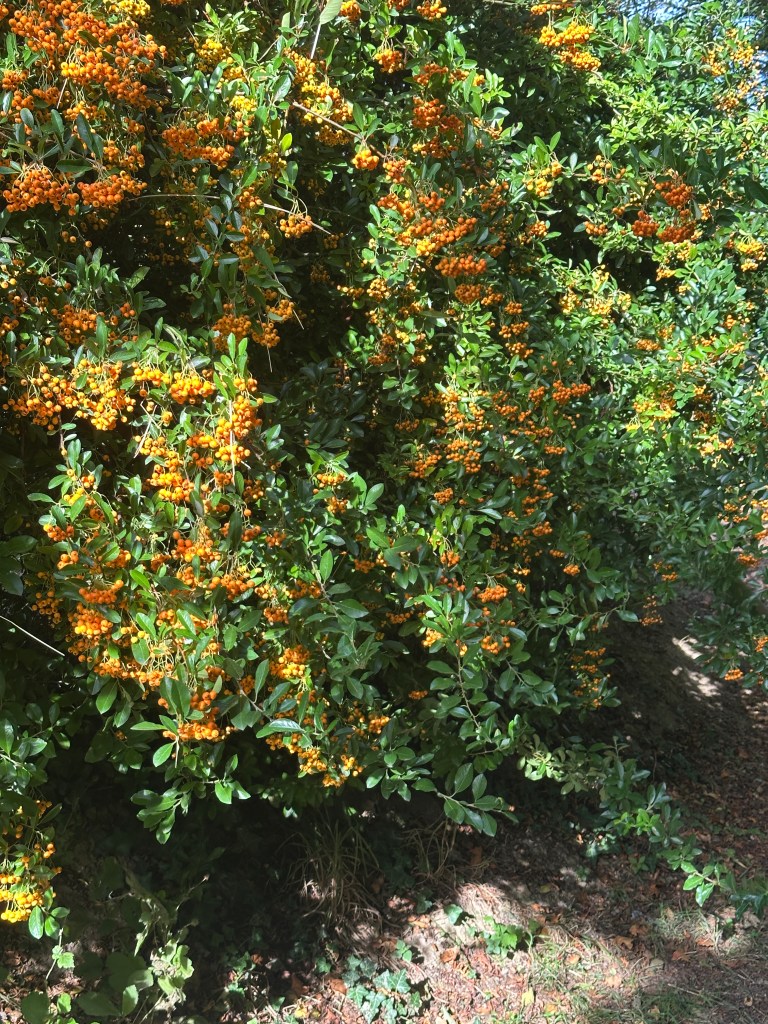
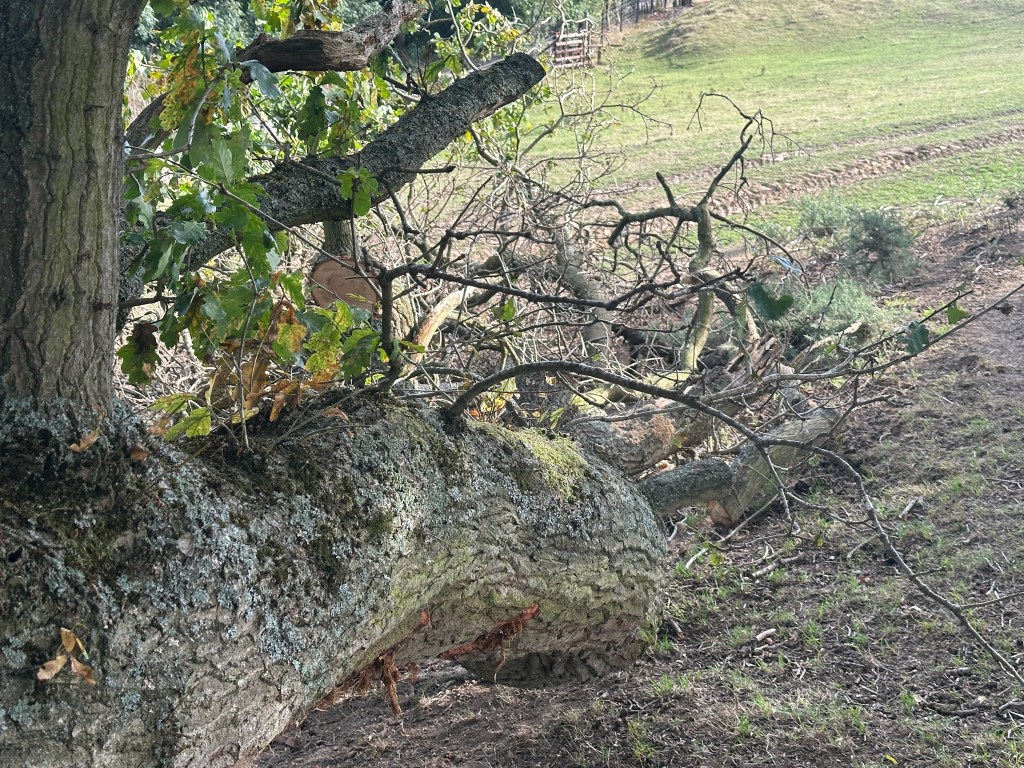
Photo ‘fishing‘. The purpose of this exercise as far as I can tell, is to take photographs almost at random, so removing any preconceived ideas about compostion, edit, end result etc. Letting go of the idea of perfection and simply recording what I see. I had come to a spot where a very large branch from a tree had fallen, so I just decided to spend a few moments there and would photograph based on an intuitive response to the newly created shape. I spent a few minutes at first, closing my eyes and feeling the sunshine on my face. I tried not to overthink and actually distracted my mind by humming a tune! These are 4 images from that walk. Each spot I would take a moment to try and empty my mind a little and reject the concerns over final results. It was a helpful exercise in learning to let go of perfection and end results and in doing so, being able to become more present in the moment.
Written word. I had planned to practice this by noting down the words, sensations and sounds, in place; Japanese Haiku poetry is one way I could do this, although I am not practiced in it at all, it is a useful way to record what I see and sense, in a way they are like verbal snapshots of a place and whilst traditionally they were often humorous and use in games of oneupmanship, the principles of ‘say what you see’ are useful in mindfulness practice. 17th century poet Basho, arguably the most famous of Haiku poets, is used as inspiration here:
“The old pond— a frog jumps in, sound of water.” —Basho
A very literal description of a moment / experience. Our own experiences tell us that the frog has created the sound of the water and so we draw on our own memories. This is a useful way to engage with audience, to help them to see what might be heard, seen and felt at the time. These are the poems I have written when reflecting on my shoots. Not typically done ‘in place’ but they are a summary of the things I notice when immersed in the environment.
Rocks and stones, algae marking their age, indigo water patient, enduring, unbound time settles here.
The leaves fall, dancing down into the depths, floating, descending light flickers on the surface in perfect rhythm as if to applaud their final show
lichen clings to nature, decorating rocks, branches and tree trunks deep emerald greens, soft grey blues and ochre yellows, serving as colourful timestamps, reminding me to embrace it all.
winter coats the lake frozen images, as though printed on satin, hold soft light silence reigns, I hear myself, Just living, breathing in place. Trees are looking down at me, their branches hiding the tiny spies who watch my every move.
Seeing. In Edward Husserl’s ‘Epoché’ theory, he says that things are not as we see them, we are bogged down in language and our own judgement. Similarly, John Berger discusses in ‘Ways of Seeing’ how our own personal history shapes what and how we see, which can make it difficult to truly ‘see’ something for what it is. In order to change my preconceived ideas and knowledge about an object then, I would need to ‘train my gaze’, which is where mindfulness techniques will come in. I hope that in adopting a beginners mind, I can better reveal an essence of a place or ‘thing’.
Uta Barth offers a unique visual experience, inviting viewers to look at self and, in some of her works, is an exploration in to domestic absorption. I researched her work for part of my BA and used this approach to photograph some otherwise mundane objects and features within my own domestic space. The photographs I made back then are among some of my favourite images, perhaps because the way they transform from the unremarkable into something mysterious and dreamlike, which mirrors the experience of meditation.
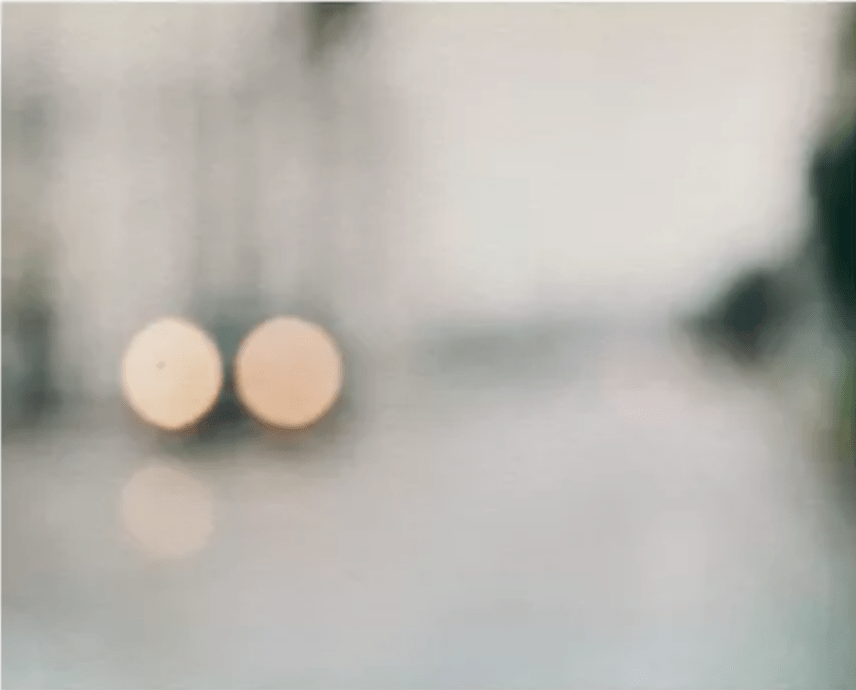
In Barth’s ‘In Between Places’ book, there are many examples of domestic spaces to street scenes and rural spaces. Her best known work is that which she refers to as the ‘space in between’ with the focus being on empty space, rather than the expected subject, reinforcing the idea of experiencing mediation. The photograph below (Fig 1) is the one which caught my attention because whilst it is ambiguous, it is also quite clear in what it actually is. A car with headlights on, driving towards the viewer (the colour of the lights can determine this) and the colour palette for rest of the scene suggests a grey, rainy afternoon, the reflection of the car headlights on the ground, tells me this. It could of course be a different time of day but my own experiences lead me immediately to afternoon / early evening.
Fig 1
The same hazy effect is created when we stare at something for too long and our focus blurs, like a visual representation of pausing in thought .
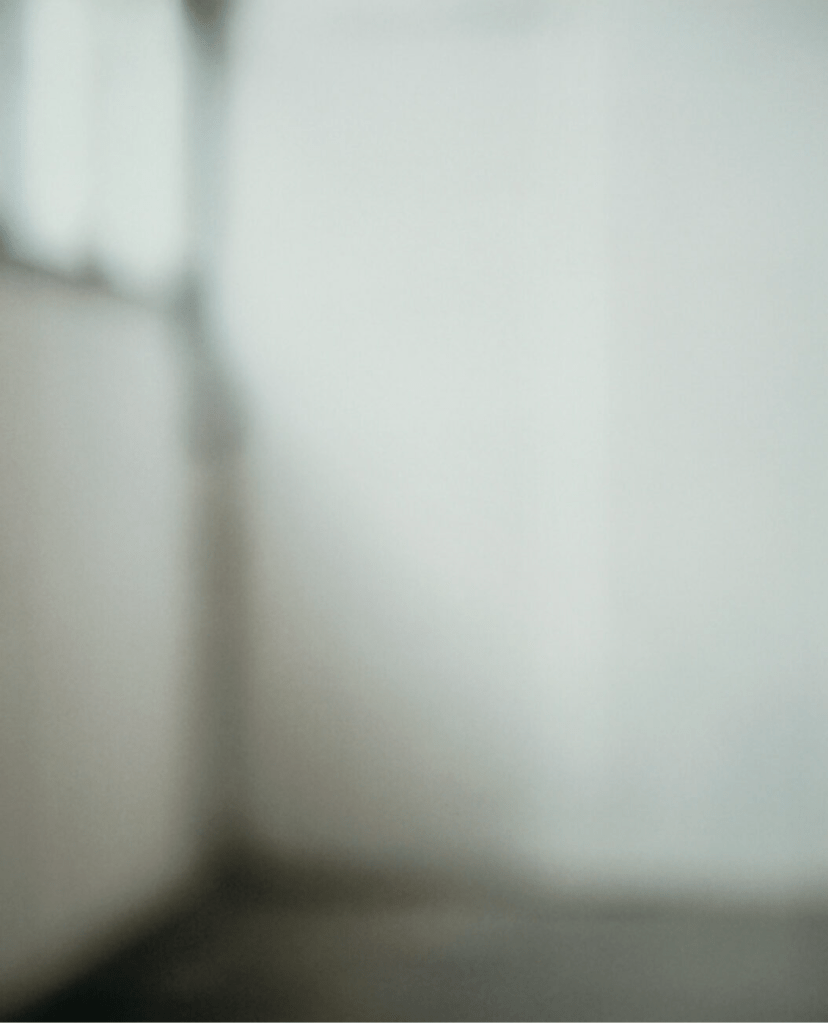
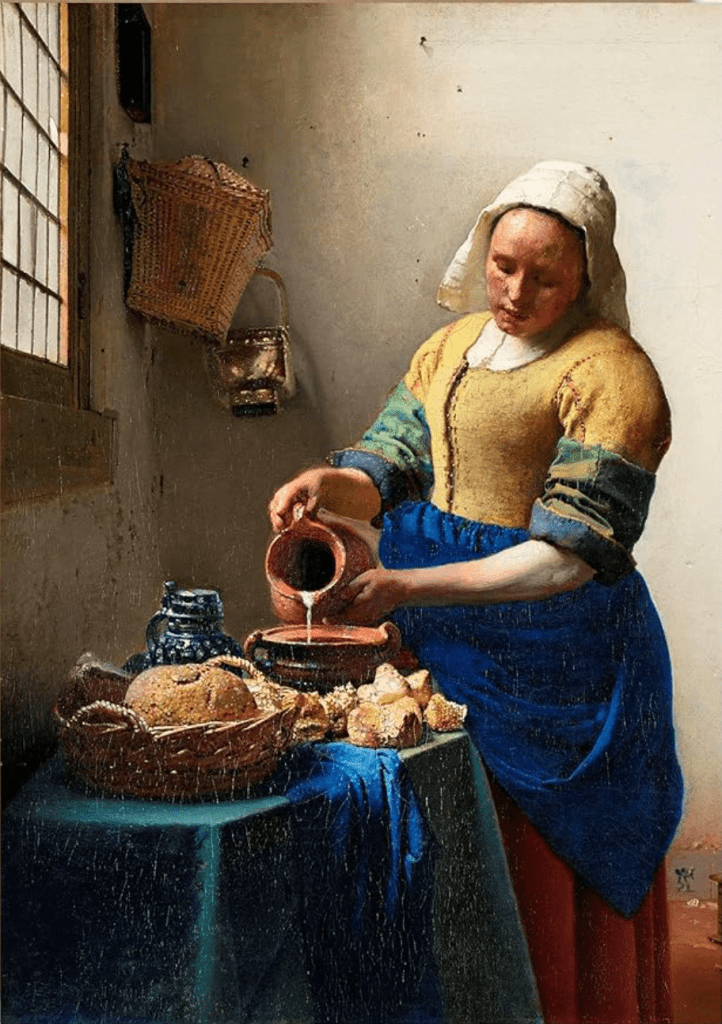
Many of Barth’s photographs have a painterly appeal. For example, the photograph below, which appeas to be a corner of a room (Fig 2 ) with a partially revealed window to the left, is reminiscent of Vermeer’s milkmaid painting (Fig 3) whether this was deliberately so, I’ve not discovered but the similarities can’t be denied with the position of the window and the corner of the room. The blurred image creates a chalky, soft texture which only adds to the idea of it being inspired by such a painting. Intentional or not, it shows that creativity is rooted in past experiences. Through moments of pause, deep breaths, and mindful awareness, we can reconnect with those inner resources and shape them into our own masterpieces.
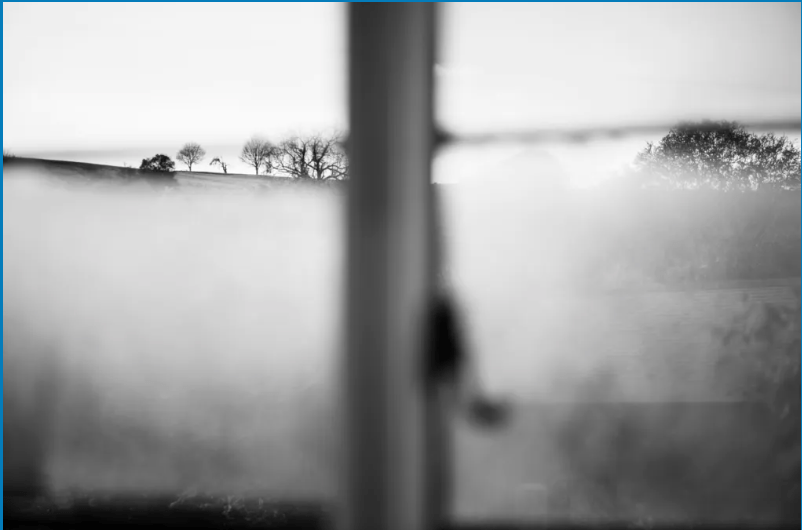
Fig 2Fig 3Fig 4. Fig 5
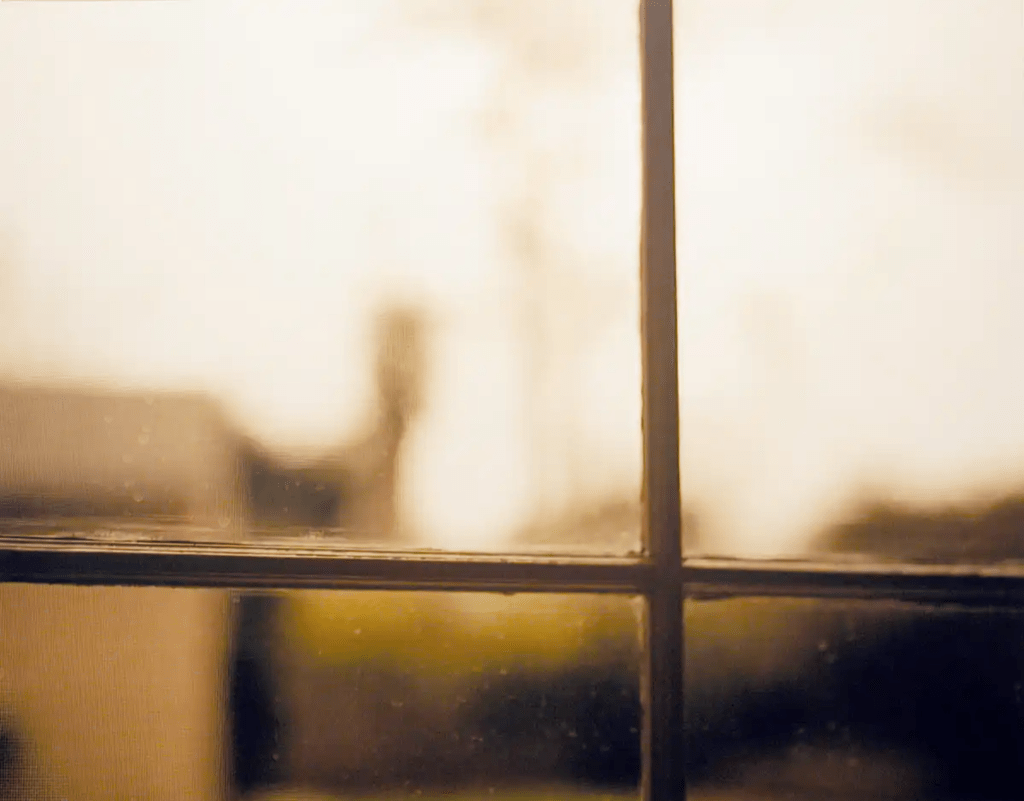
To further this, I note this photo (Fig 4) which I took for a previous module. This was inspired by, I now see, Uta Barth’s photograph in Fig 5. My photograph was taken from my bathroom window and although it appeas as though a sectin of glass is missing, its actually condensation (its a very old house!) with just enough of a clear gap in the glass to see the trees at the top of the first climb onto Bredon Hill from my village. I take this route several times a week and often look up from this window to the trees in recognition, then staring back to the house when I reach them.
Uta Barth’s photographs had an impact on my work from the earliest point in my creative studies. I reflect on this often and I am grateful that I discovered her images, this was a point where I could see how I could creative metaphor in my photography to add potency and dimension to my images.







 Lucinda Taylor