
Here I give more information about the key texts I have read during my MA, those which have had the most influence and given me the change of direction I needed, with which to help me identify my true interests in my practice. Although there is a lot of critical theory that I have studied over the course of this MA, these contemporary writers and experts combine many of the older philosophical views that I’ve researched already, therefore, I have chosen to expand on these, rather than unnecessarily repeat myself. I have listed other key influences on my page, to demonstrate my knowledge and sources in my post titled ‘Landscape Mindfulness & Photography‘
Tim Ingold
Landscape as seen as a temporal ‘taskscape’ by Tim Ingold. Regarded as ‘the familiar domain of our dwelling…and through living in it, the landscape becomes a part of us, just as we are a part of it. His book The Perception of The Environment (Ingold, 2022) has been essential reading in helping me to understand the concepts of landscape, dwelling, space and place. Ingold adopts the dwelling perspective, having been influenced by the philosophy of Martin Heidigger (p190) Like Heidigger, Ingold argues that humans are not simply detached observers of the world but are already deeply involved in it.
This reminds me of a book I read called Braiding Sweetgrass, written by Robin Wall Kimmerer (2013) She is a member of Citizen Potawatomi Nation, an indigenous tribe, originally from the Great Lakes area of the USA, and who are well known for their cultural resilience. The book demonstrates a culture of reciprocity and of being ‘in’ nature, not separate to it. In doing so, there is no objectification, just an unquestionable sense of being part of the land, alongside all the other elements. Her work is predominantly focussed on “restoration of ecological communities and restoration of our relationships to land“. I recognise aspects of this culture running through the ideas presented by Ingold/ Heidigger. They both reject the idea that people first think about the world and then act on it, instead emphasising lived experience and practical engagement. For both, meaning comes from dwelling in the world through everyday activities rather than from abstract thinking or viewing the world from a distance. This research does emphasise how the Potawatomi relationship to land and nature is much more connected and instinctive than our own.
In the chapter ‘The Temporality of the Landscape’ (p234:258) Ingold uses the example of a painting, ‘The Harvesters’ by Pieter Bruegel the Elder (fig 1), to illustrate his views in the essay (p250) This was especially useful to visualise his key points. He dissects each landscape element into their individual components; the hills and valley, paths and tracks, the tree, the corn, the church and, the people. He demonstrates how each of these elements is measured by time and has been shaped by the lives present and past.
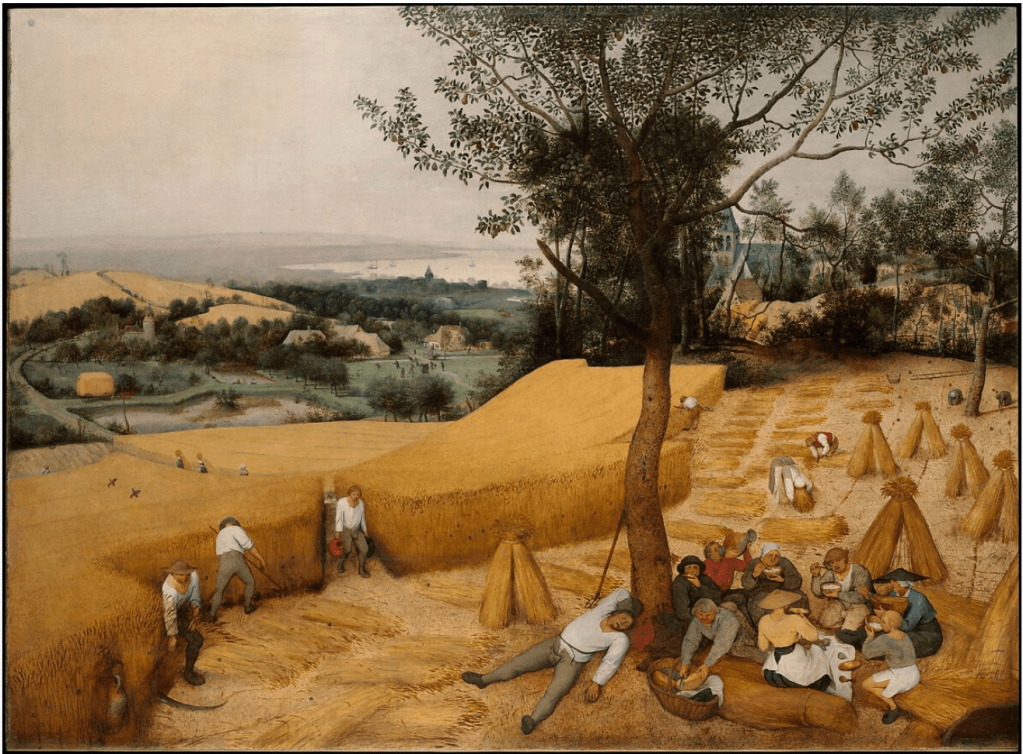
Key points to be made about the painting:
- The land is not an abstract surface or property but a worked ‘lived’ ground
- It has evidence of historical labour – paths, hedgerows etc
- shaped by repeated human engagement
- Trees show a different temporal rhythm to humans and coexist, they are not background scenery but active elements of the landscapes becoming
- grain represents seasonal growth and the rhythms of agriculture, they show the interdependence of labour and natural cycles
- The painting shows a specific moment within the year (late summer harvest)
- The church indicates long term habitation and along with other buildings signal ongoing dwelling
- The harvesters are shown working, resting and eating, in different phases of carrying out their tasks, which forms the basis of the ‘taskscape’
- People are not separate but part of the landscape
Ingolds book altered the way I understand my surroundings, in so far as I could validate my personal response to it. I have used his method of describing the painting below when I initially try to immerse myself in my environment, as a way to distract myself from my usual thoughts. I sense the lives before me embedded in the landscapes I document, especially related to Ingold’s concept of taskscape; my grandfathers work in Guiting and surrounding area is particular resonant here, plus the stories I’ve heard and photographs I’ve seen relating to my stepfathers ancestors and the gradual creation of their personal landscape at Dacha. In seeking to understand my visceral response to significant places, his writing is probably most significant.
Christopher Tilley
In his book ‘A Phenomenology of Landscape: places paths and monuments’ (Tilley, 1994) Tilley argues for landscape being an embodied experience – our body is the primary way that we engage with the world. Slightly differing from Ingold’s perspective, who emphasises more of a ‘doing over sensing’ approach. Tilley’s philosophy proposes we engage with it through being in it; through perception (seeing, hearing, touching), bodily actions and movements, and intentionality, emotion and awareness residing in systems of belief and decision making, remembrance and evaluation’ (p12) So, landscape then, is an experience, not just an observation, as far as Tilley is concerned. It becomes known through sequences of movement and memory with its past shaping its present and future in our minds. Tilleys arguments mirror the philosophy of Merleau-Ponty , whose emphasis is on perception, movement and being in the world.
To show my understanding of his book, I have included my entry for the annotated bibliography I completed for 7802, to view in its original context, refer to p32 in my Notions of Home Essay:
“This book by Professor of Anthropology, Christopher Tilley, combines insights from phenomenological discourse in ‘philosophy, ..anthropology, human geography and..archaeology’ (Tilley, 1994, p1) At the starting point of the book he interrogates ‘theoretical perspective on the significance of spaces, places and landscapes’(Tilley, 1994, p1) referencing well established phenomenological research (Heidegger, Merleau-Ponty) to establish the significance of the topic, then for the second half of the book Tilley examines an ancestral relationship & perception of place within landscape, using evidence from civilisations in Wales and Southern England. He illustrates with examples of Mesolithic material finds as evidence of those ancestors identifying with place in relation to its setting and conversely, the Neolithic understanding of landscape was in terms of relationship, shown with the setting of monuments. The spatial relationships and topographical aspects discussed in this book, offer rational explanation of my own interest and sense of place within the area I work. It is an area that is rich with cultural heritage and an informed understanding of these sites will provide a fundamental aspect of understanding my own practice in relation to landscape photography” (Taylor, 2024: p32)
 Lucinda Taylor