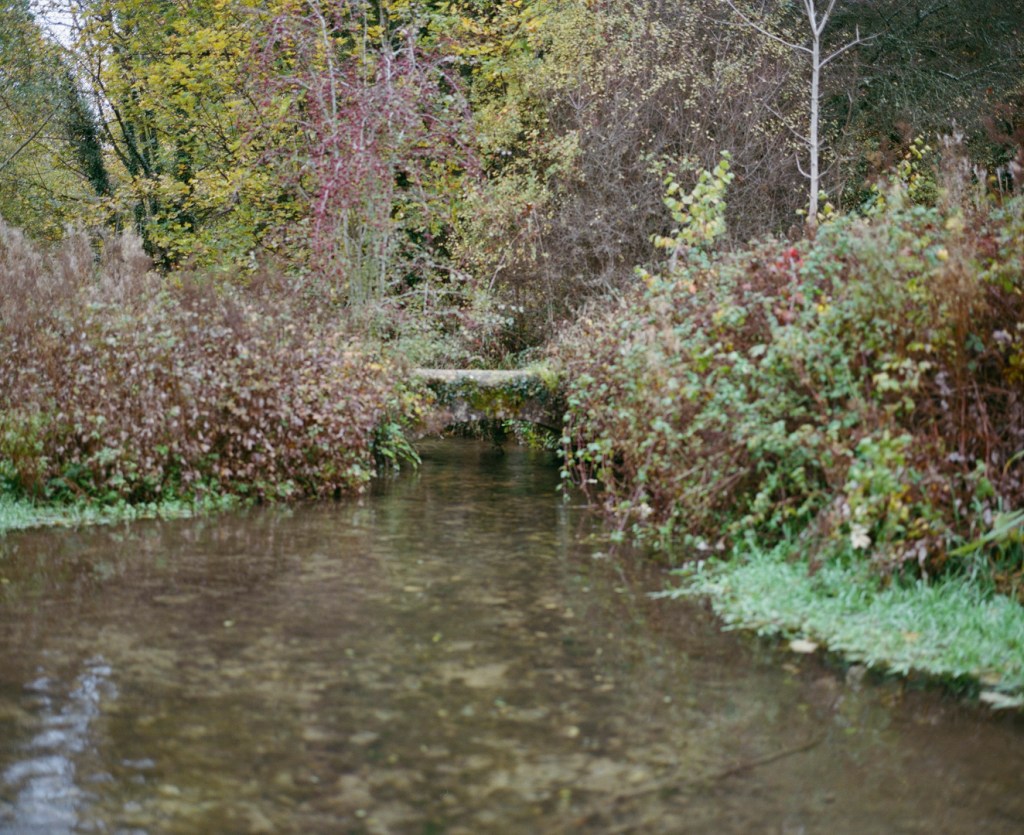
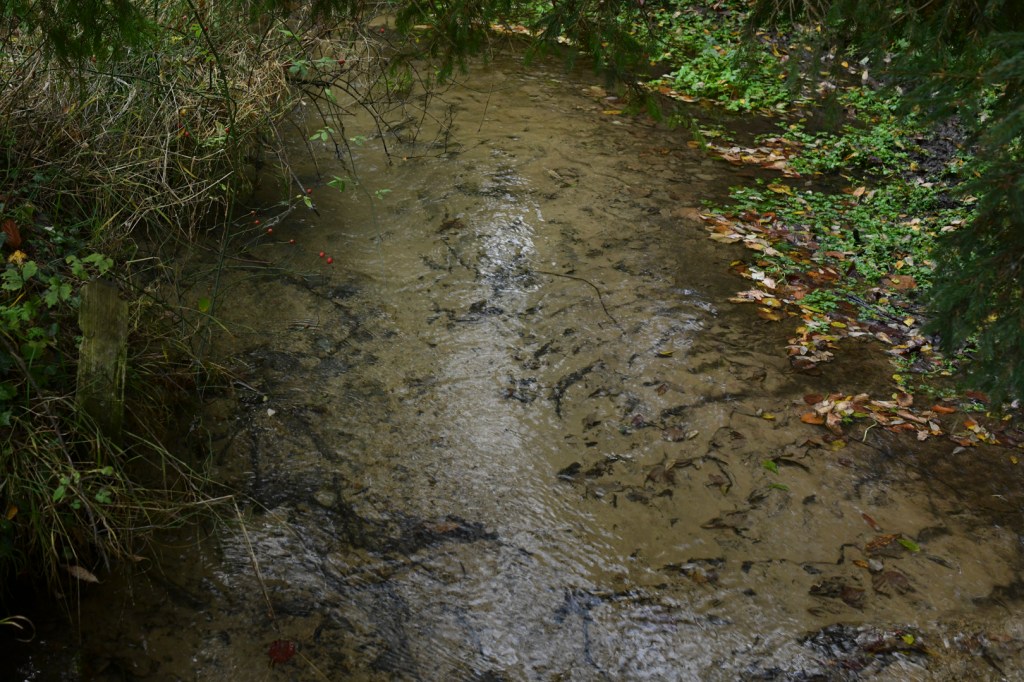
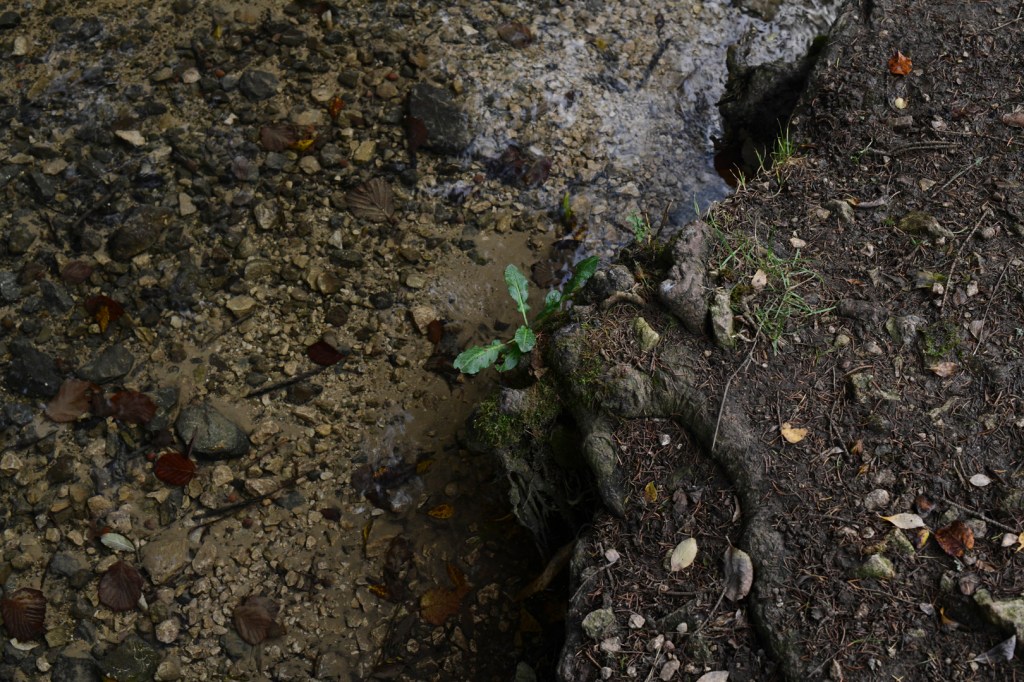
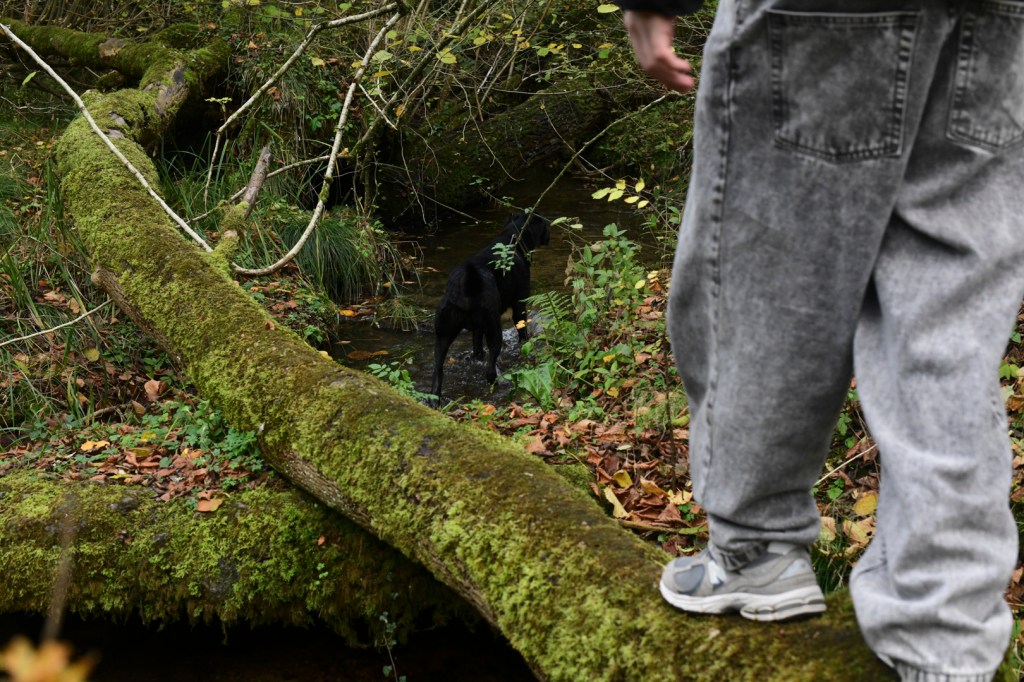
This is the analogue version of the shoot that I did at the end of October – see blog entry Guiting Wood : digital 31.10.25. I revisited to photograph this place as it is of particular importance to me, I detail in the earlier blog post about this.
As I am getting used to being more present with my environment, I spent some time walking though this area of landscape, initially with my running group, who after a while set off in another direction to allow me to focus on my space. I walked slowly, looking all around me, bending down to look underneath objects, letting my hand hang in the water for a short while (its very cold!) and looking up at the tree canopy to see what hides there.
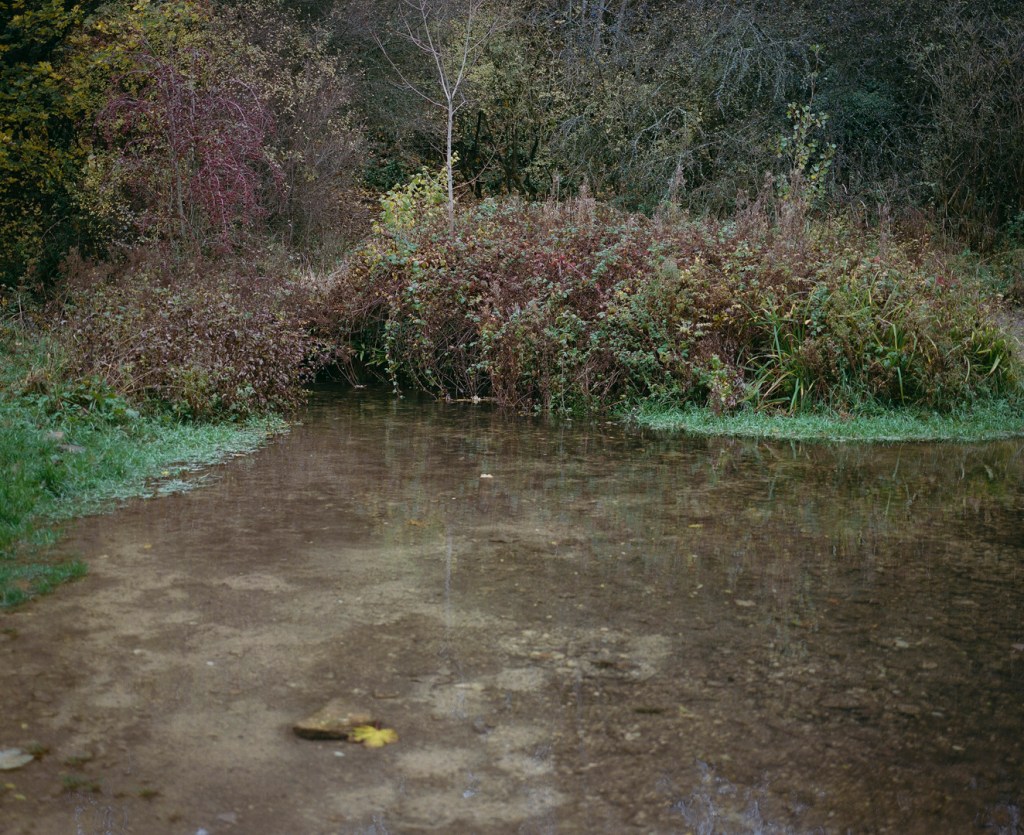
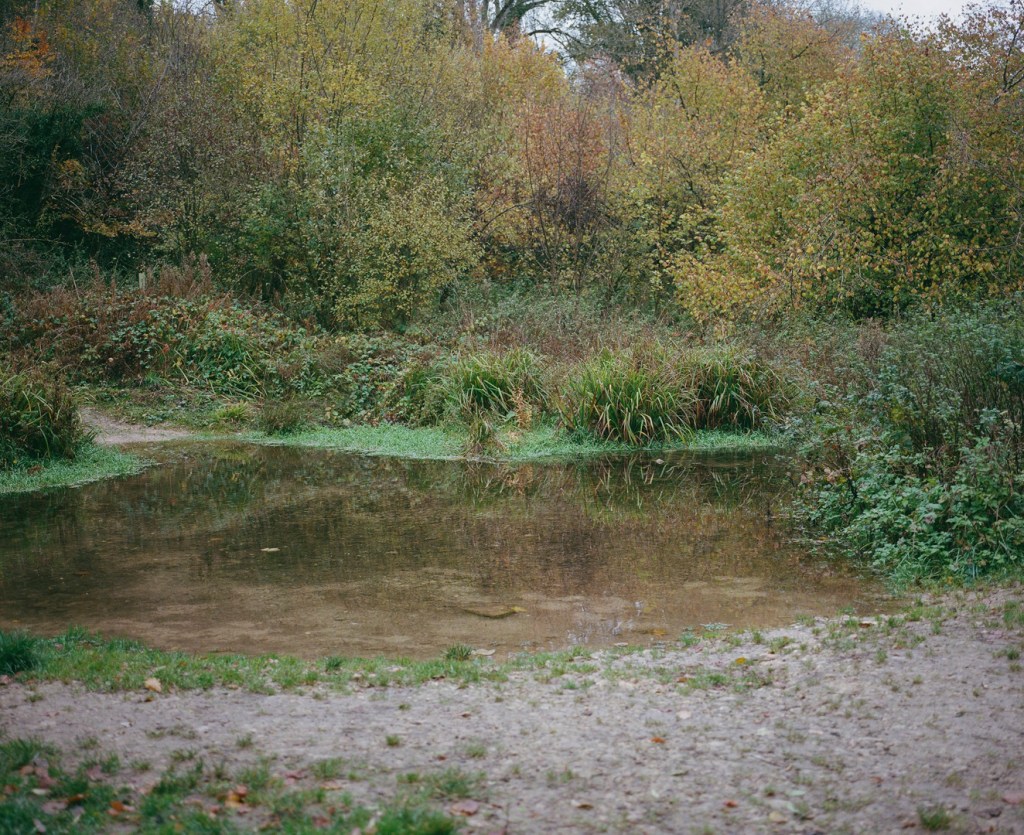
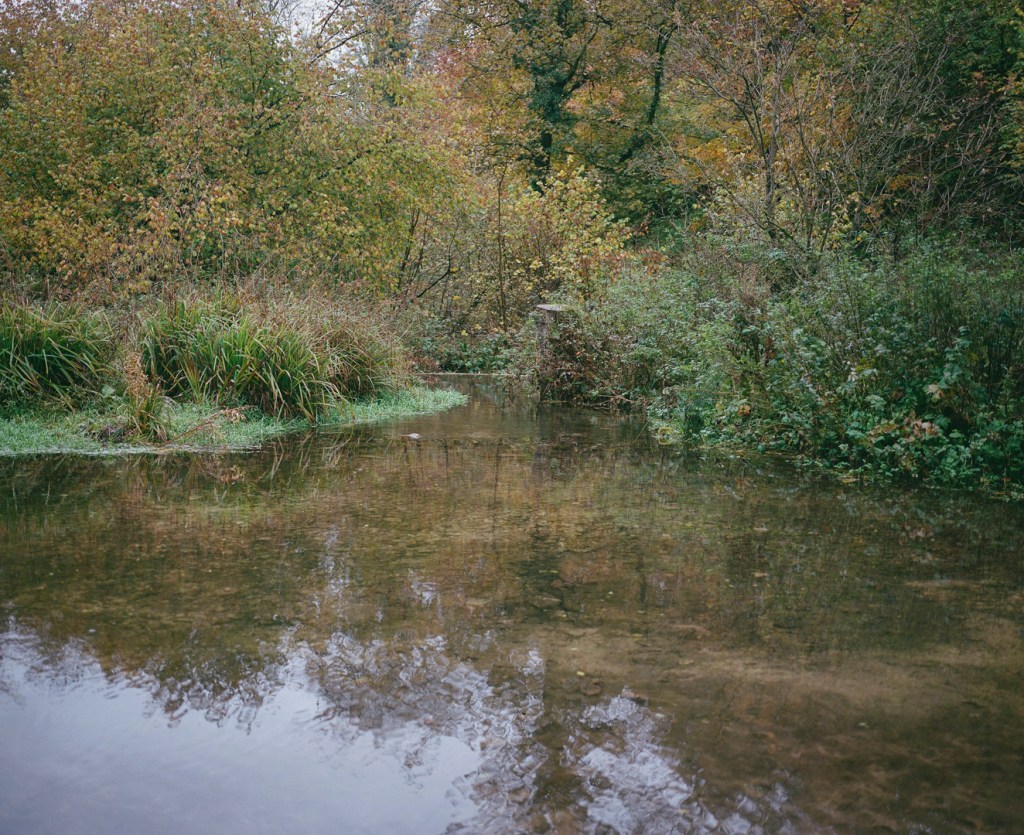
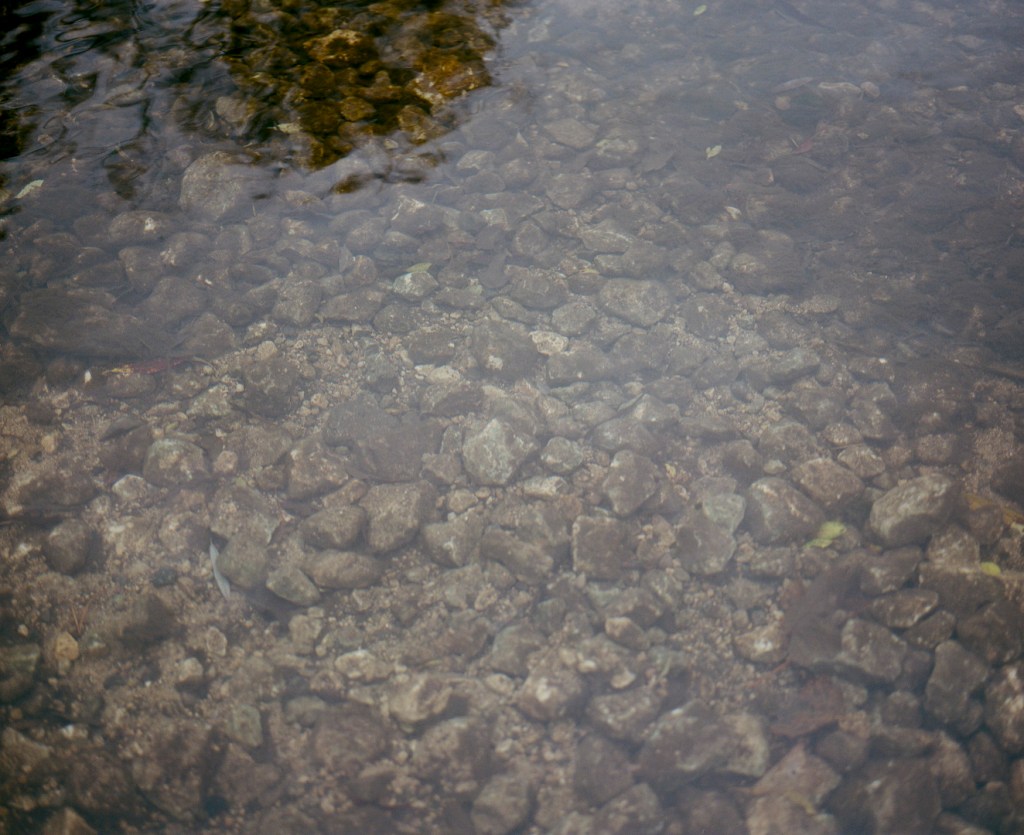
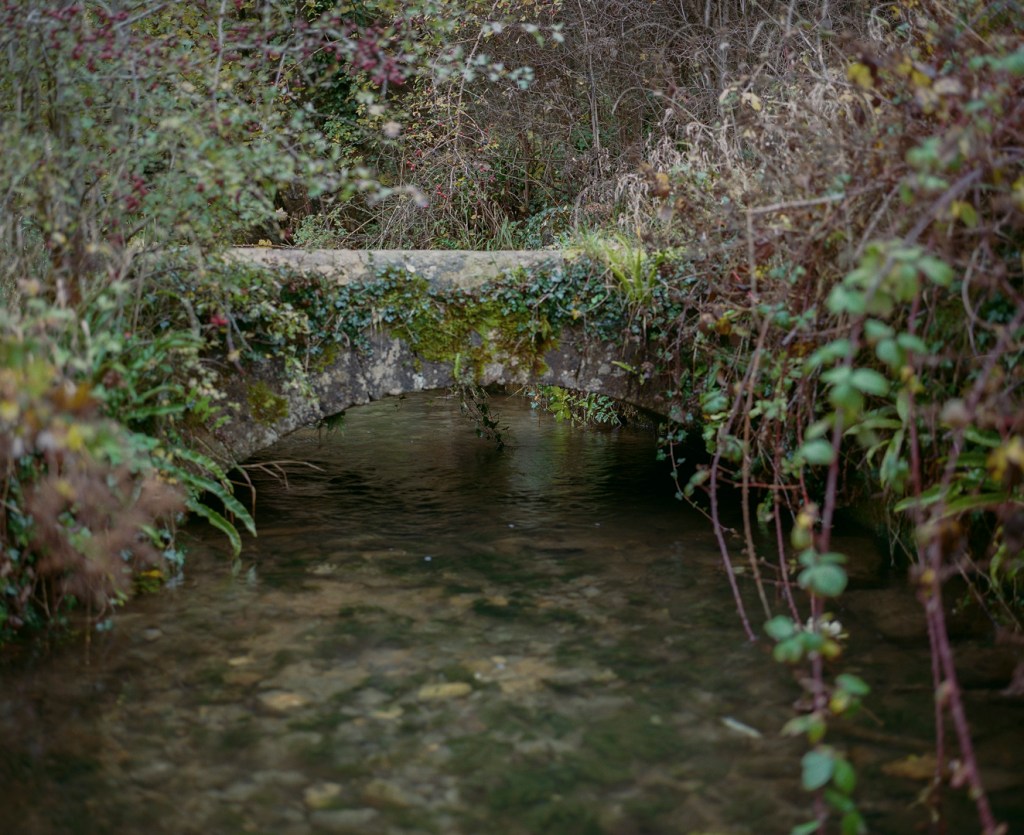
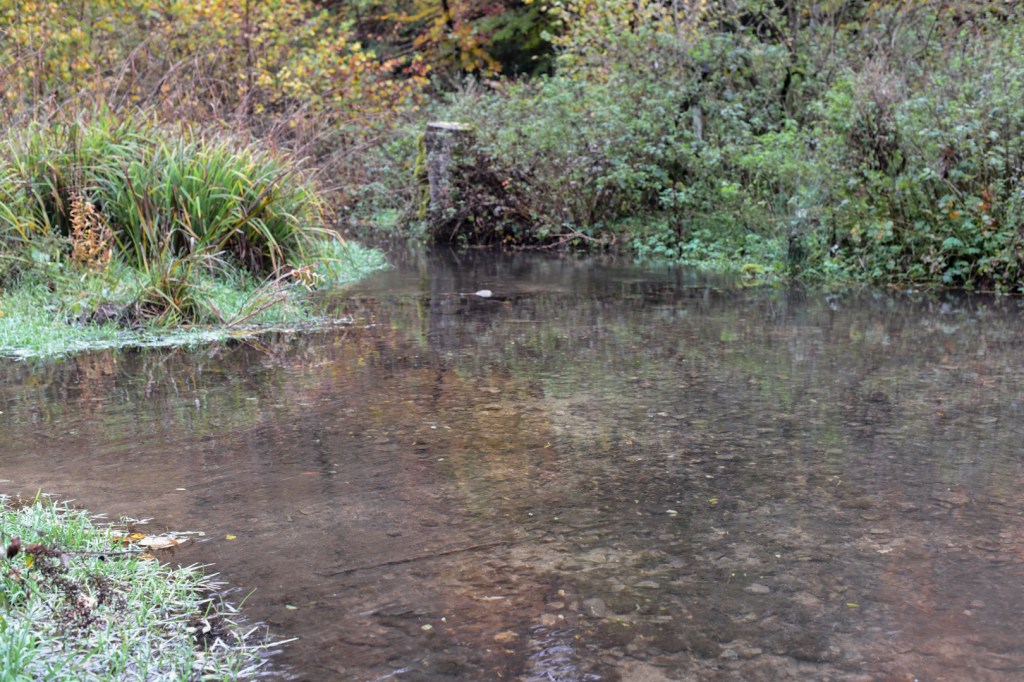
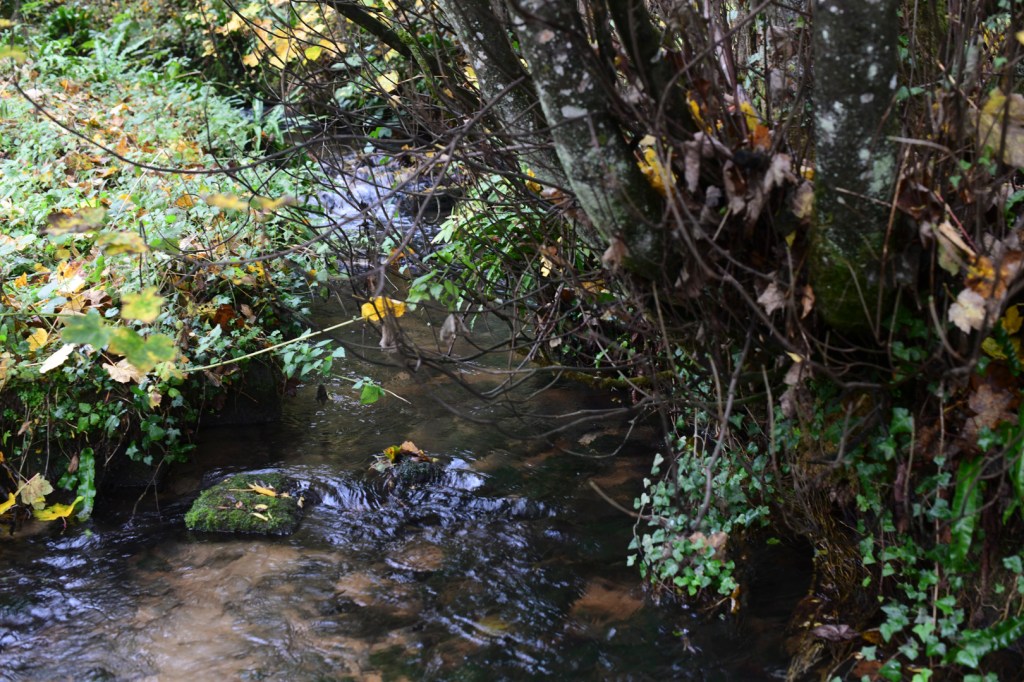
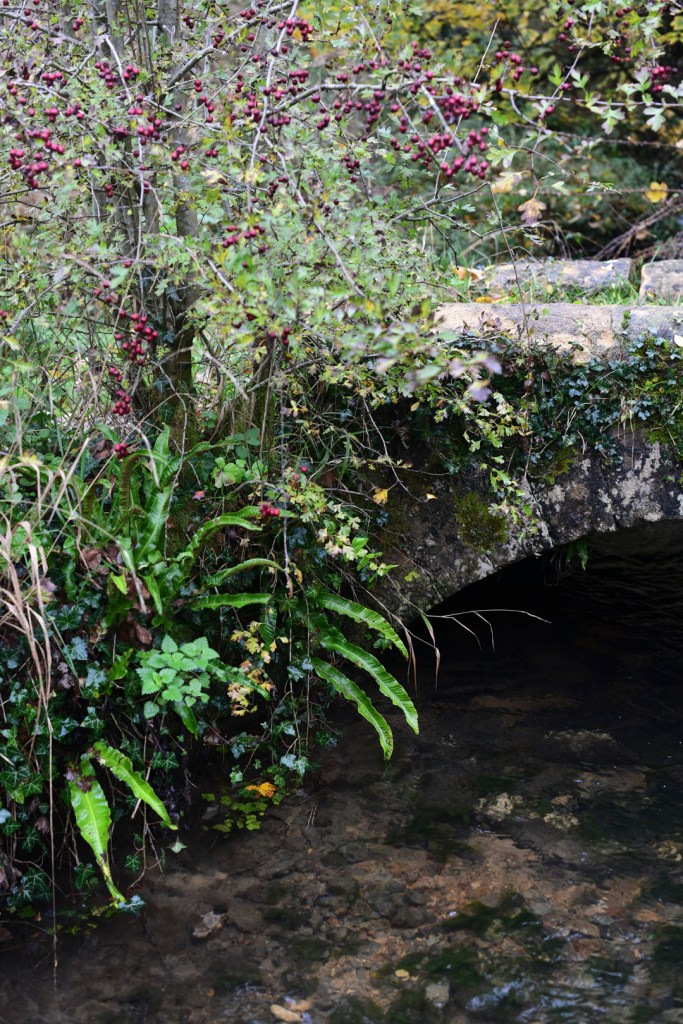
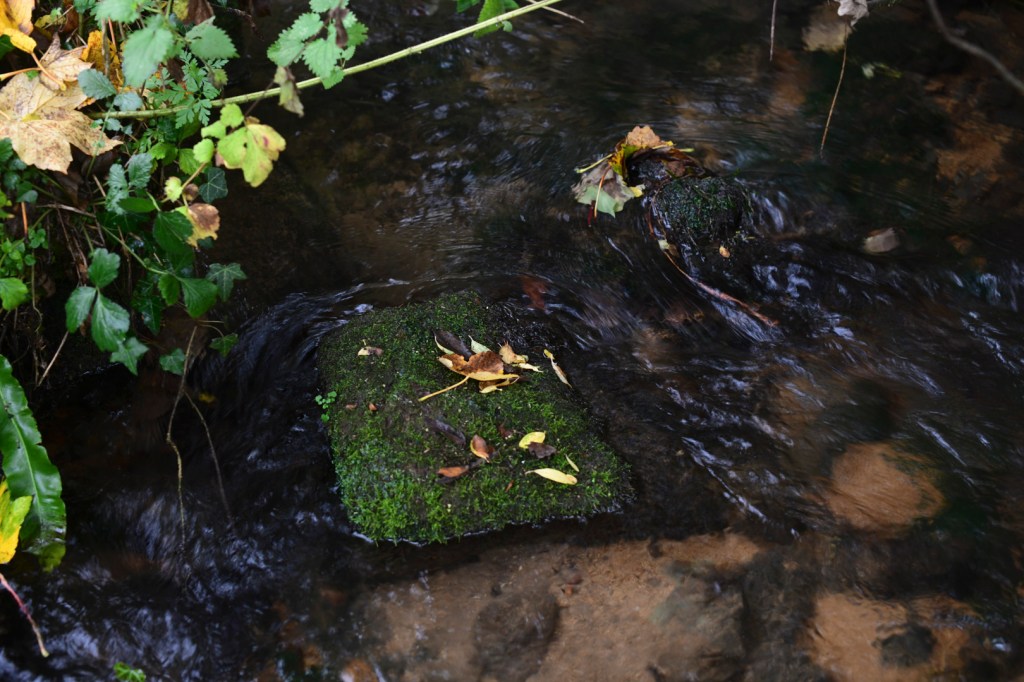
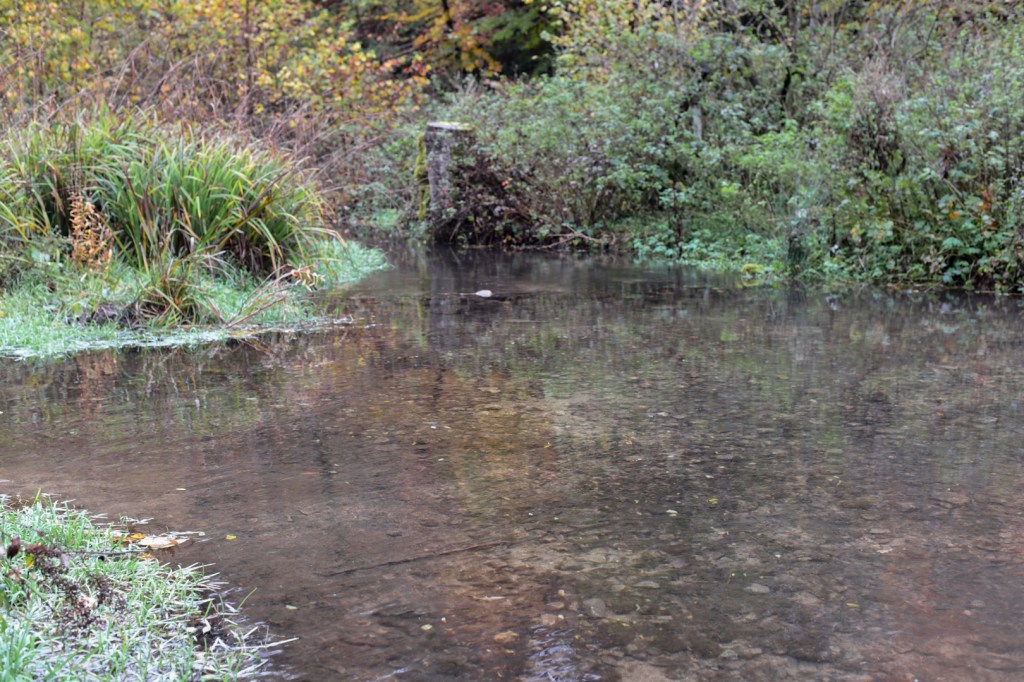
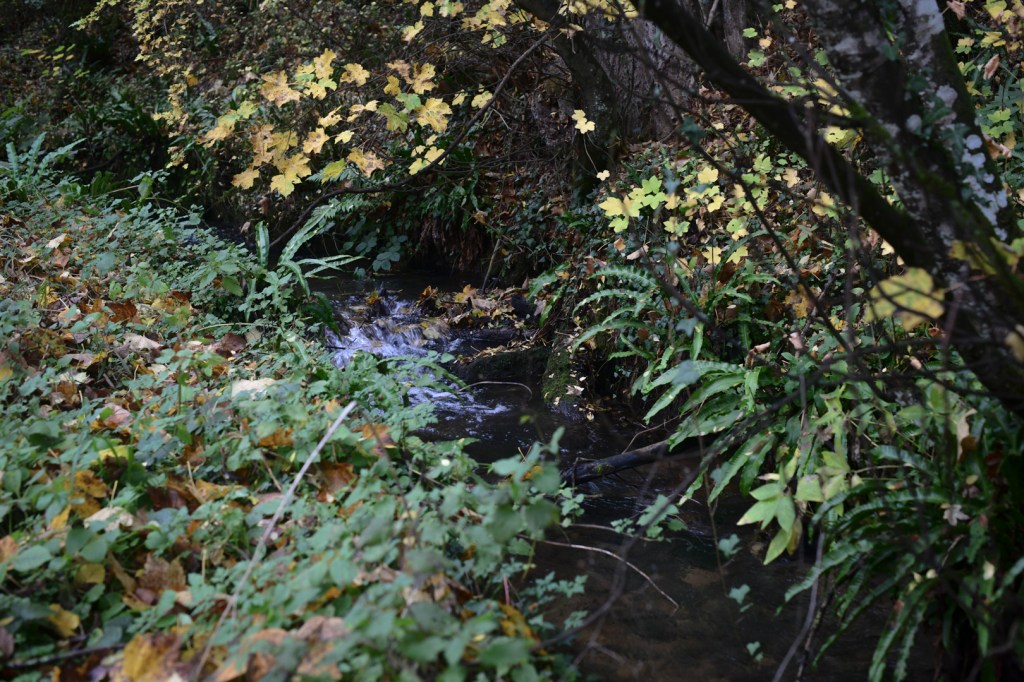
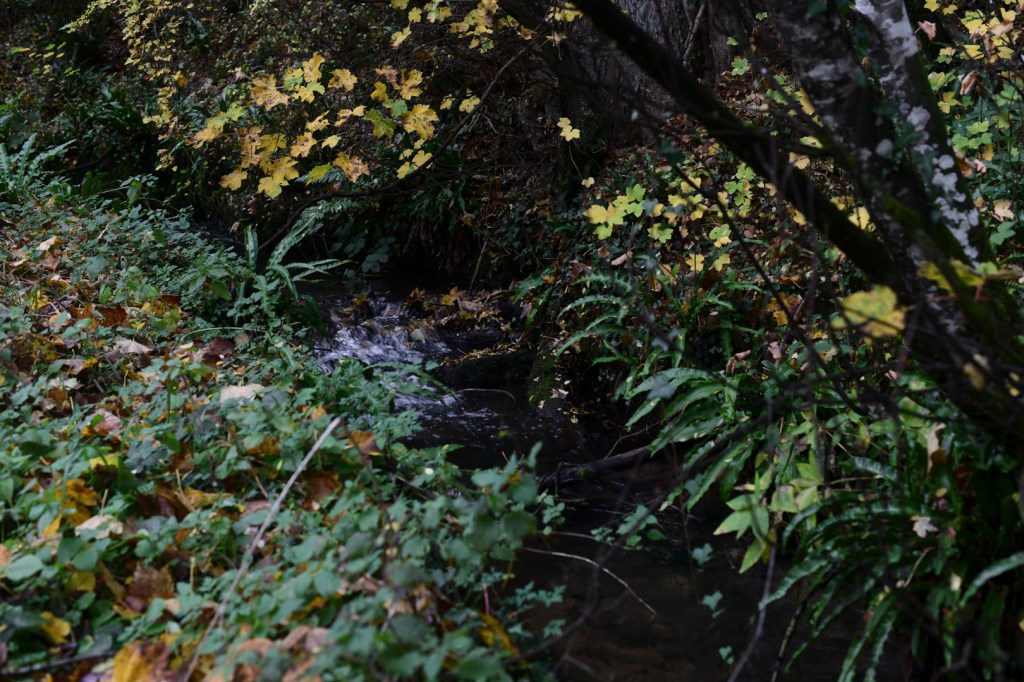
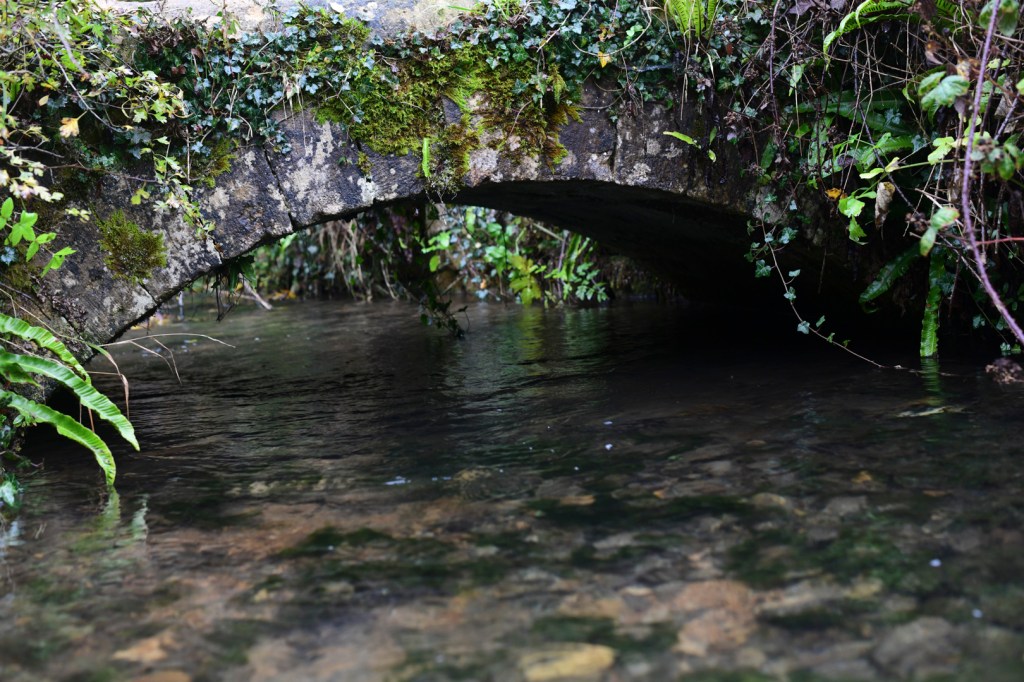
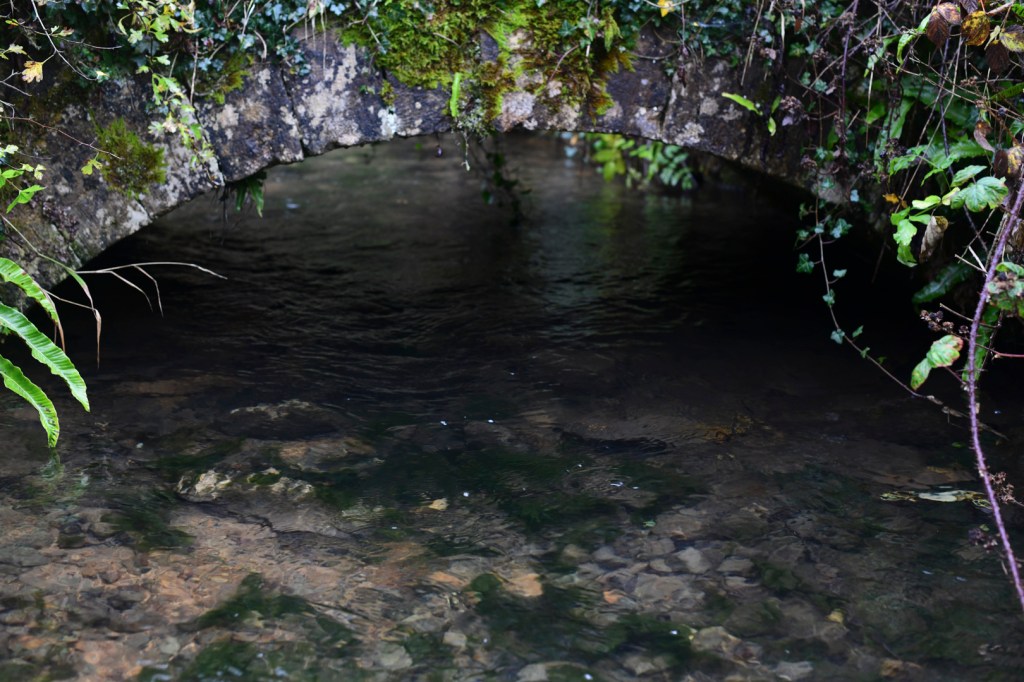
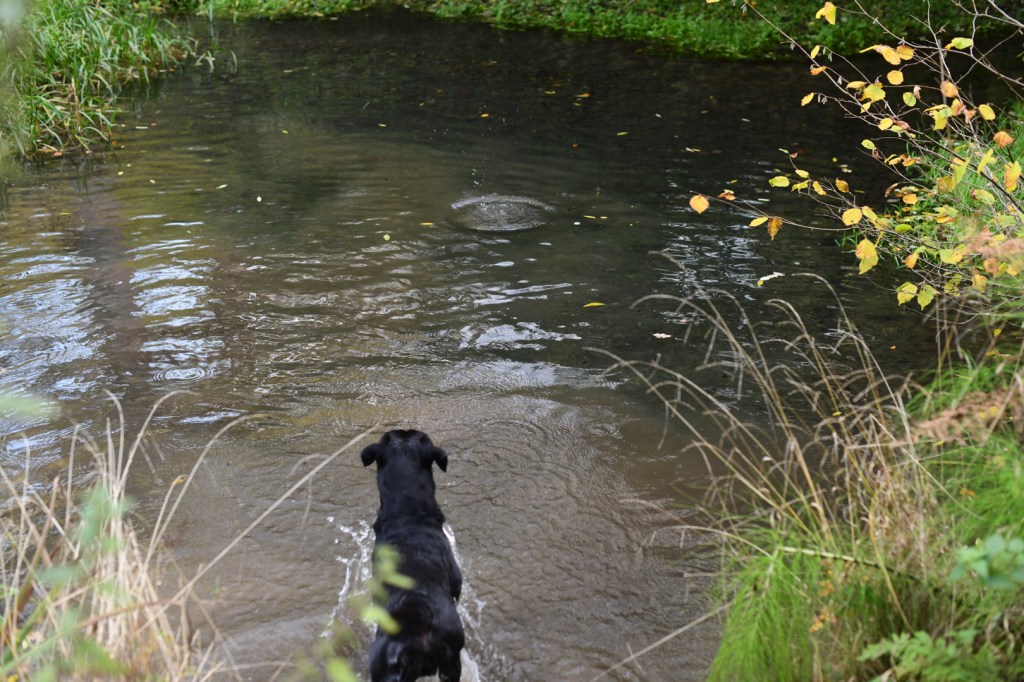
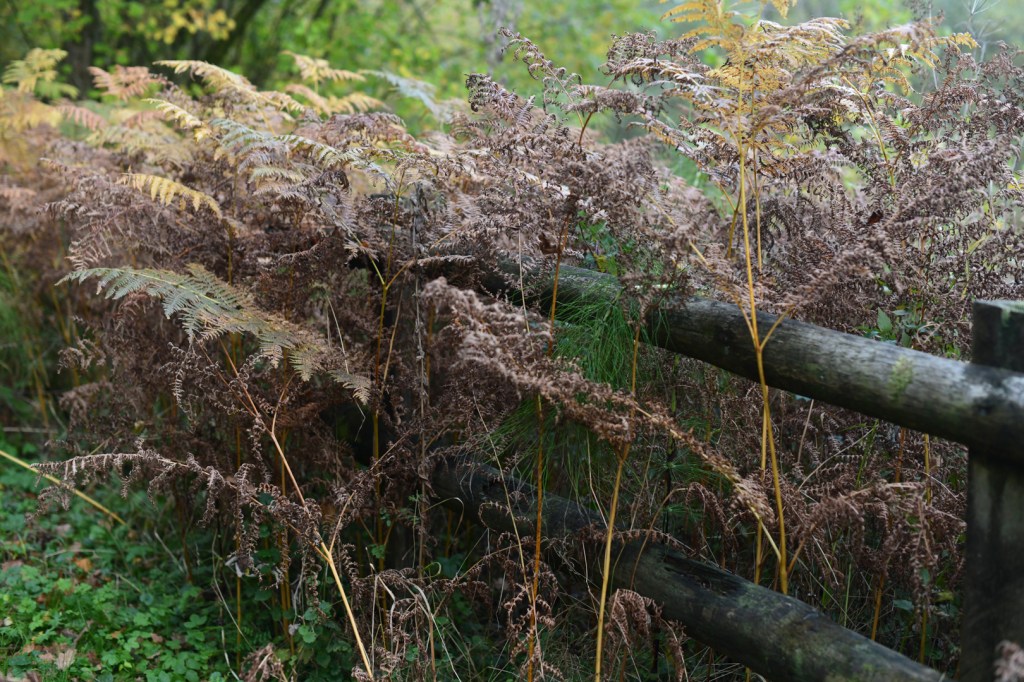
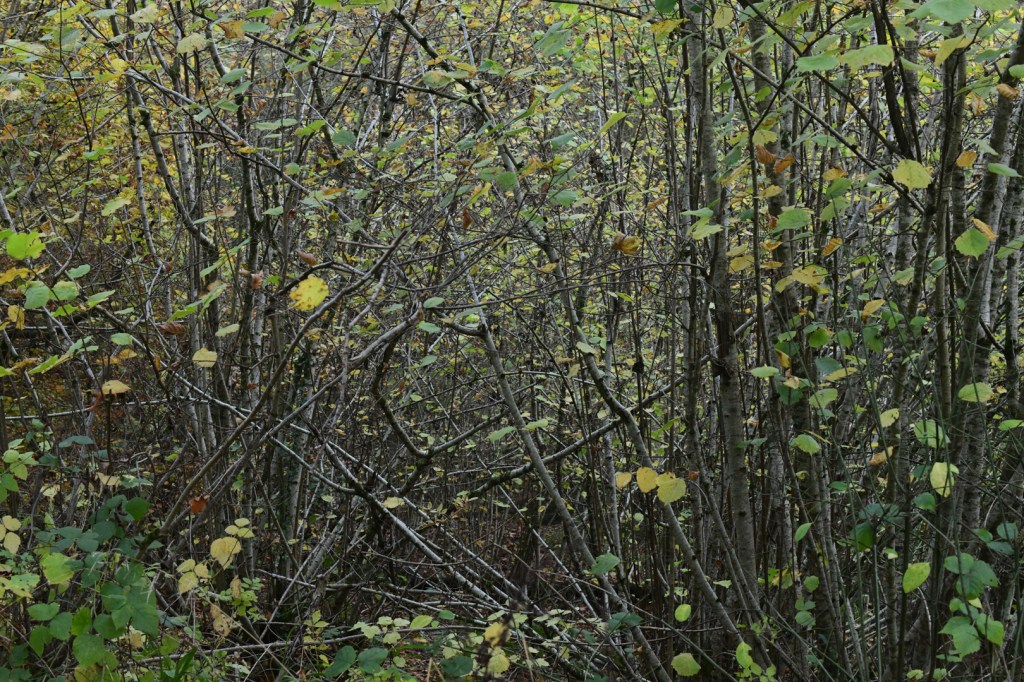
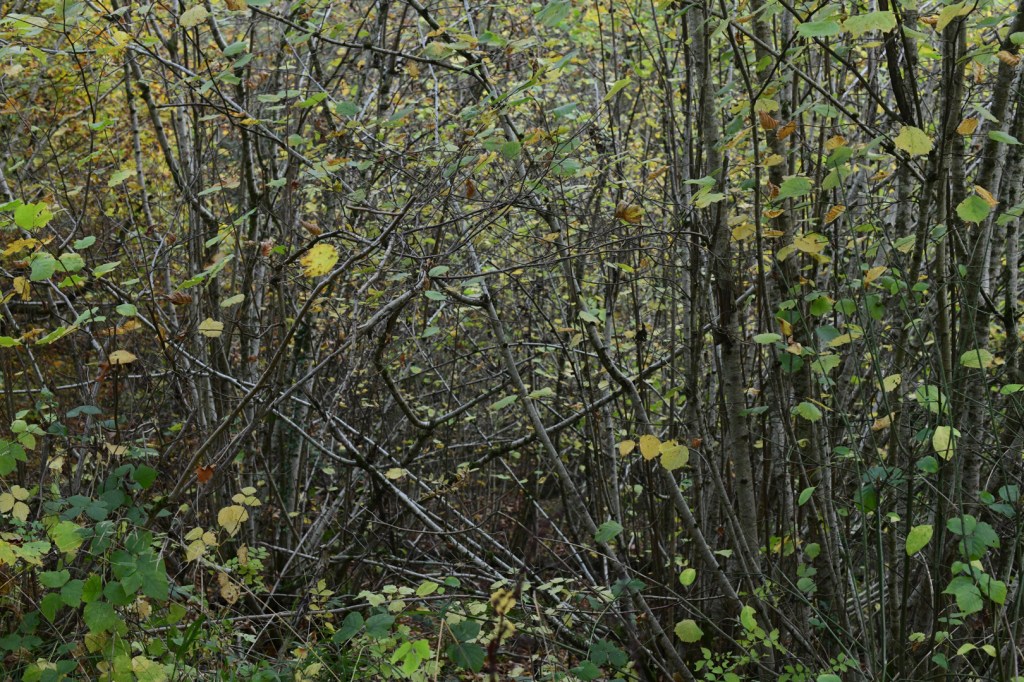
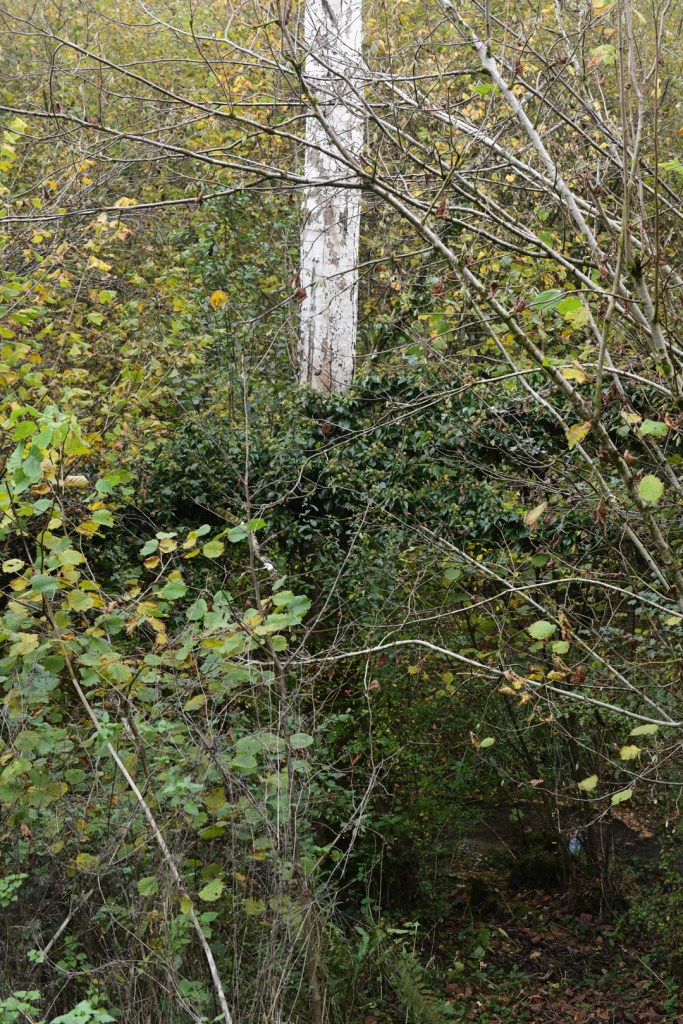
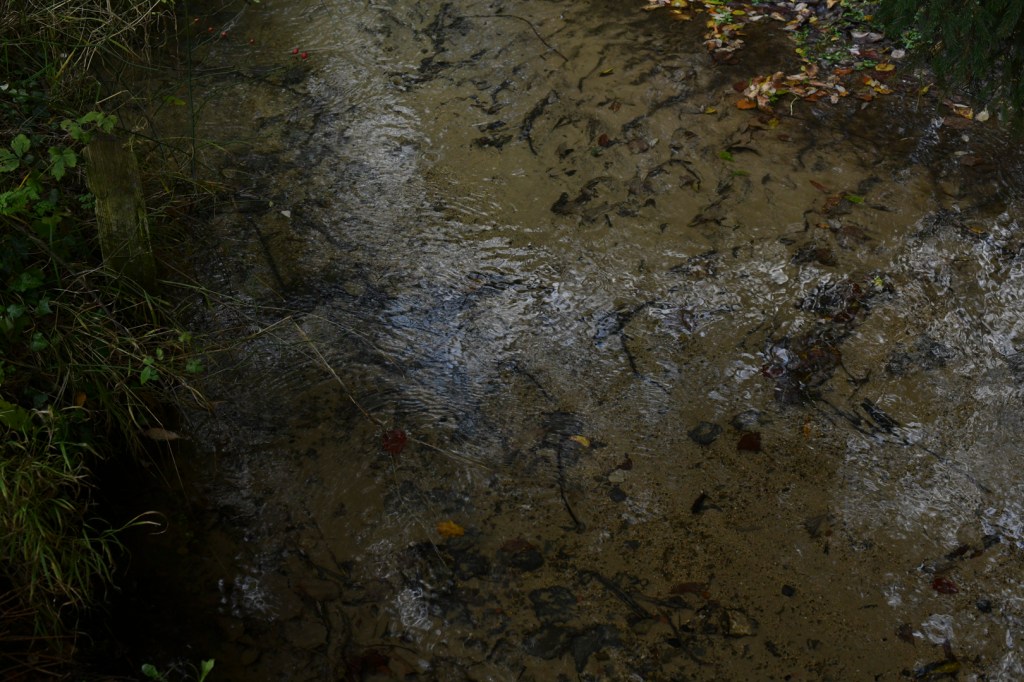
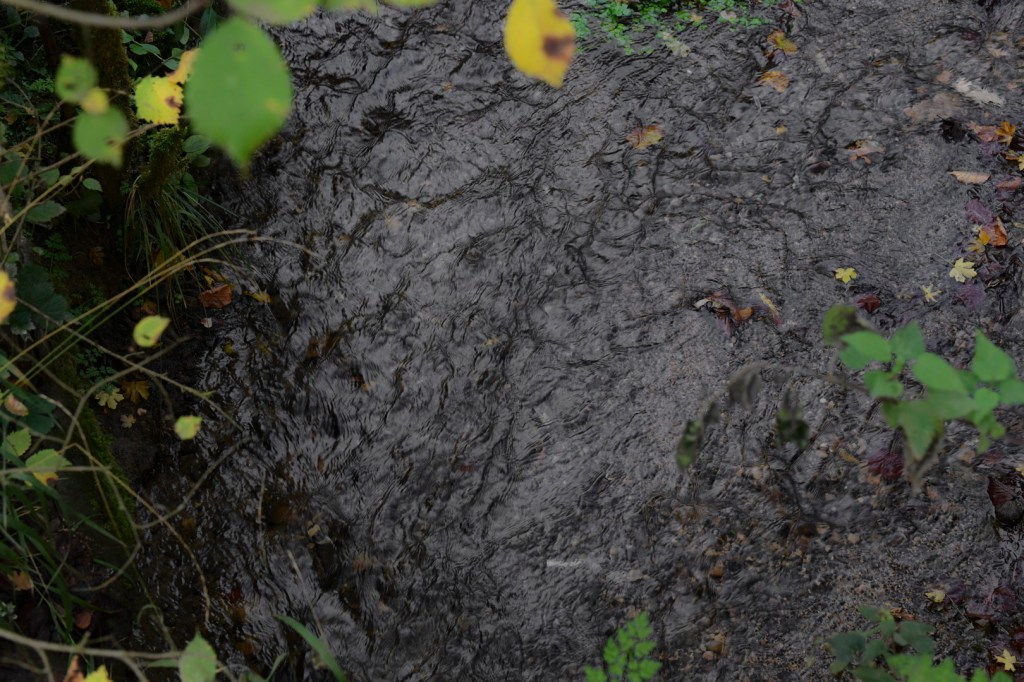
Once I started to shoot, I felt fully present in the place. Nothing else distracting me, I set my camera on a tripod and placed it in the water of the pond. All the of the images are taken from within a few metres of this same spot, I only moved the tripod a few metres for each shot and let it sit in place for a while whilst I just watched and listened. There are no roads or built up areas close by so I could only hear the water, reminding me of Nan Shepherds description of water in her book The Living Mountain (see my blog bost: Women and the embodied landscape) and the birds calling above.
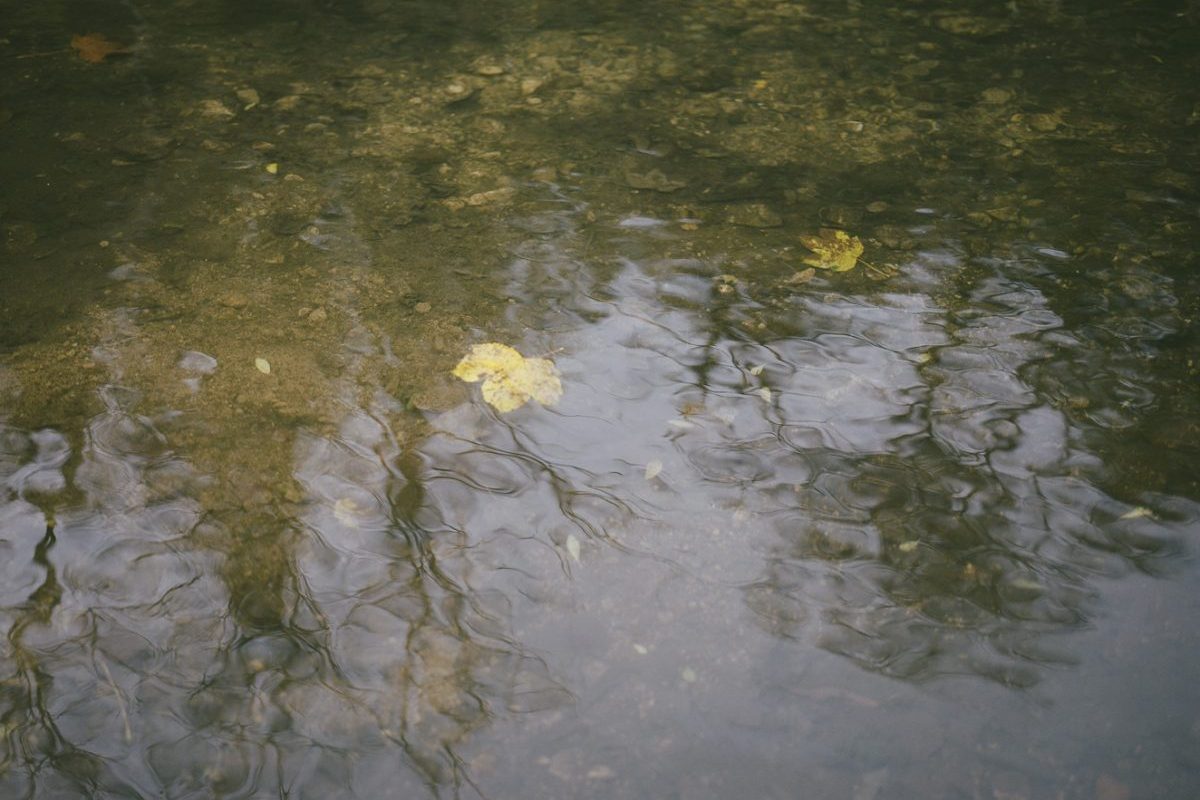
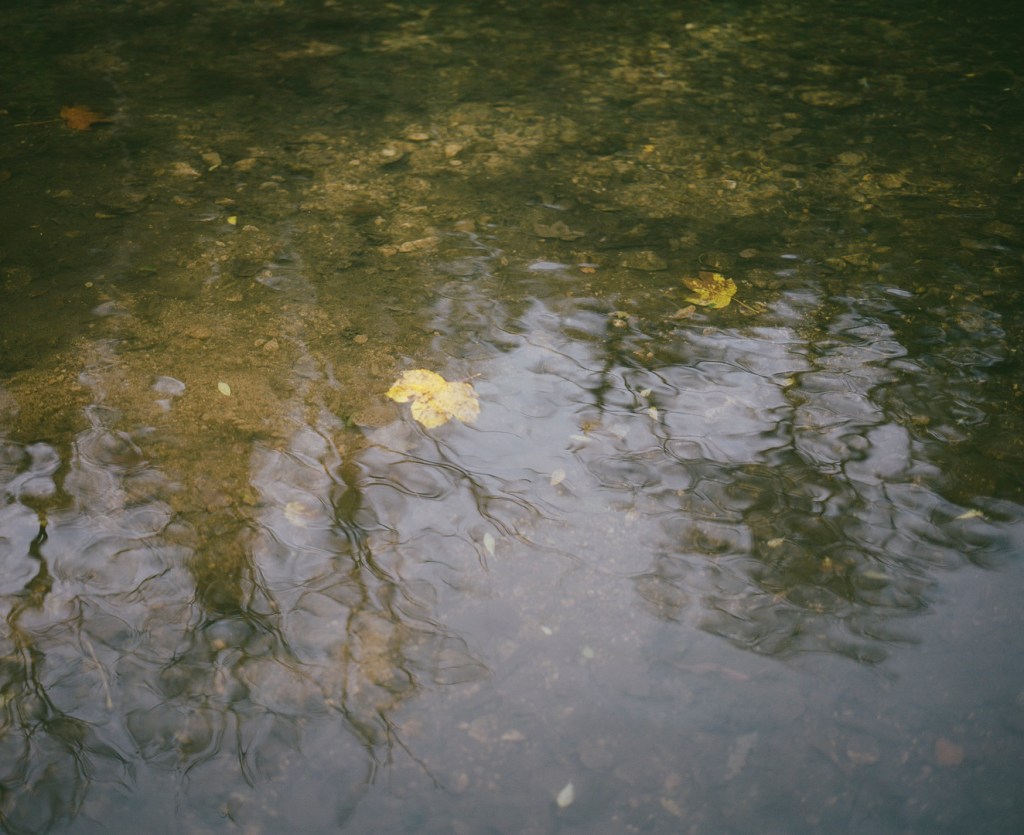
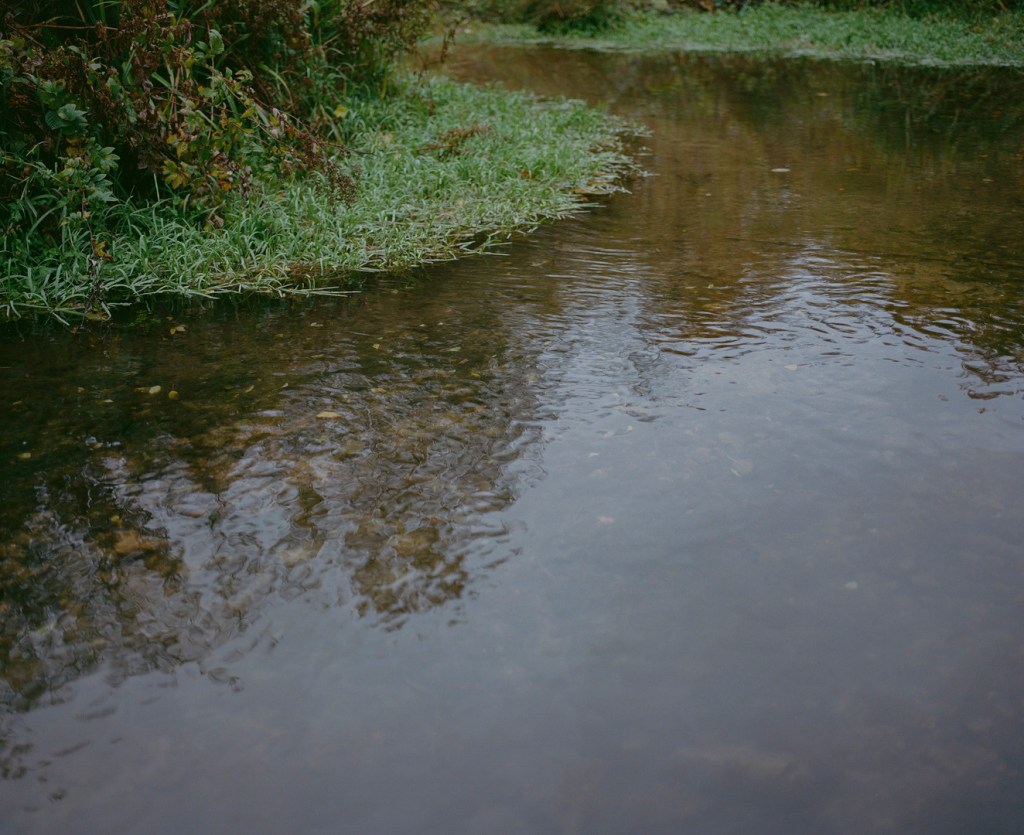
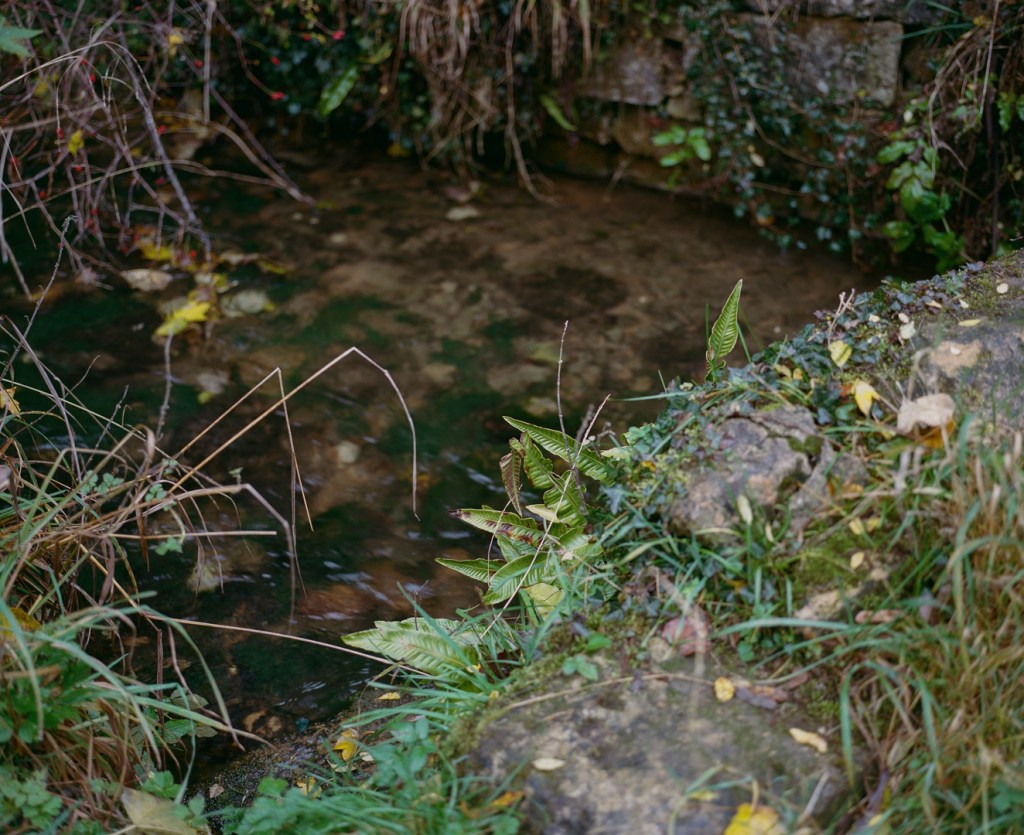
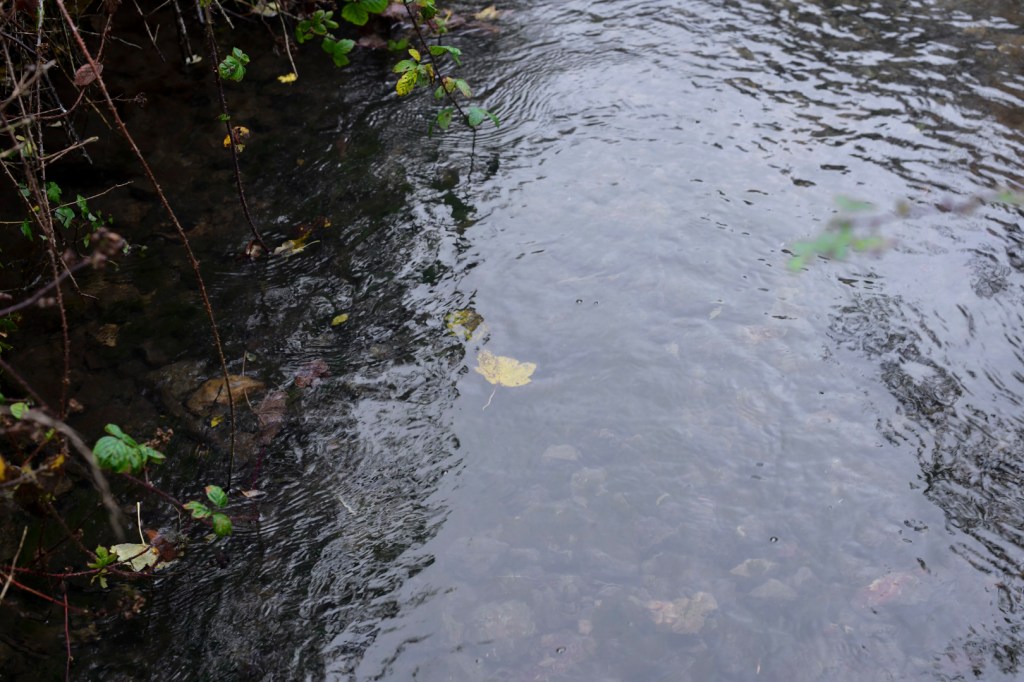
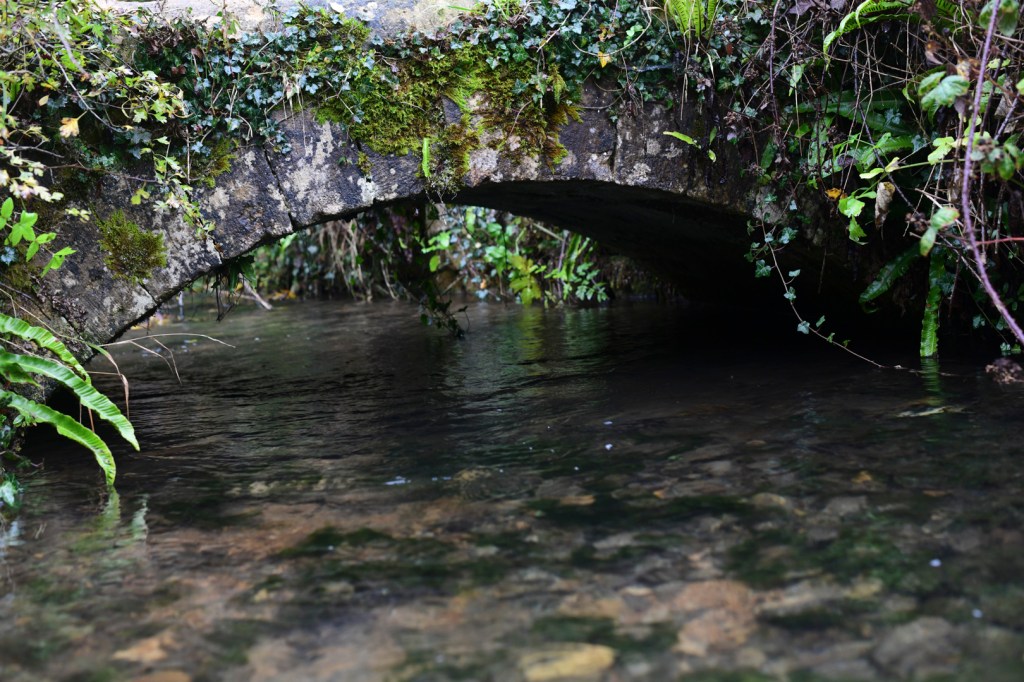
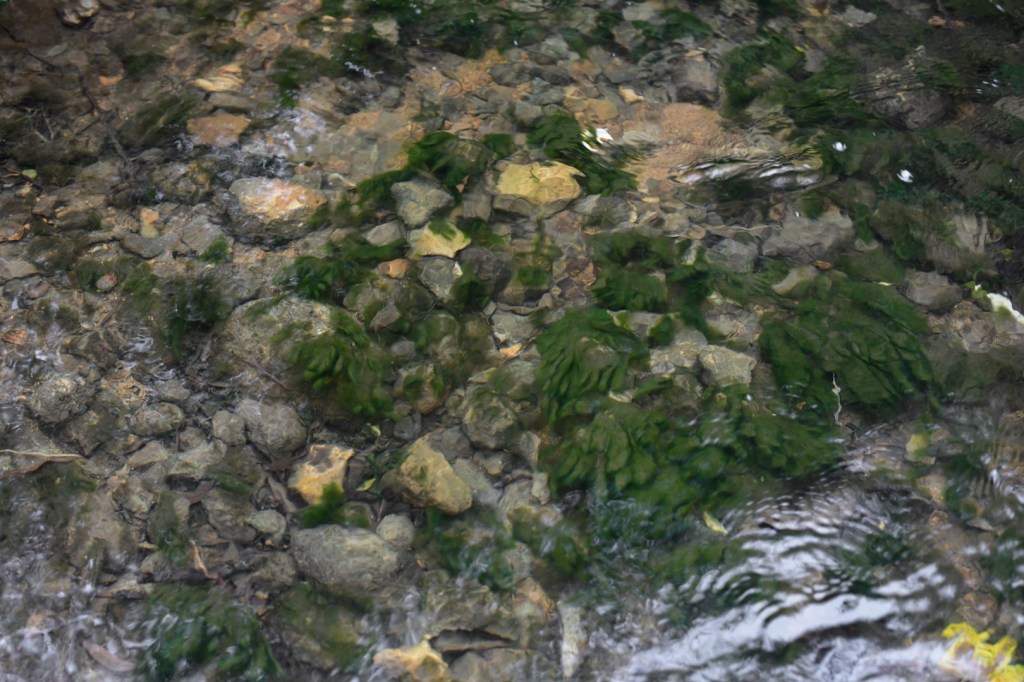
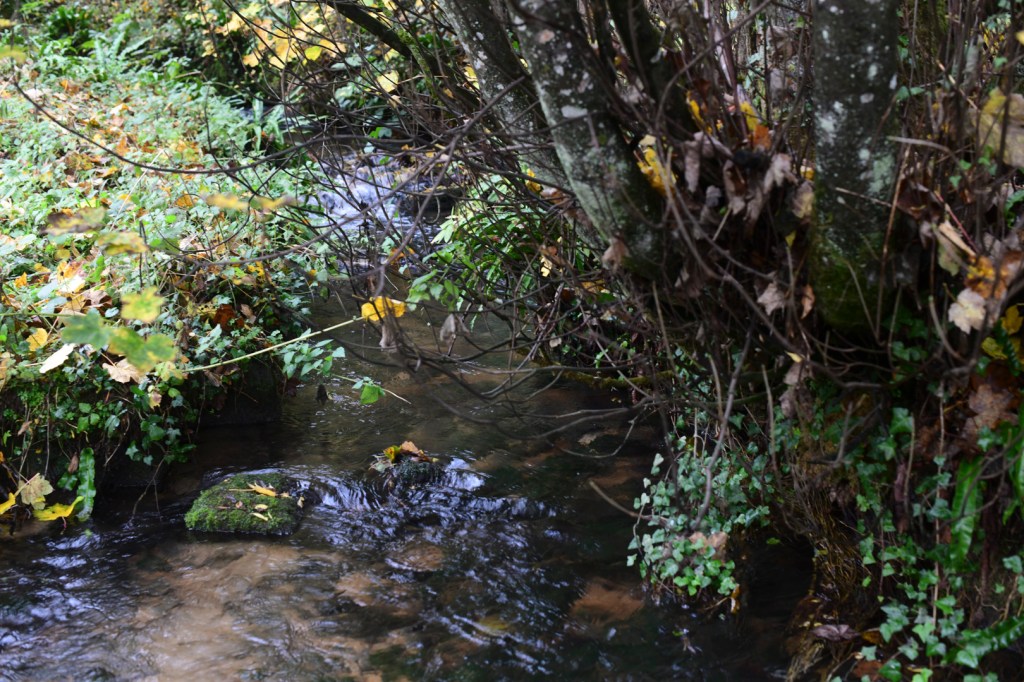
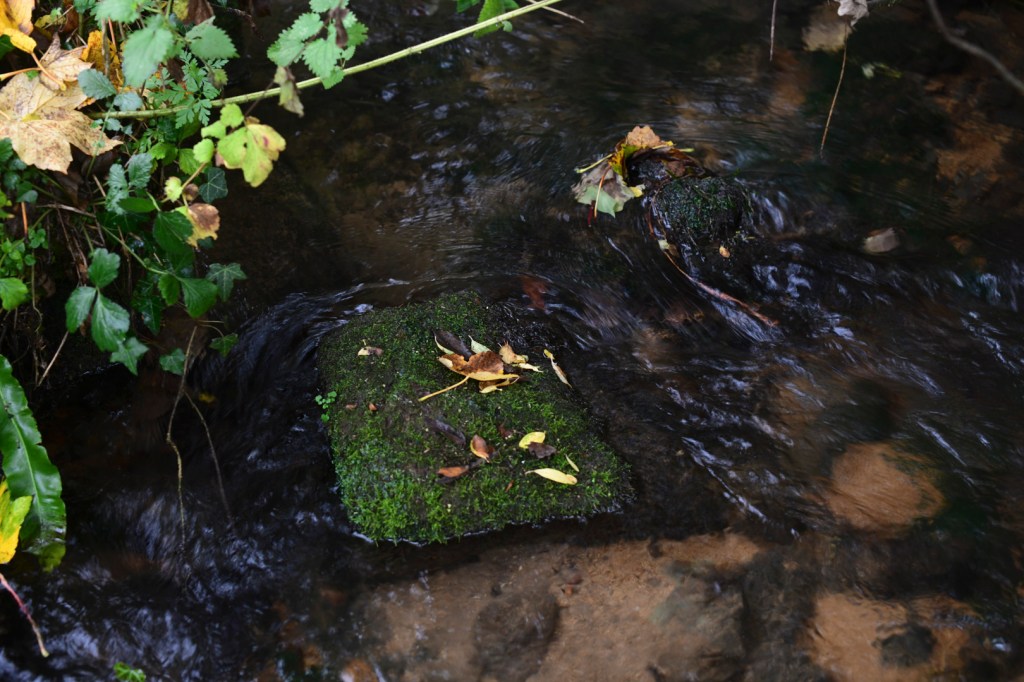
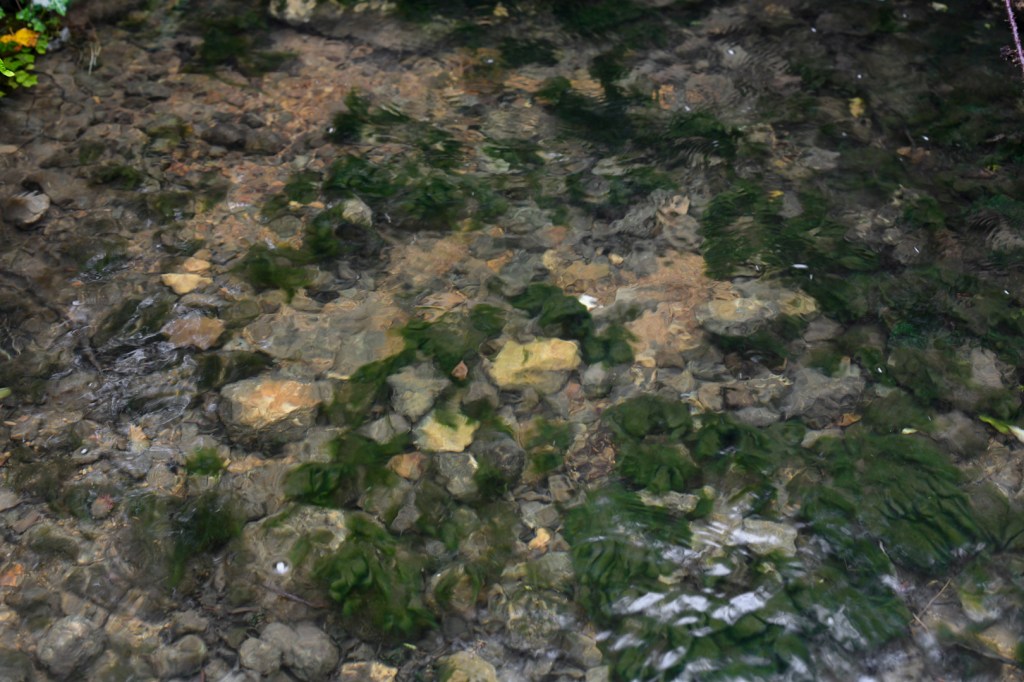
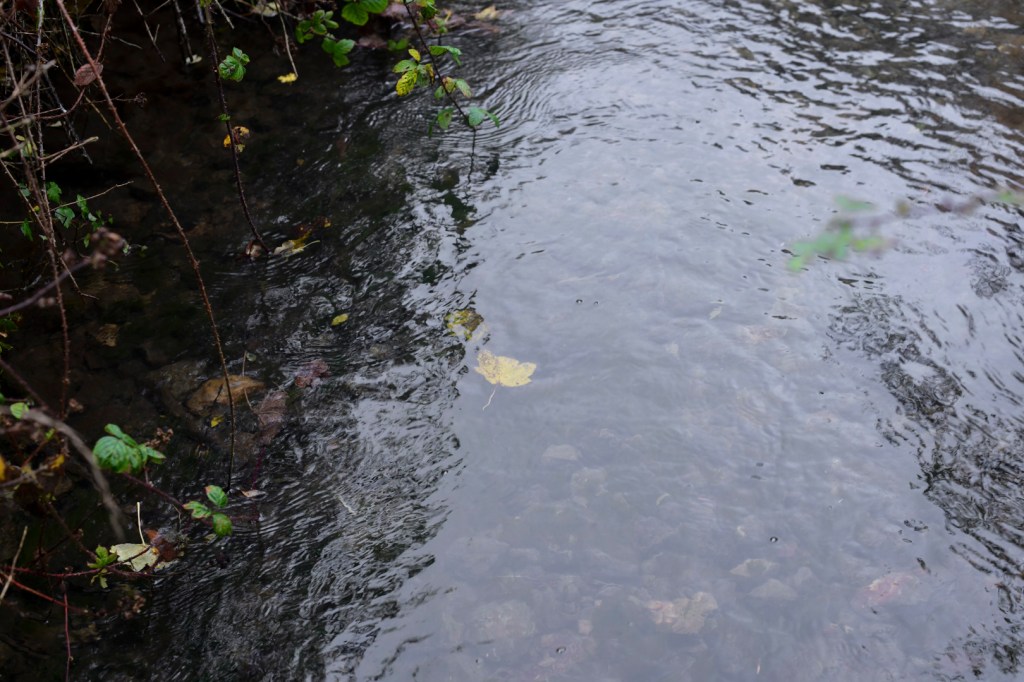
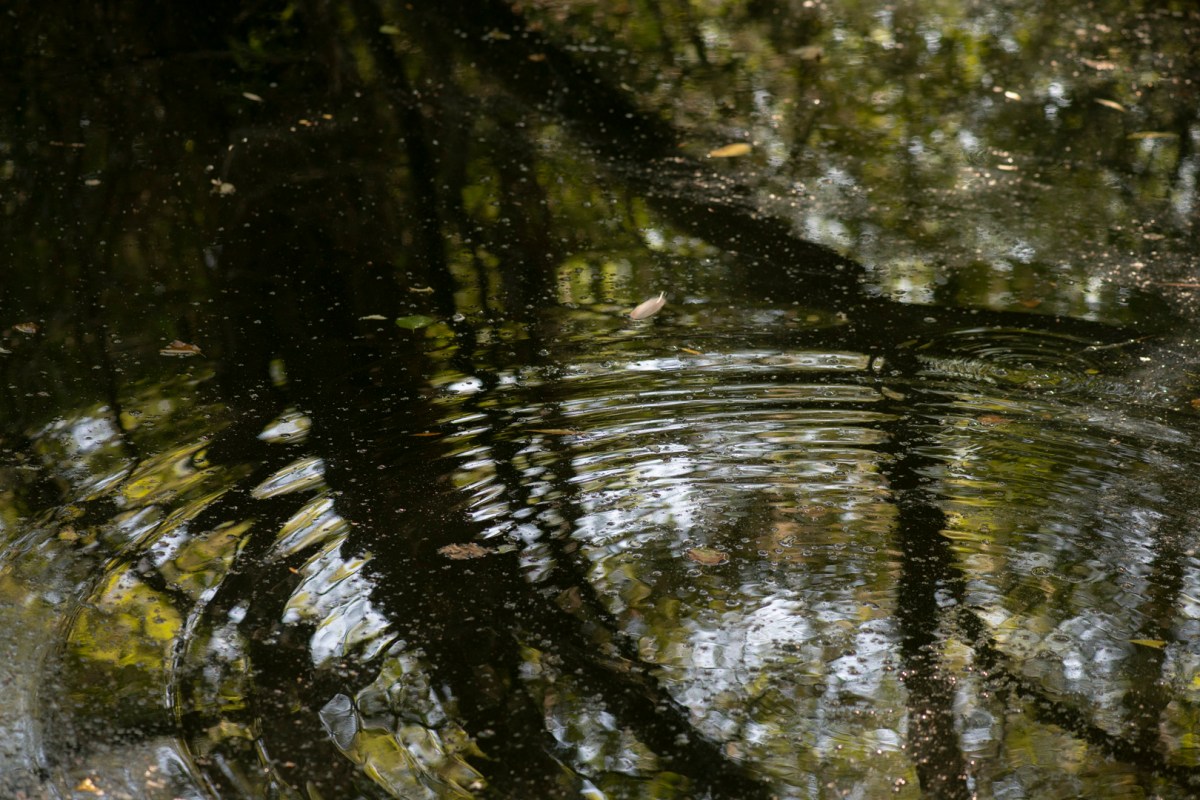
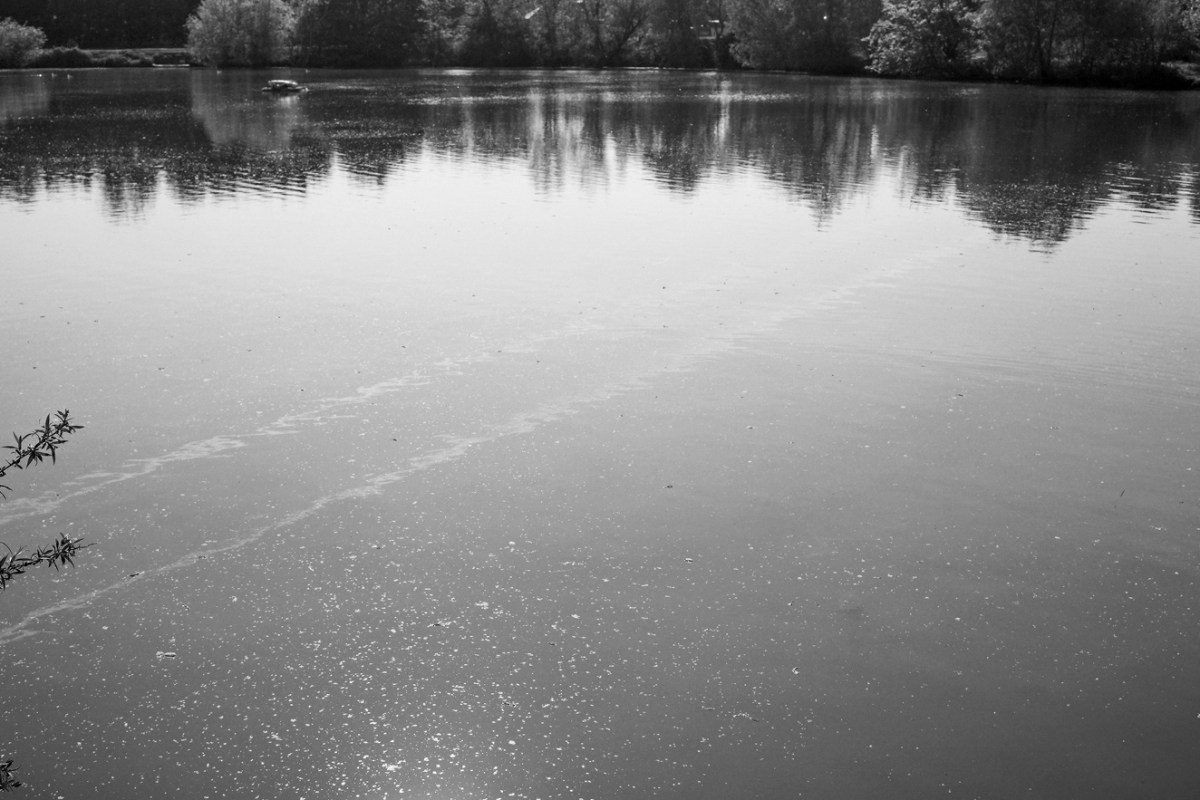
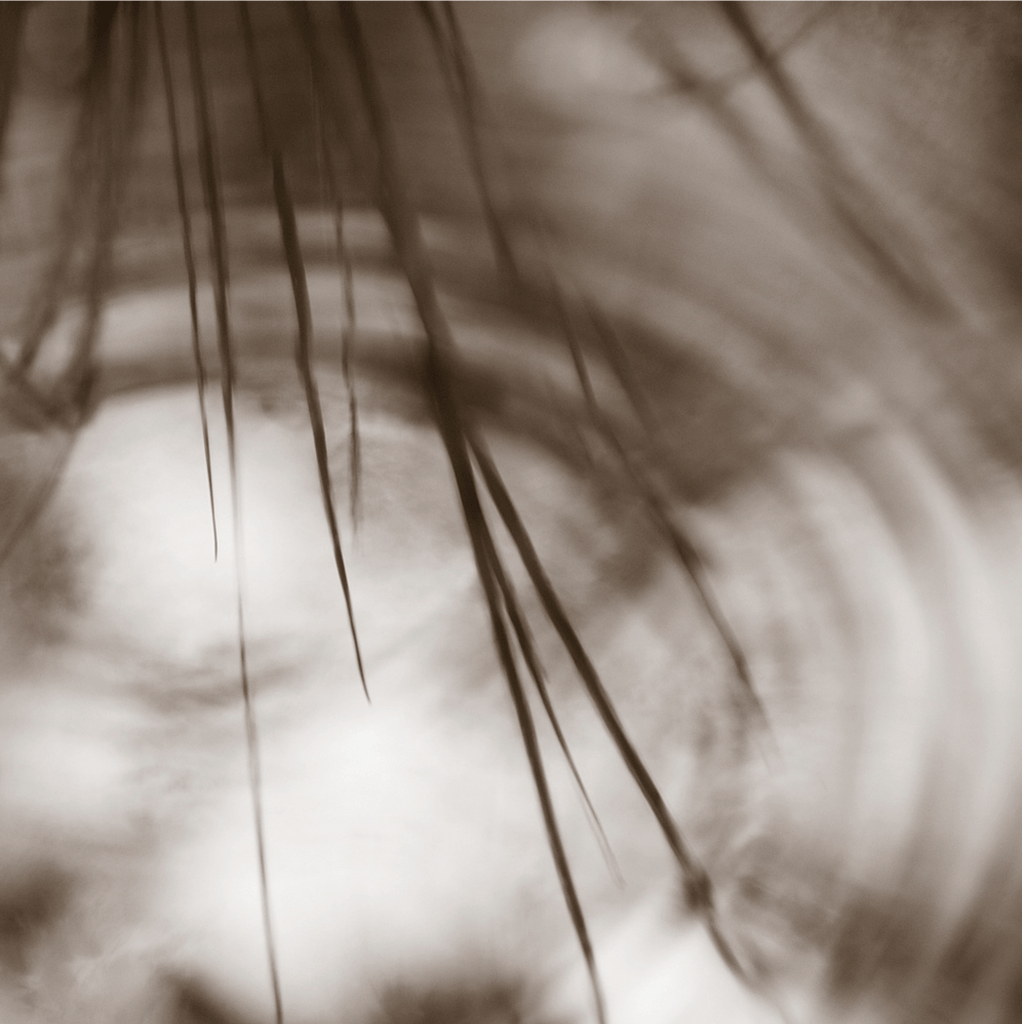
Once I had the film developed I felt the images weren’t as strong as I had hoped, albeit an honest gallery of a mindful experience. However, I am very drawn to the close images of the water itself, especially the one with the leaf because you can see the reflection of the trees above which serves to emphasise the ripples in the waters surface. This reminds me a little of Van Goughs ‘Starry Starry Night’ painting with its distinctive shape of the cypress tree and the swirly patterns in the skyscape.
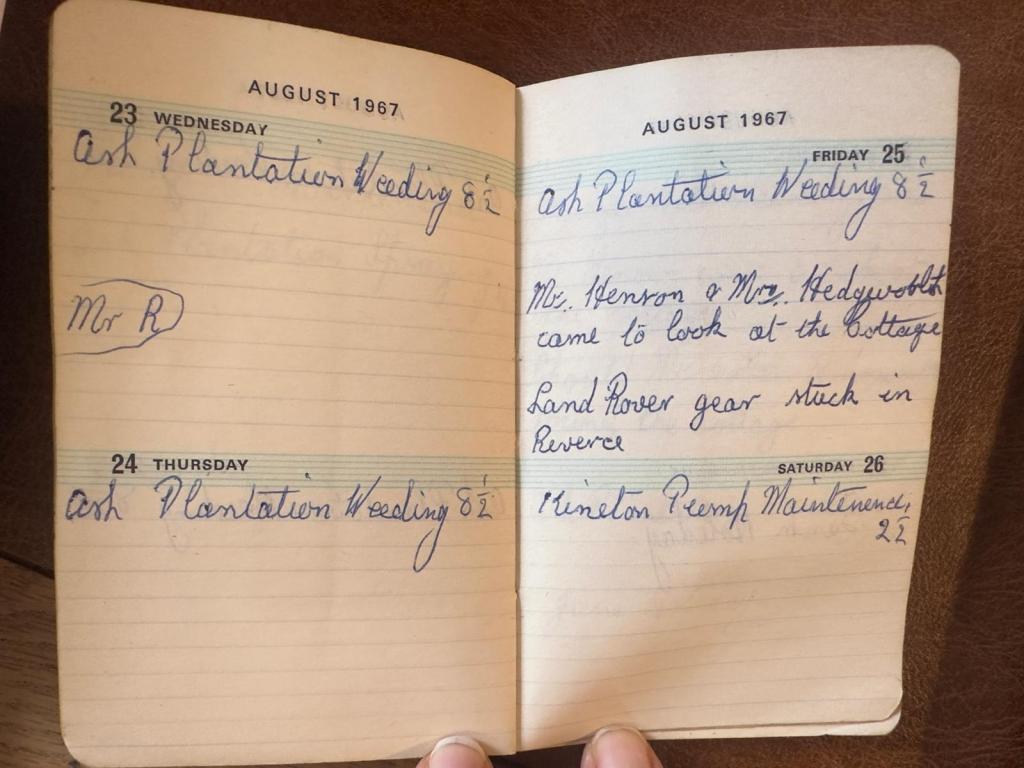
This area of Guiting Wood is of particular importance for me. This is a place, tucked away at the Southern end of the woods, where the stream comes from underground and opens up into a small pool. The water here is always freezing cold as it makes its way from under the ground and its always crystal clear. My grandfather was responsible for looking after the water pumping station, situation about three quarters of a mile away. I always think of him when I am here, wondering if we’d be looking at the same view. Here is an excerpt from his diary, which details this along with his other duties that week. I love his writing and the details of his hours spent working locally. I chuckled at the landrover note, it seemed so matter of fact, as though this was an unsurprising occurrence!
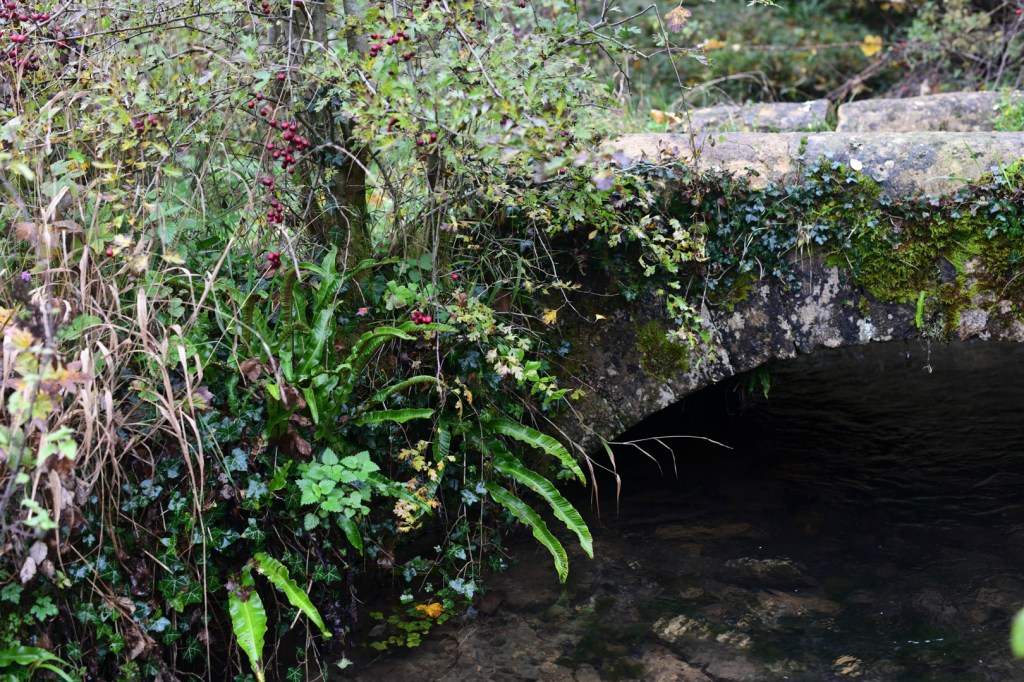
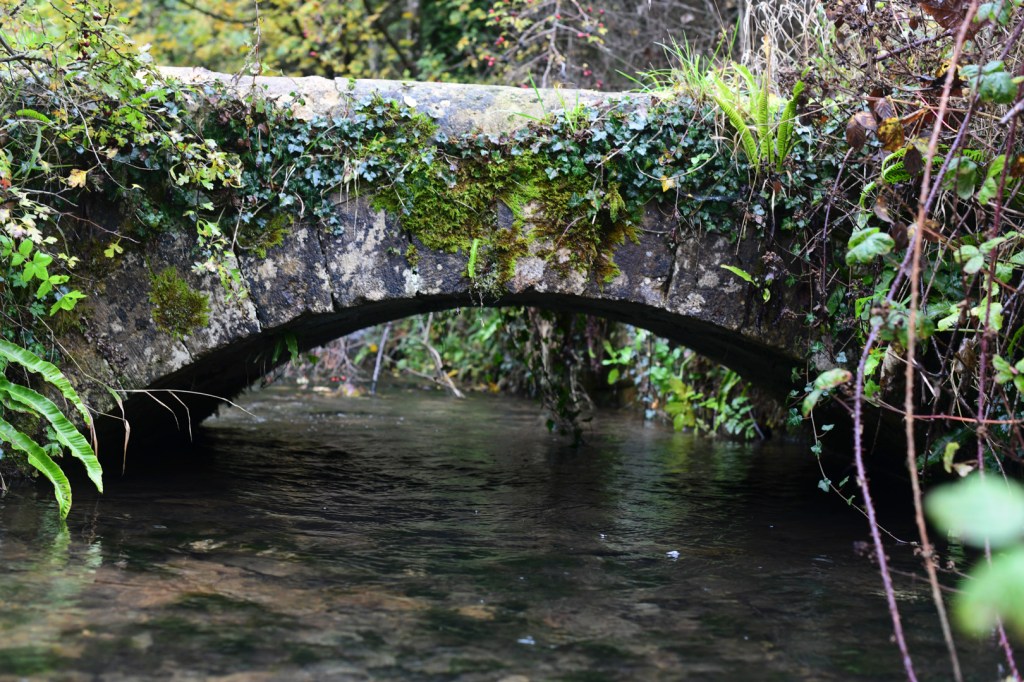
I spent some time here, just alone with my thoughts and thought about my family. As my mind settled, I thought about the bridge that we used to sit on, skimming stones throwing sticks and leaves, seeing who’s would win the race. I thought above how my cousin and I collected creatures into buckets or pre-prepared jars and studied them for a while. I am reminded of the time I was so fascinated by the huge Roman snails that can be found in this area and took several home with me to live in the garden, except (unbeknownst to me, they are protected and since 1981 it has been illegal to take them!) I accidentally left the jar in my parents car with the lid off. My father wasn’t thrilled when i went to get in his car at 5am for a long drive up North for work. Needless to say, I have taught my own children to leave things in place (thats what a camera is for, after all)
As I settle into place and tap into my memories, I can sense what I can only describe as echos of conversations past and I can feel everyone in this place. I am reminded of one of my favourite quotes that I discovered when researching 7802, by landscape architect Jacques Abelman, for his study into the dwelling perspective. It poetically describes the scientific facts of atomic turnover “Every atom in our bodies is replaced over time…our skin sloughs off and becomes dust; the carbon in our breaths becomes the bodies of plants…we become the landscape, and the landscape becomes us, creating our bodies anew over the course of our lives” (Abelman, 2023: p1) I often think of this when I am in a landscape environment. I find it comforting to think that we are all still here in some form or another. A recent novel that I read which stayed with me for some time after I finished it was ‘There are Rivers in the Sky’ by Elif Shafnak. It tells a story that is woven through by the journey of a single raindrop. It is about ‘the politics and preciousness of water’ (guardian: online) and features different characters, spanning history from ancient Mesopotamia and the tale of Gilgamesh, to modern day London. I haven’t looked at water in the same way since.
For this shoot, I again used my digital camera as a tool to practice in place, to settle in and immerse myself in the environment. The intention being to shoot on analogue afterwards. I am finding this is an effective way of working when still getting used to my Mamiya. I lack a bit of confidence with it and so that distracts me from the focus on becoming mindful. I realise that this could raise the question of contradicting myself as it might suggest the images are contrived / pre planned. However, I feel that I become more relaxed if I satisfy that part of my mind which wants some control, therefore I’d argue that conversely makes the process of mindfulness easier.
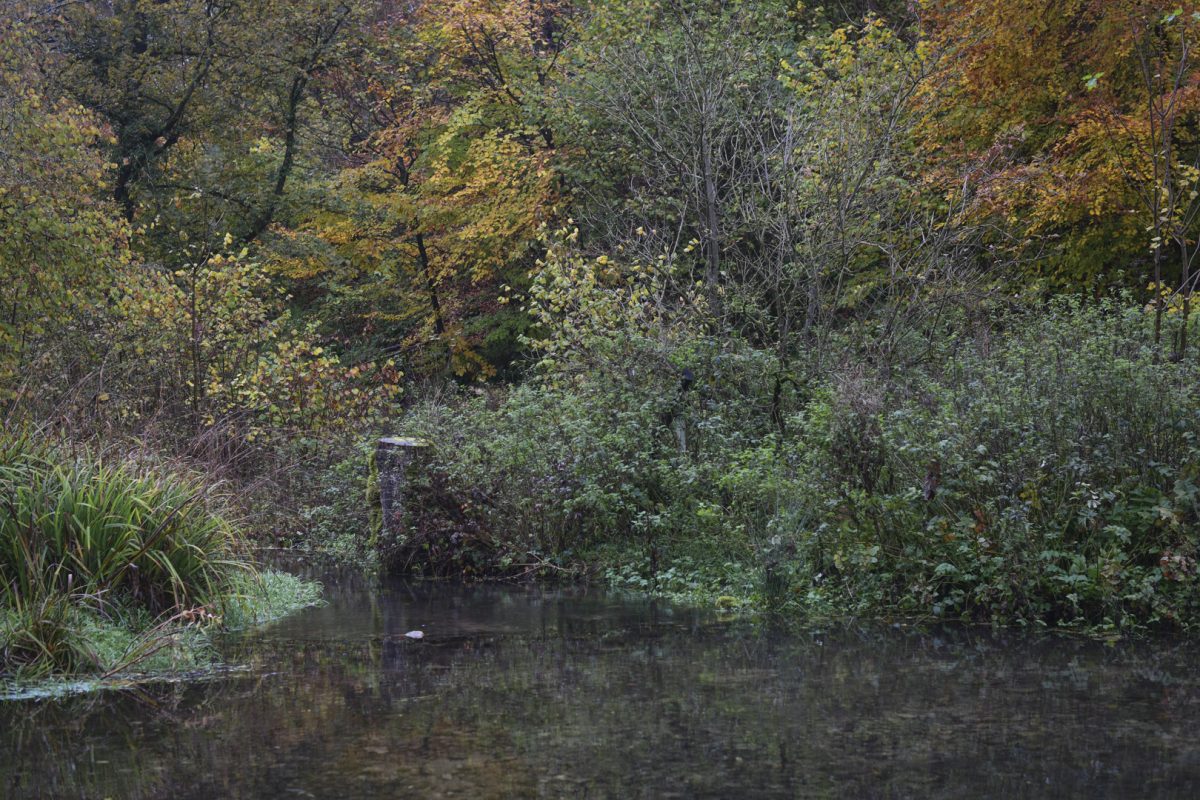
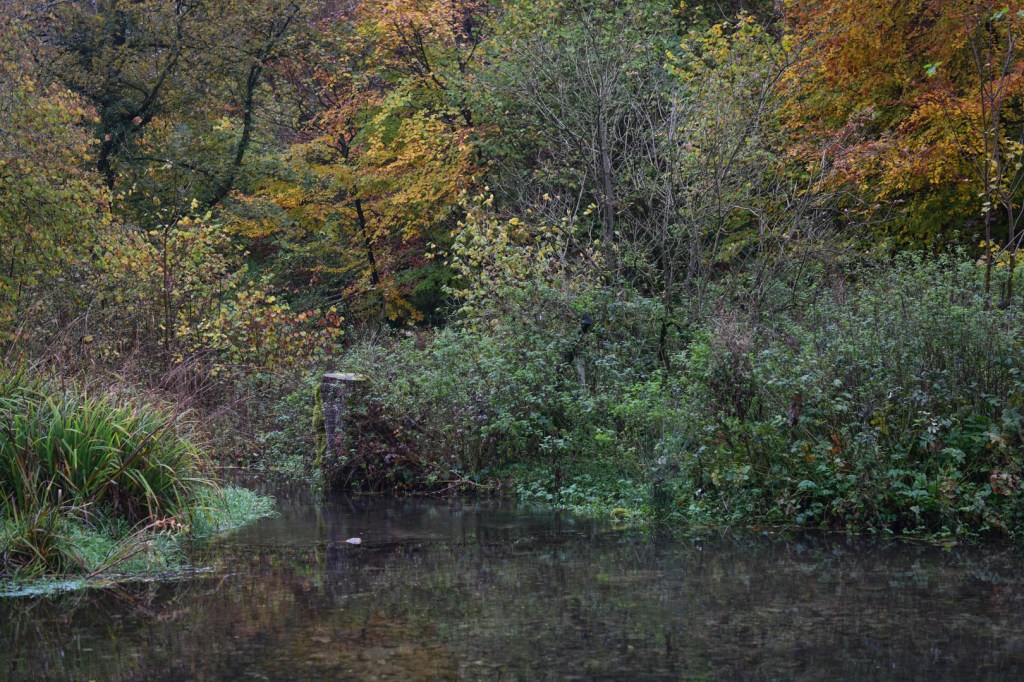
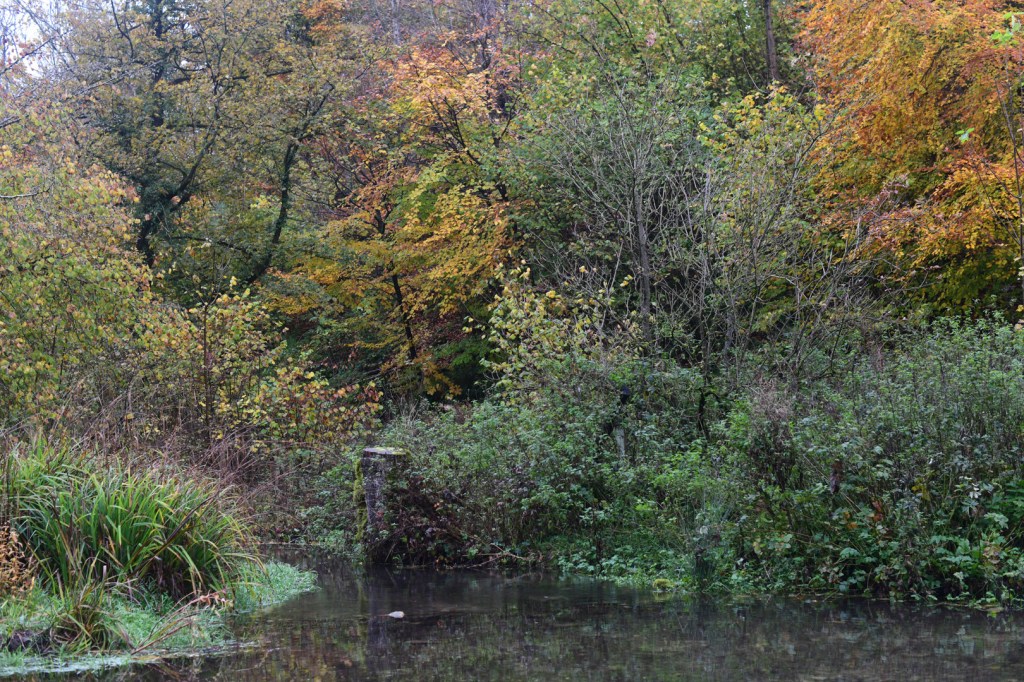
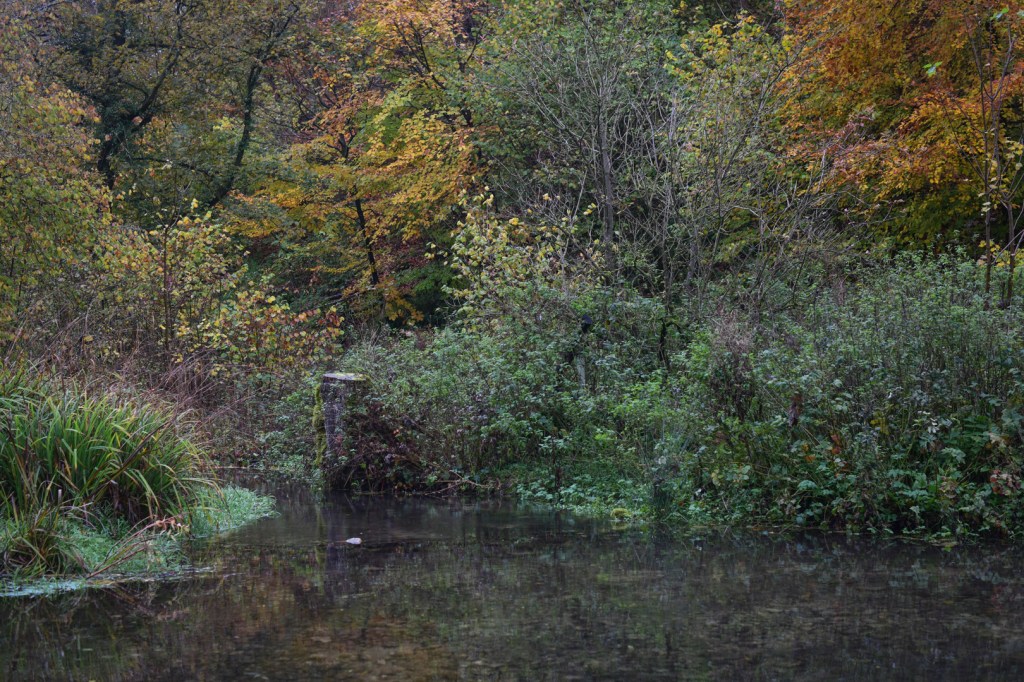
My most successful image in this series is the wider perspective of the pond itself. With the tree trunk in the centre at the point where the water begins to disappear again on its journey along the valley and eventually back underground, it is evocative of those memories I mention above. As though time itself is being carried along, with water as its vehicle. The colours at this moment were so saturated and almost seemed to be lit up. I like that the trees fill the frame and that there is no sky visible, like the work of Thomas Struth for his ‘New Pictures from Paradise’ series.
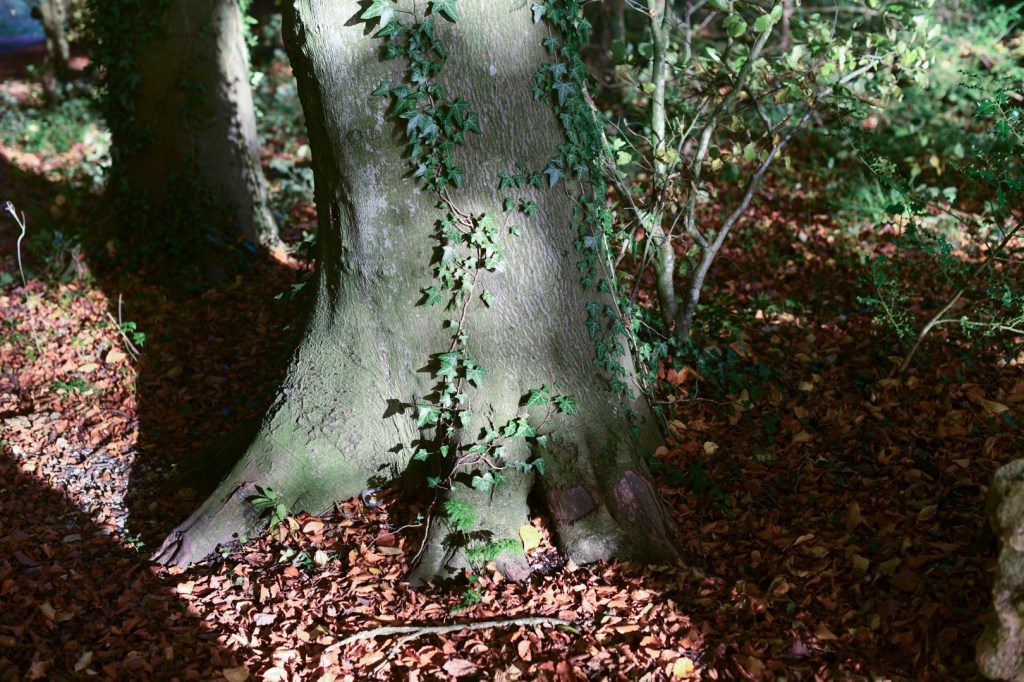
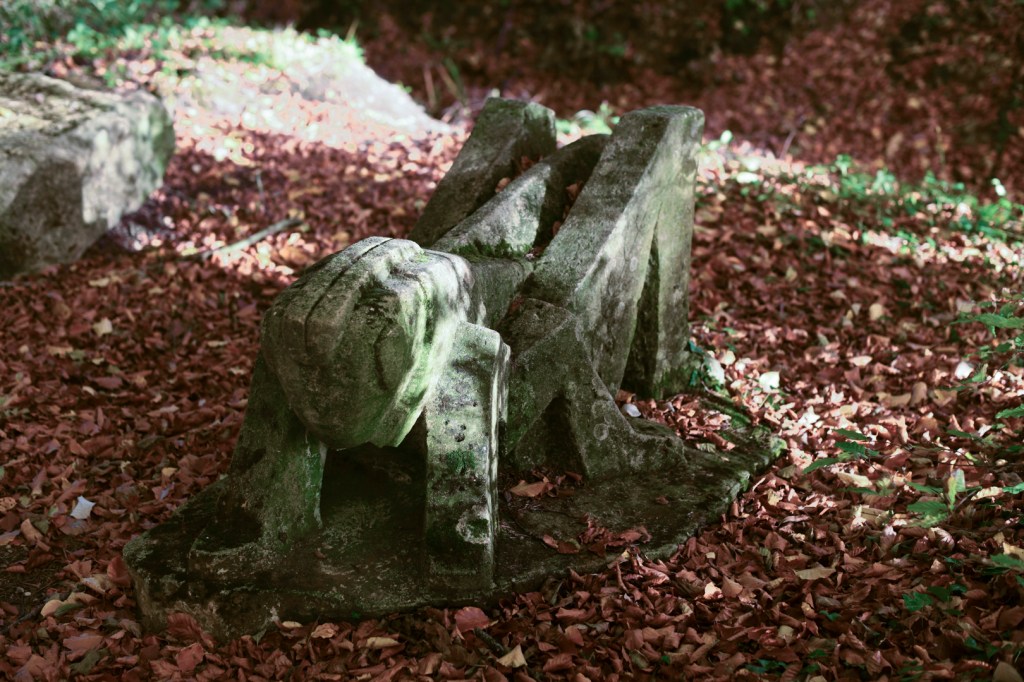
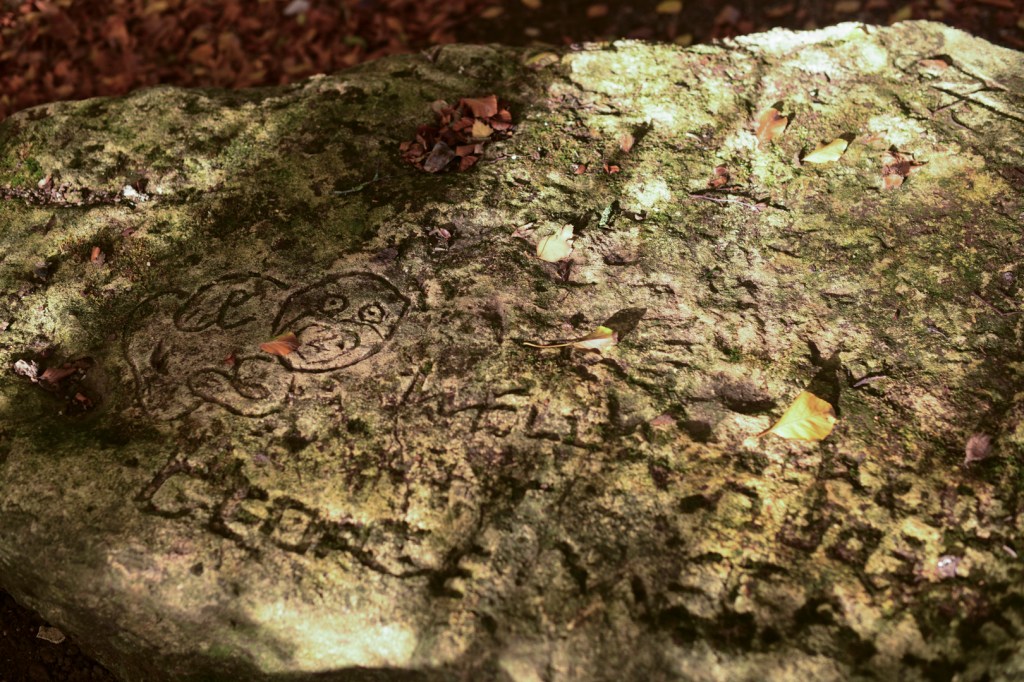
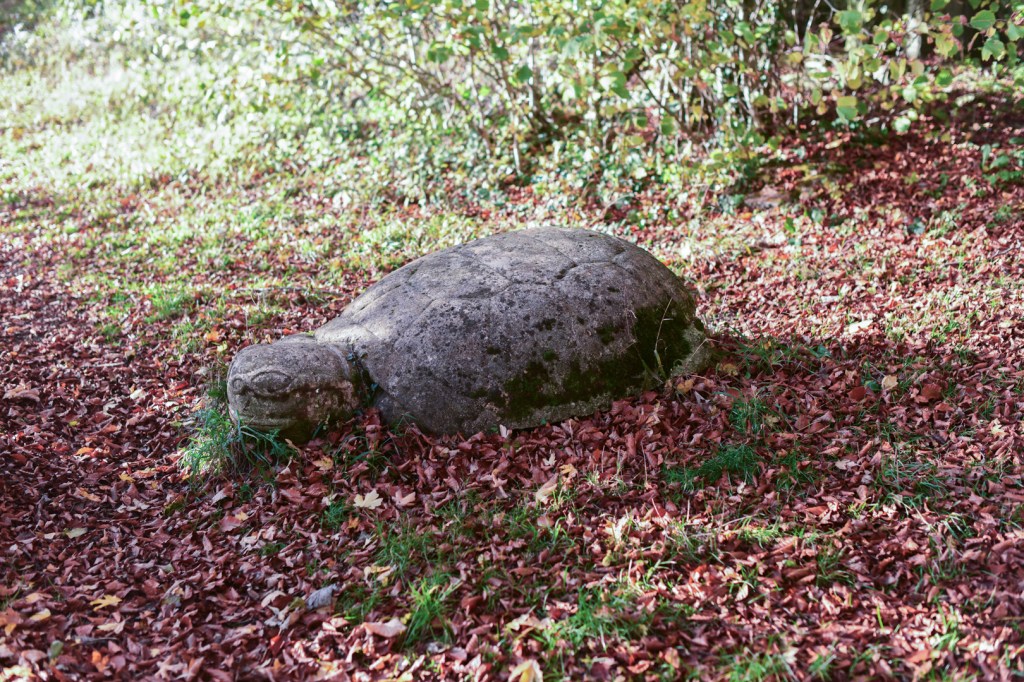
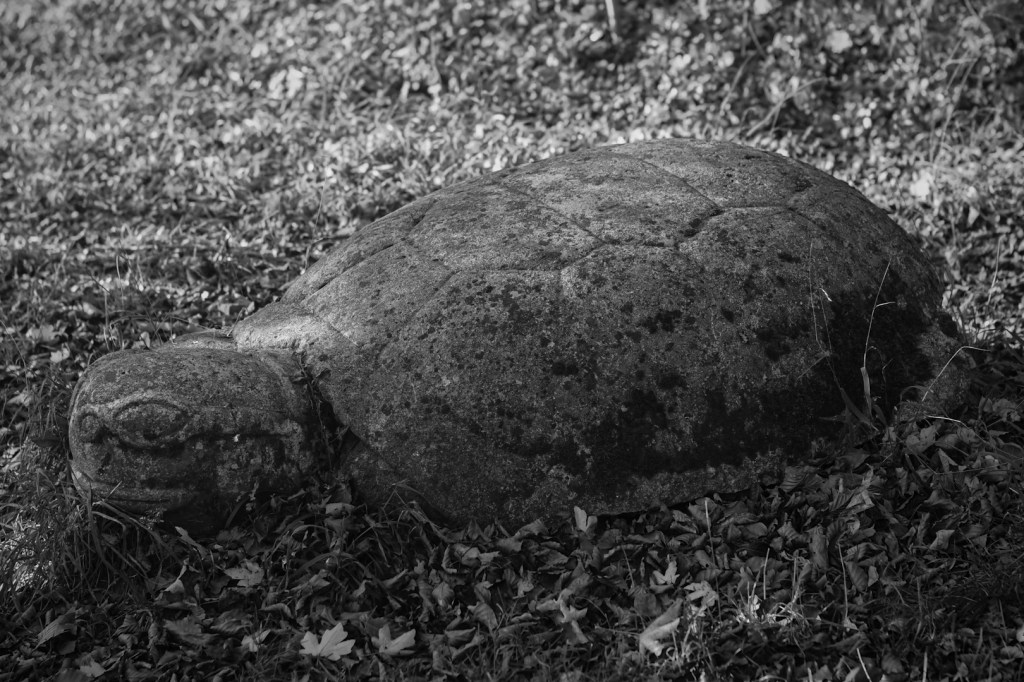
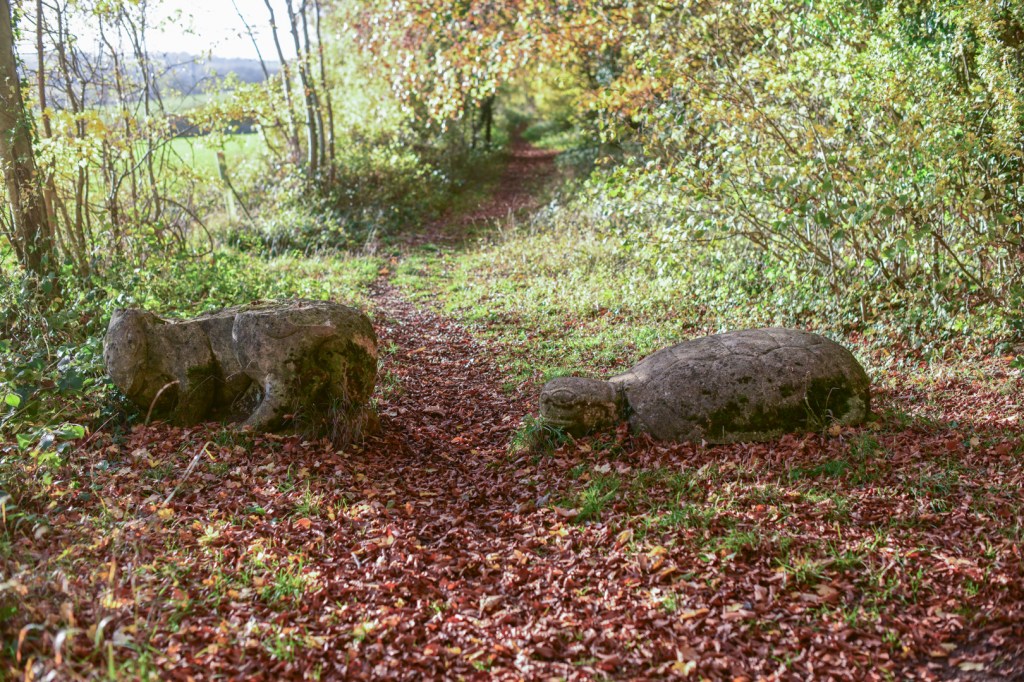
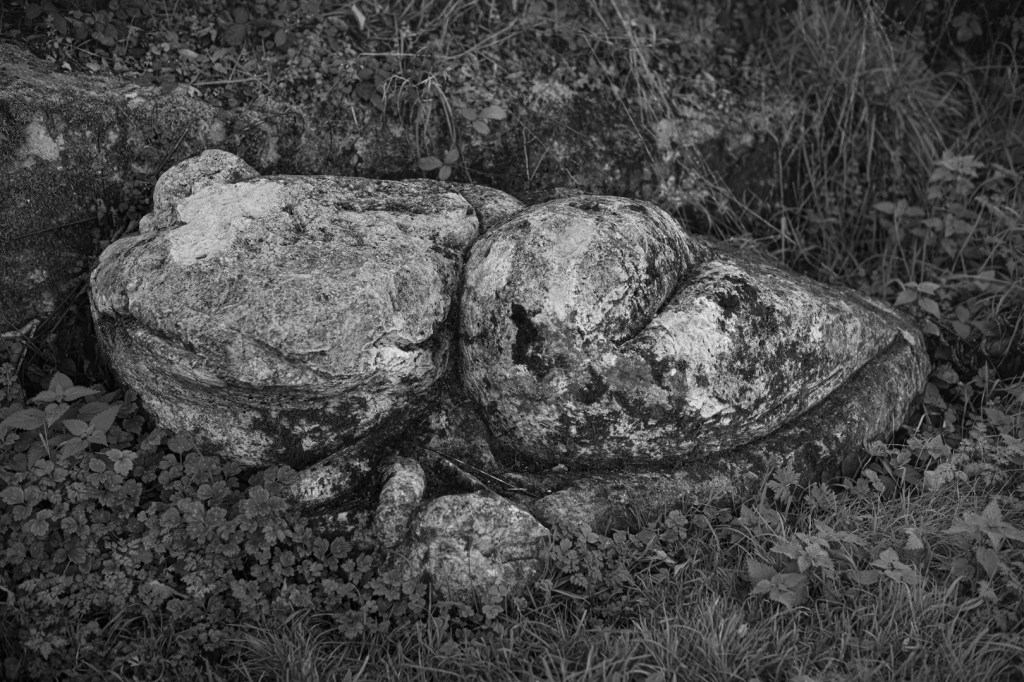
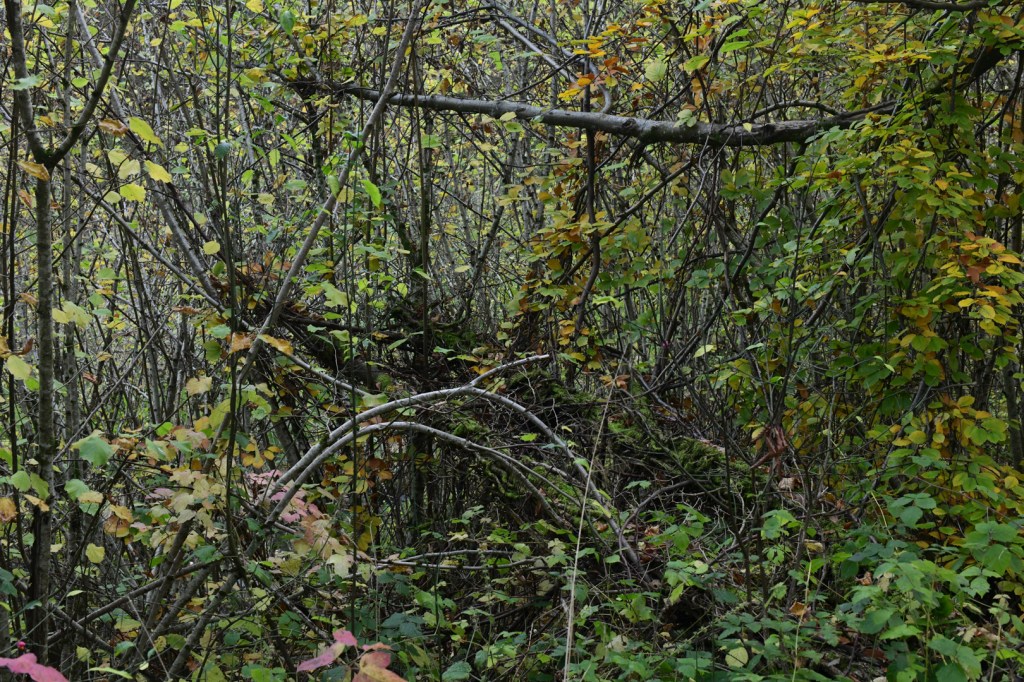
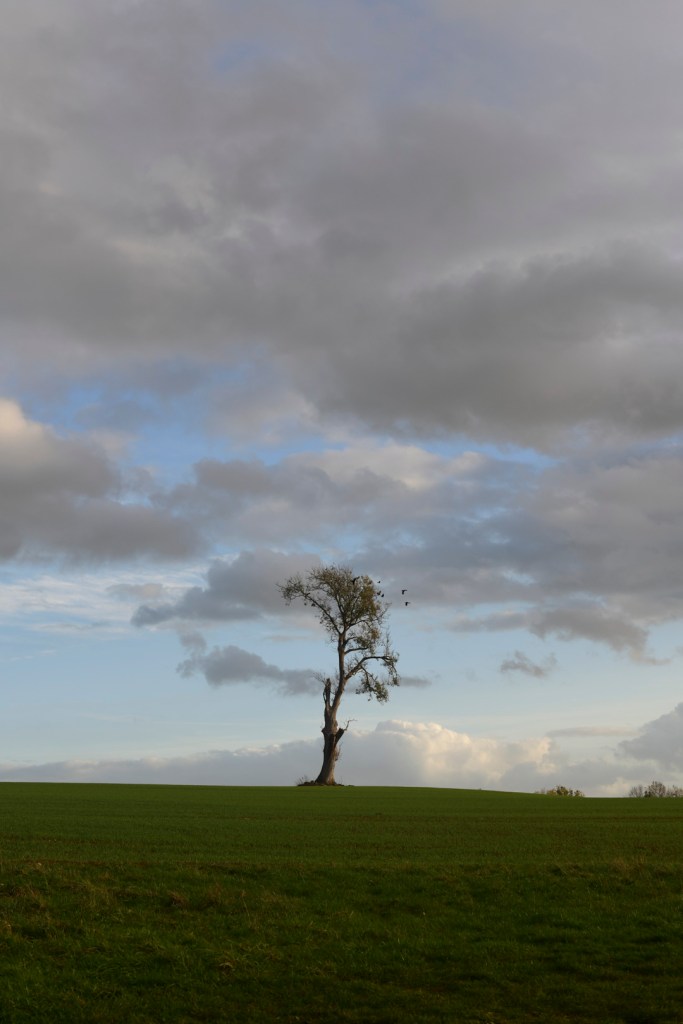
This was a shoot in Autumn, late into the evening when it was very bright. I wanted to explore the area and remind myself of some of the key aspects that trigger memories for me. The carved stones are personally evocative as I remember the stone mason who carved them. He lived in a caravan in the woods and made these pieces in place. Carved from the local Cotswold Stone, they have been there for 40 or so years.
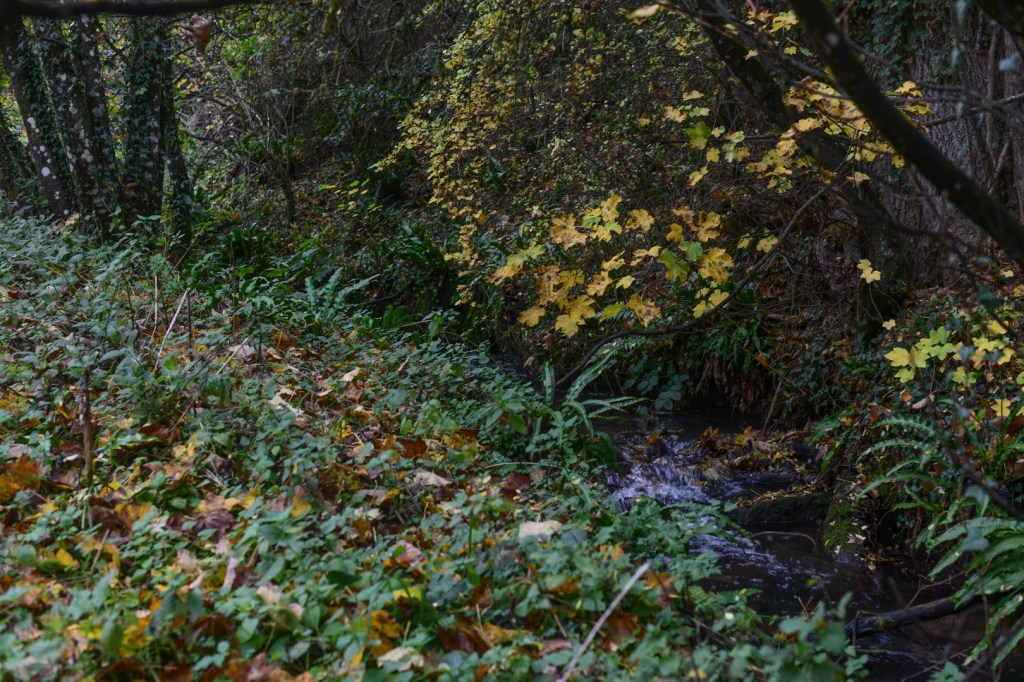
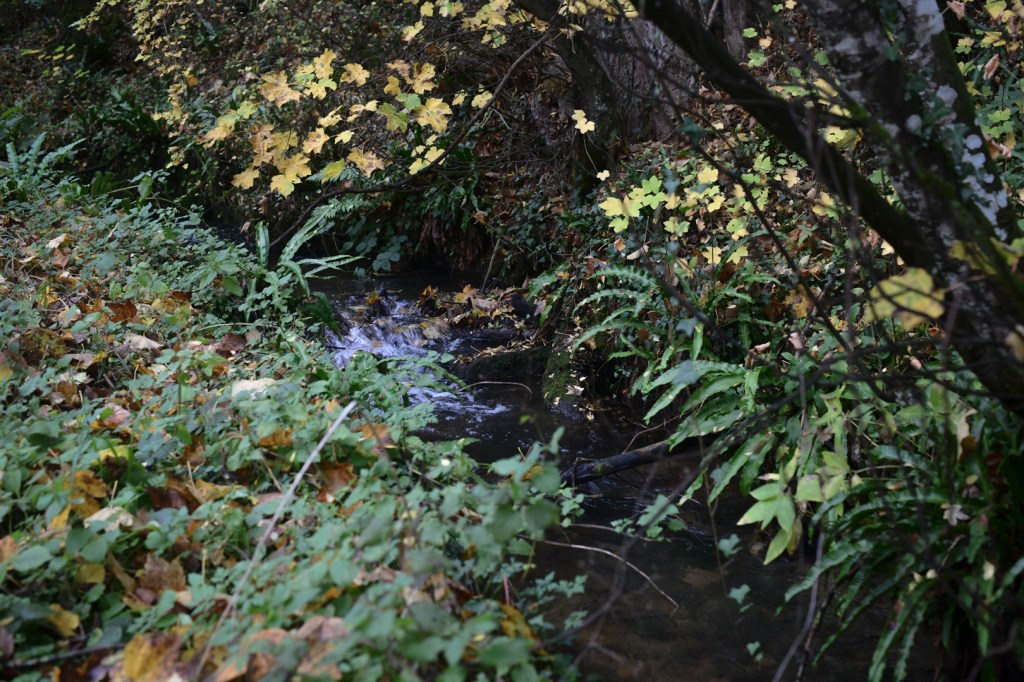
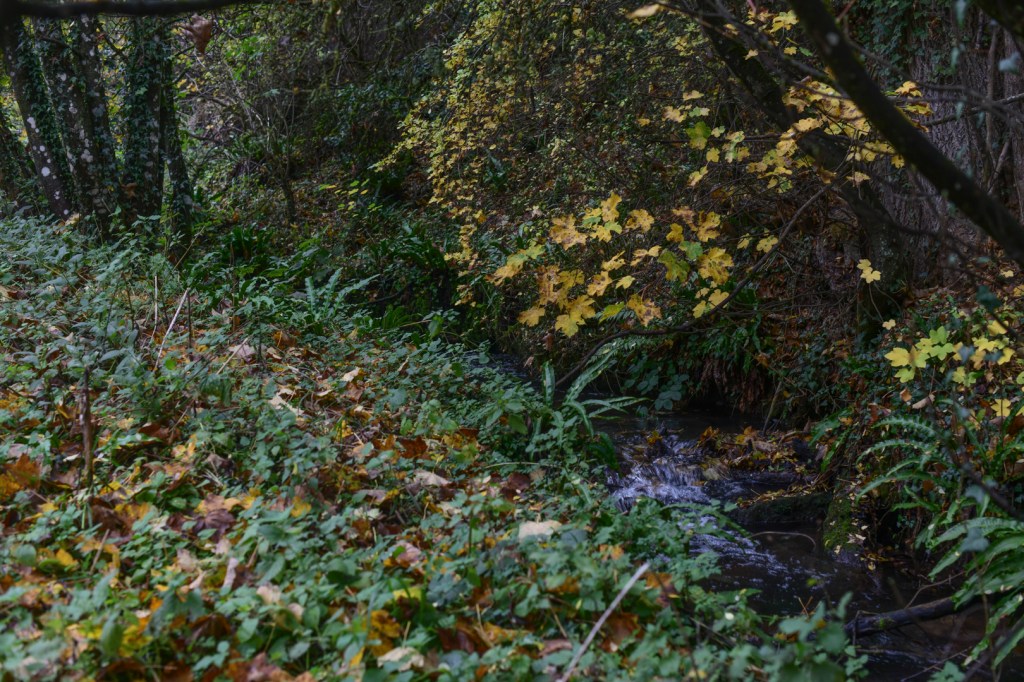
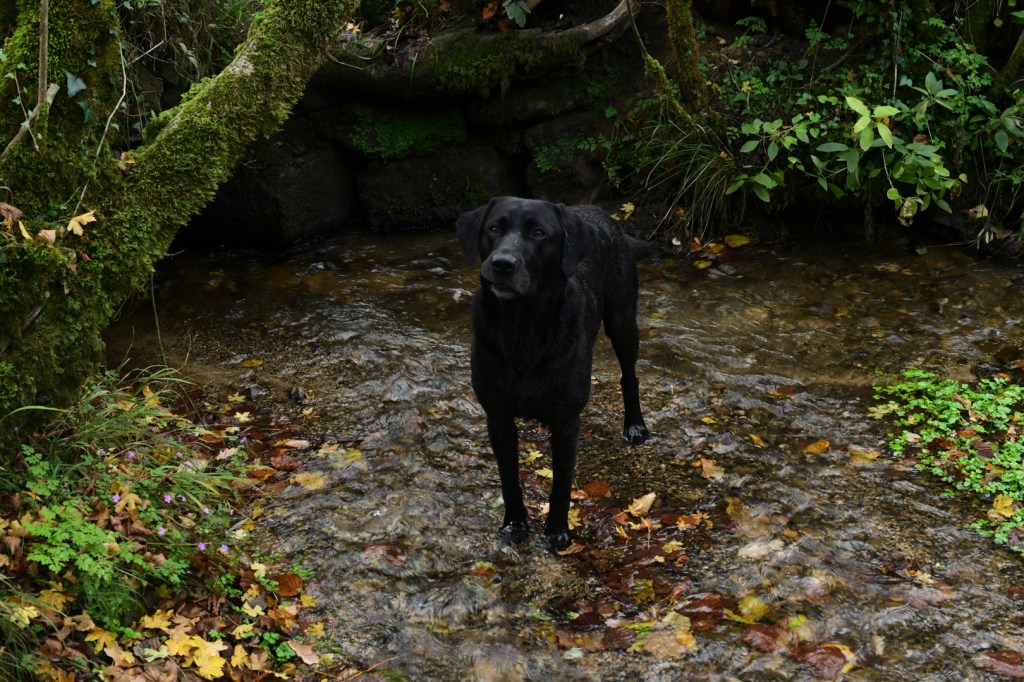
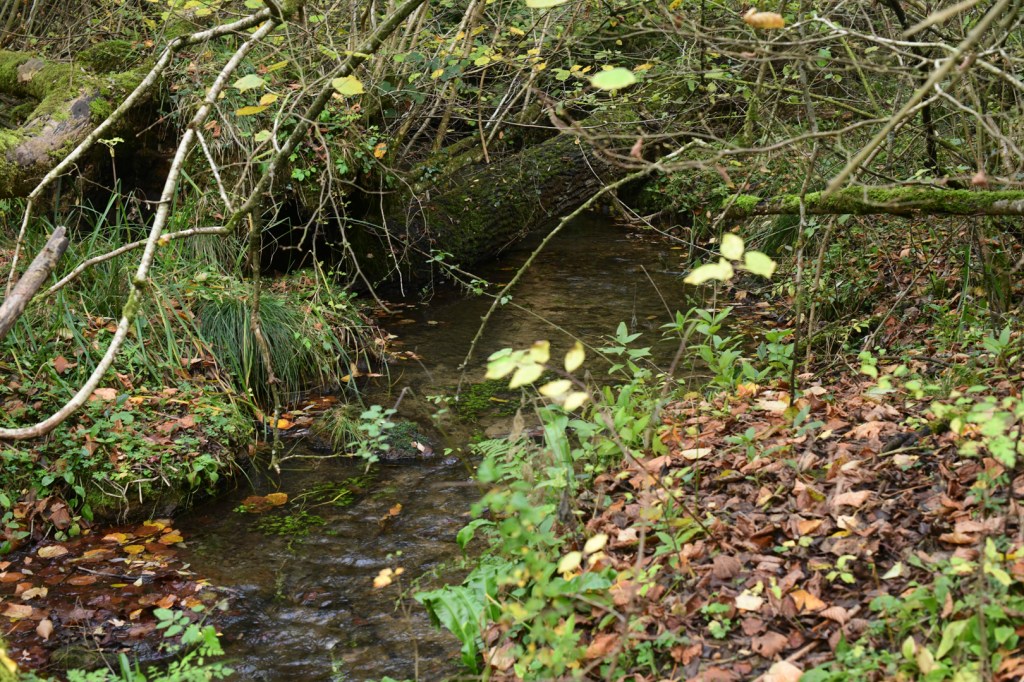
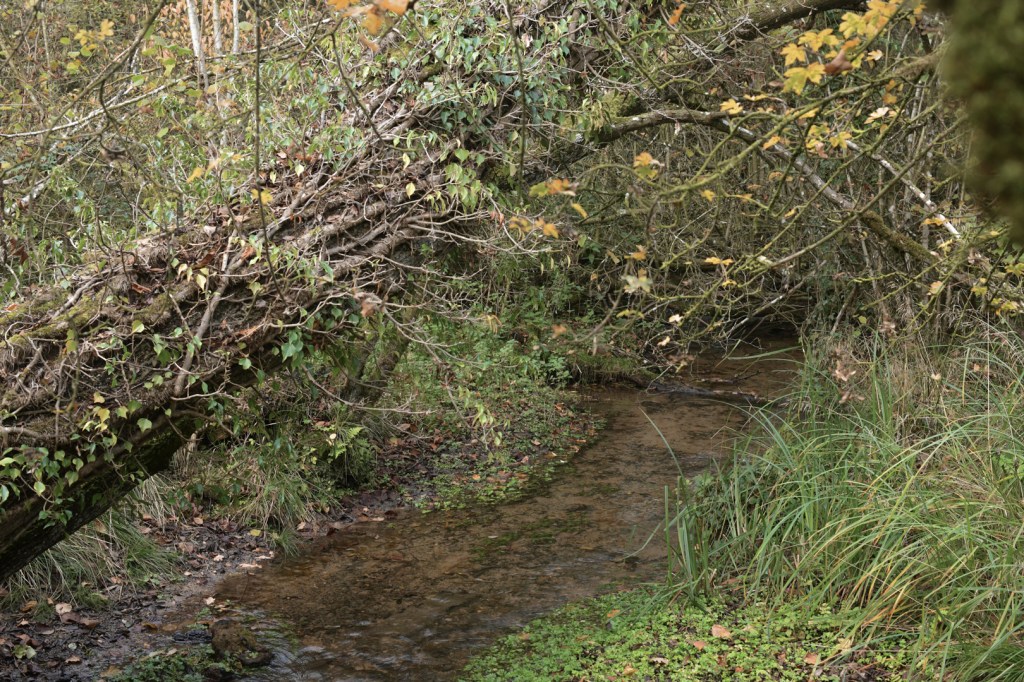
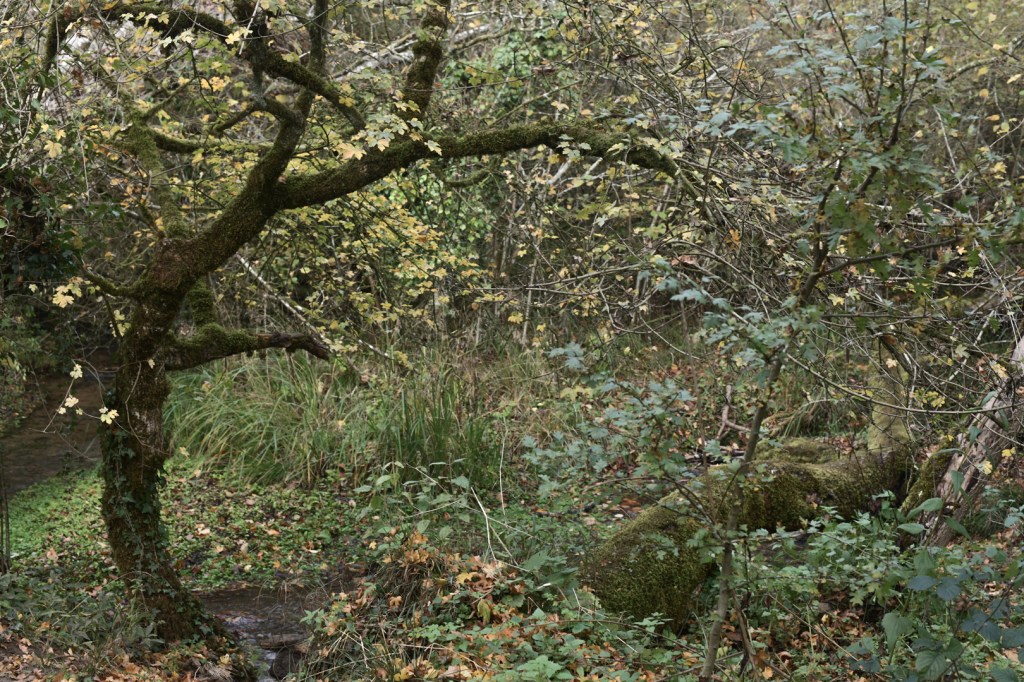
The stream that runs through this woodland was a place of great excitement when I was a child. Bathing in it, investigating it and following its route, we lost hours here. I plan to return with my analogue camera to shoot some key areas.
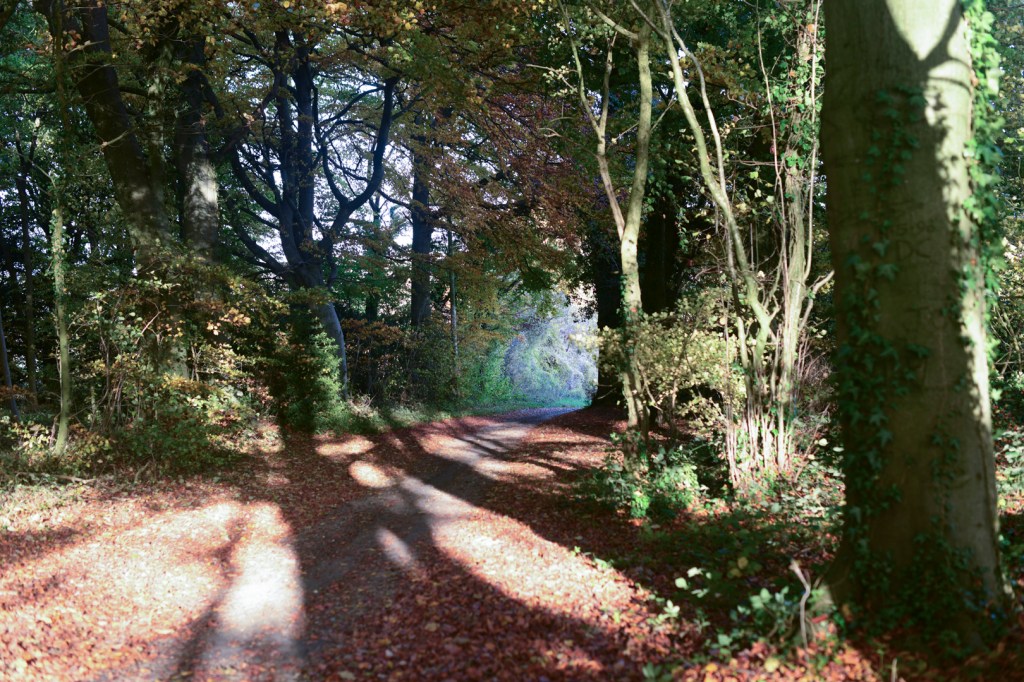
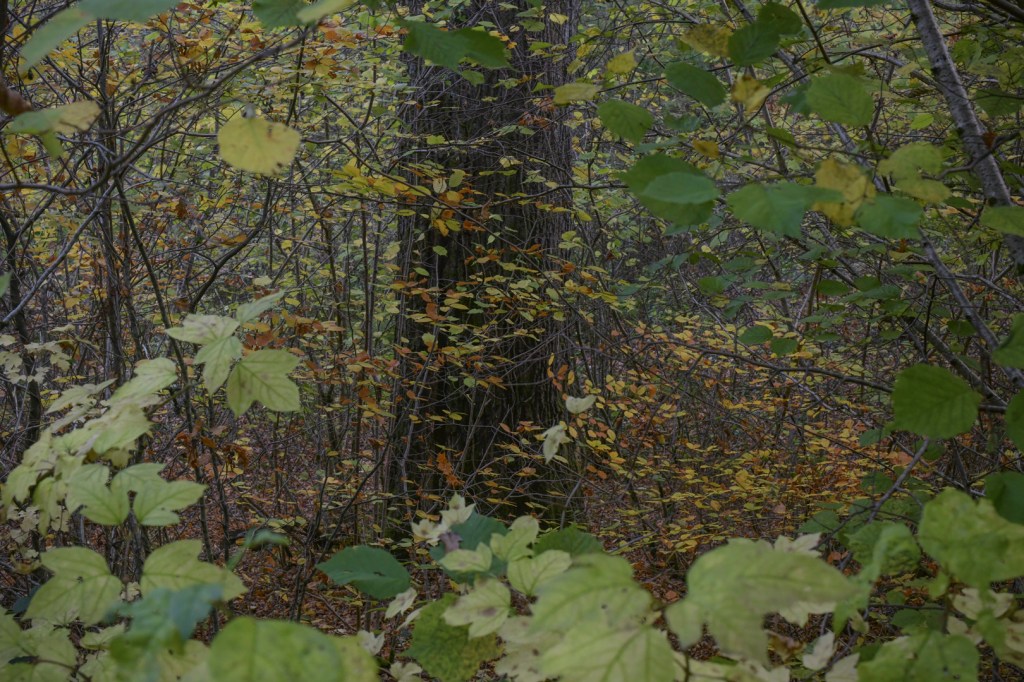
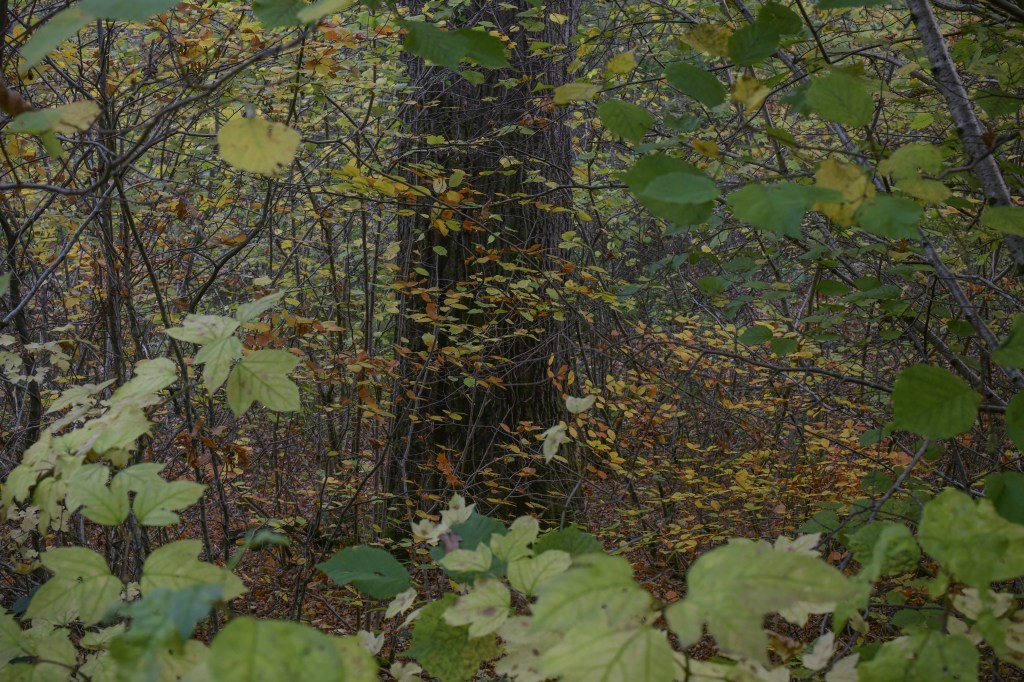
This is the image I selected to use in my lightbox. I like how the leaves form a frame and draw the eye into the tree trunk at the centre. It gives an impression of depth and mystery to the woodland:
Since studying photography, through my BA and then into my MA, my research at some point has always presented the work of Hiroshi Sugimoto to me, yet I’ve not studied in depth or paid much attention to it, dismissing it as not directly relevant. So, when looking at relevant practitioners for my final project and searching with ‘new eyes’ for photography with a meditative quality, Sugimoto’s work seemed ridiculously obvious. I wonder why I haven’t given more time to study his his photography before.
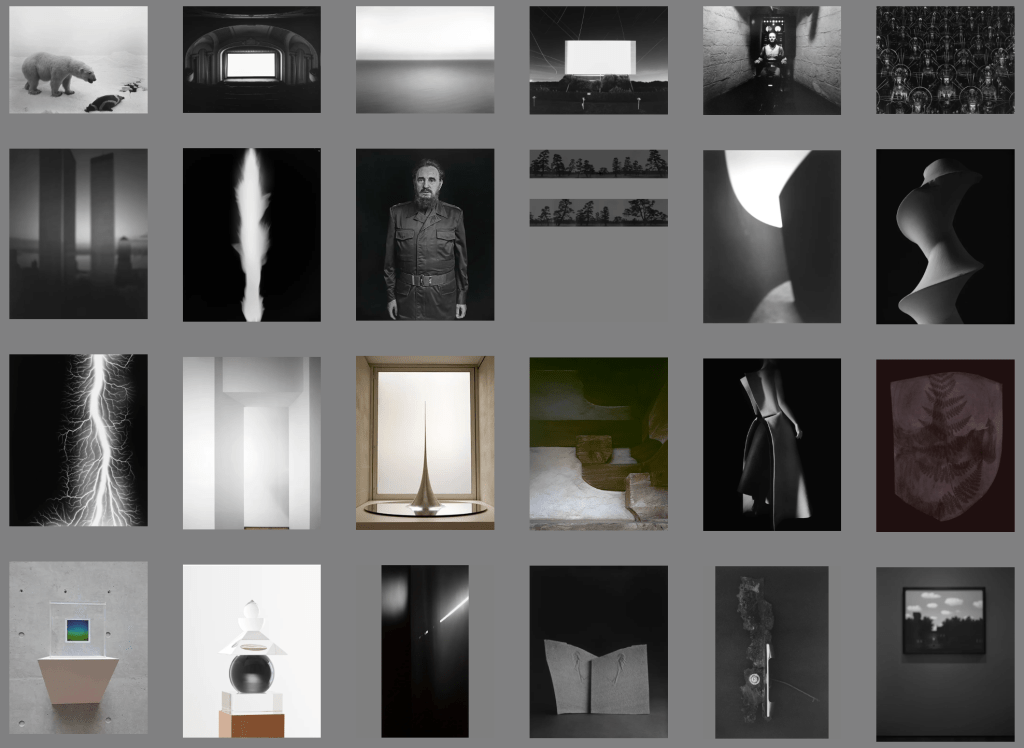
One of the findings from the last few years, more so for the MA, is how interrelated architecture is with landscape based art. It is like a hybrid discipline combining art, engineering, technology and science. Much of the critical theory I’ve studied stems from architecture (e.g. Tilley & Abelman) and so it should have been no surprise to discover that Sugimoto, as well as being a photographer is also an architect. It is clearly evident in Sugimoto’s work. There are many elements in his art which align with the conventions of architecture, just a quick study of his photography shows the lines and forms which are synonymous with the profession.
This is a quick screen grab from his website to demonstrate my point:
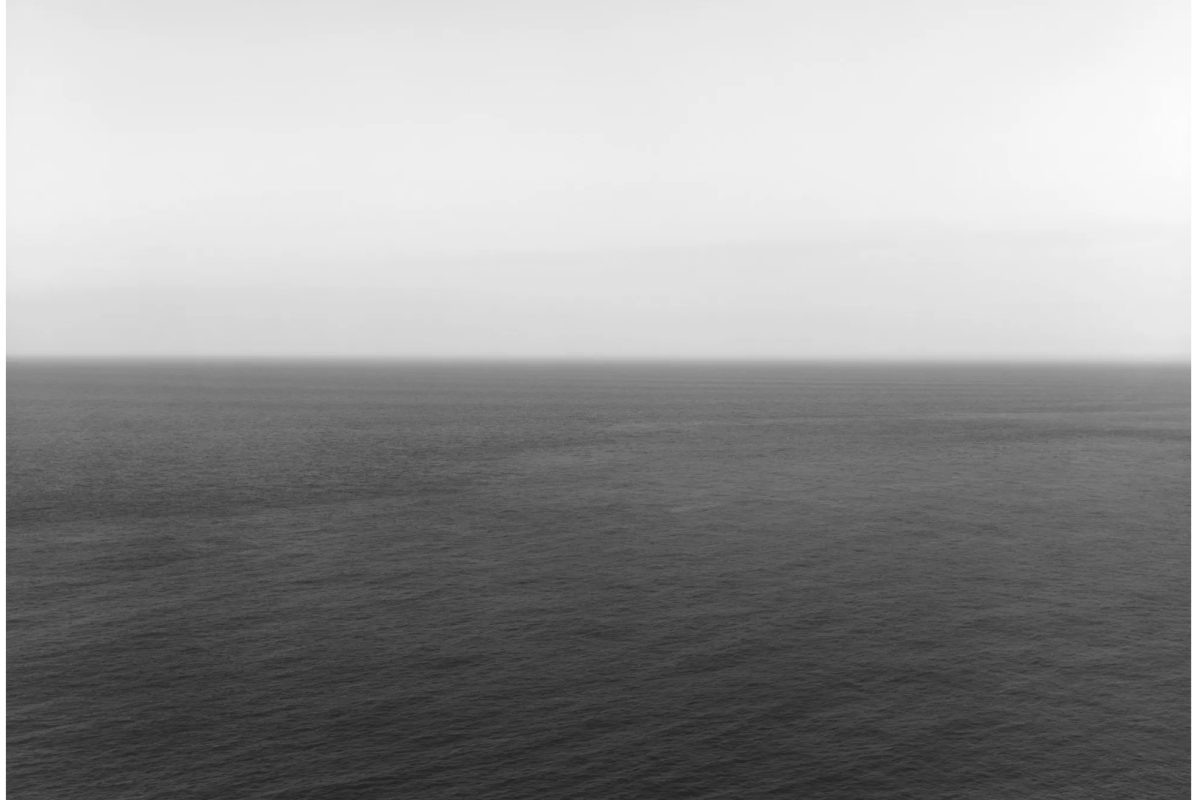
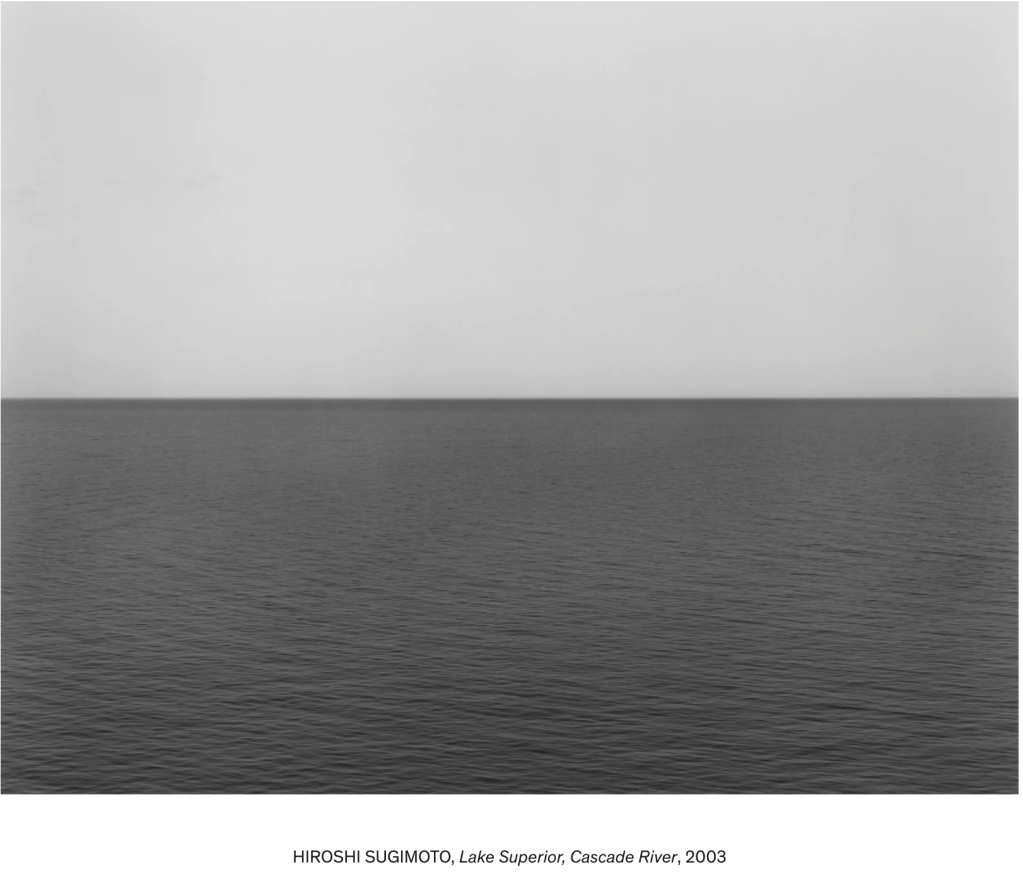
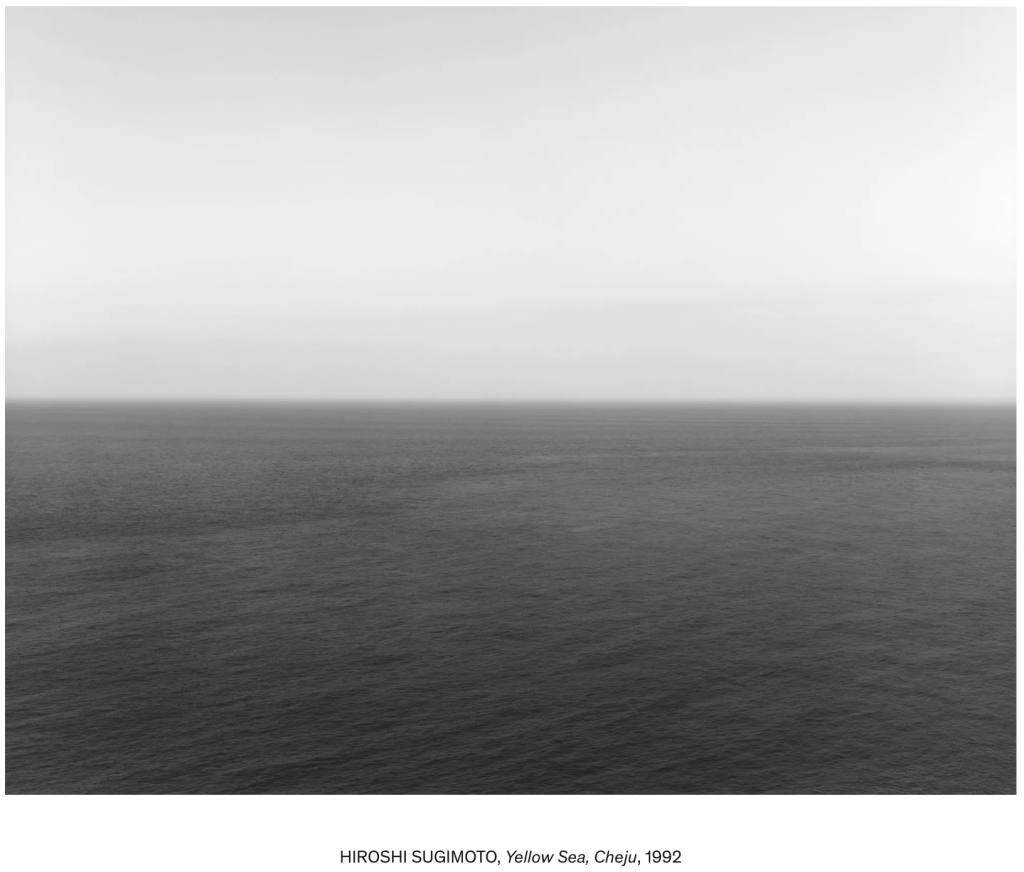
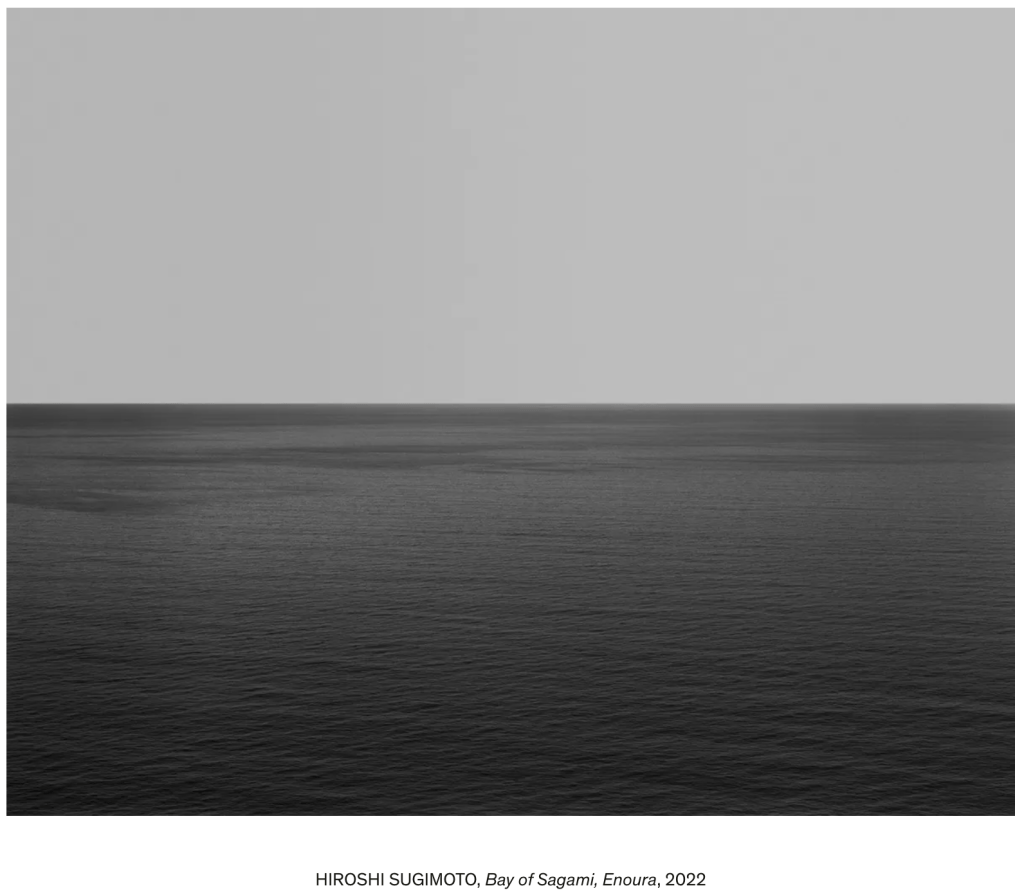
His ‘seascapes’ work is perhaps the most well known, at least to me it is. I remember being drawn to these in the first year of my BA but didn’t fully question why (see previous point!) so as I turn my attention to this work, it is sometjing of an epiphany to realise this work is all about meditation, memory and time. The question of whether there might be someone on the other side of the world, seeing the same scene and then the fact that this scene has barely changed since the beginning of time on earth; the sea, the horizon, the sky, all lying in a line. There are questions around climate and how that might make the scene appear different, ie the reflection on the sea from the sky above, the sealife and the conditions it once thrived in, somehow dulling the waters hues.In the photographs below, the dates span 30 years and yet nothing looks particularly different between them. They are all from different parts of the world and in different decades. For me this is an intriguing study into concepts of time, which these images seem to reject.
The sea is something I gravitate towards, when I can. In its absence, I seek out other bodies of water. Although they don’t have the horizon, they still offer a space for reflection and contemplation. This is evident in my work as when I walk through the landscape I would usually chose to photograph near the water or the water itself.
Mystery of mysteries, water and air are right there before us in the sea. Every time I view the sea, I feel a calming sense of security, as if visiting my ancestral home; I embark on a voyage of seeing.
Sugimoto’s seascapes are presented in gallery spaces as large prints (around A0) allowing the viewer to experience the perspective up close. His words below describe his motivation and further evidence of his work being meditative & contemplative.
“A sharp horizon line and a cloudless sky– here began my consciousness… from there my thoughts race to the origins of human consciousness itself. The sea reminds me that within my blood remain traces of human evolution over hundreds of thousands of years.” (Frankael: online)
The work of Hiroshi Sugimoto will be much more of a consideration in my own research as I continue beyond my MA.
Exploring the fragility of human connection with the universe and ecology
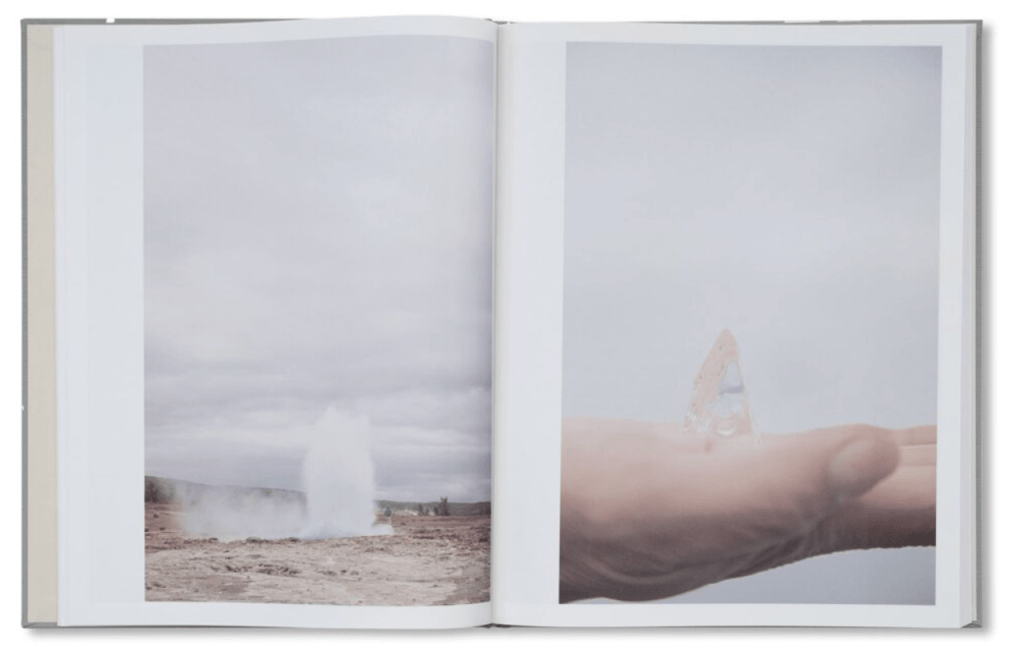
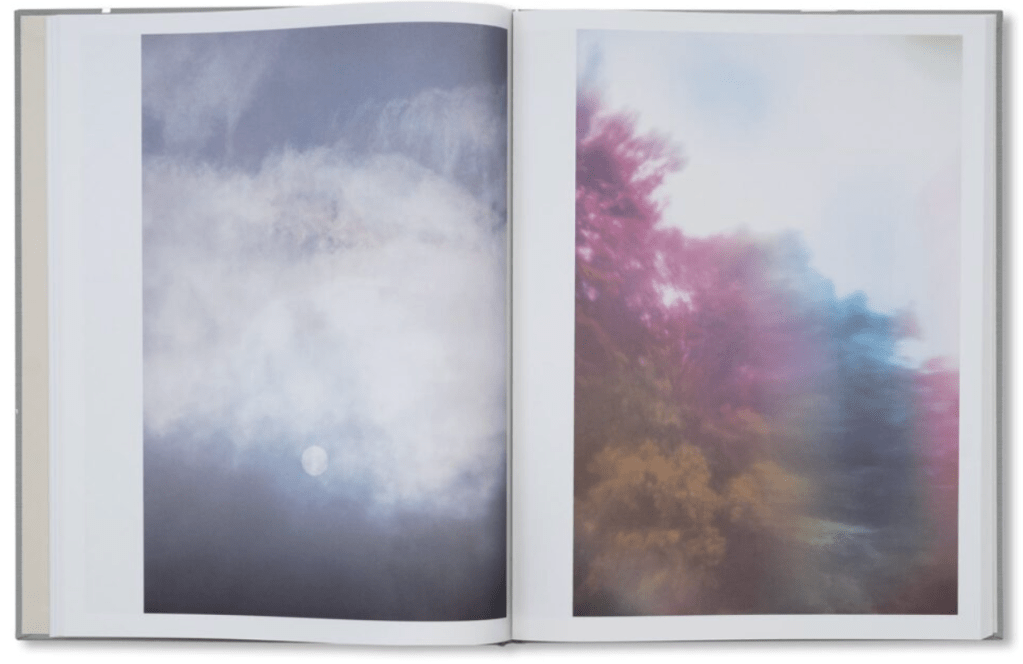
I came across Kawauchi’s work during module 7802. She is a Japanese photographer well known for making quiet, intimate images of the day to day objects that we might otherwise ignore, which aligns with ideas around mindful photography practice. Her photographs characteristically have soft light and pale colour palettes with a shallow depth of field. I find many of her photographs are quite surreal and seem to be other worldly. In 2024, she exhibited at the Arnolfini as part of Bristol Photo Festival, the organiser described her work as being ‘characterised by a poetic, dreamlike quality that imbues mundane scenes and objects with a sense of wonder and transcendence’(Arnolfini: online)
The ‘dreamlike quality’ is the first aspect of her work that I notice, I spent some time just simply looking and in an attempt to practice the mindful aspects of photography, just ‘sat with’ the images. It is interesting to experience the change from a simple visual acknowledgement to something more like a physical sensation, which feels more meaningful and immersive.
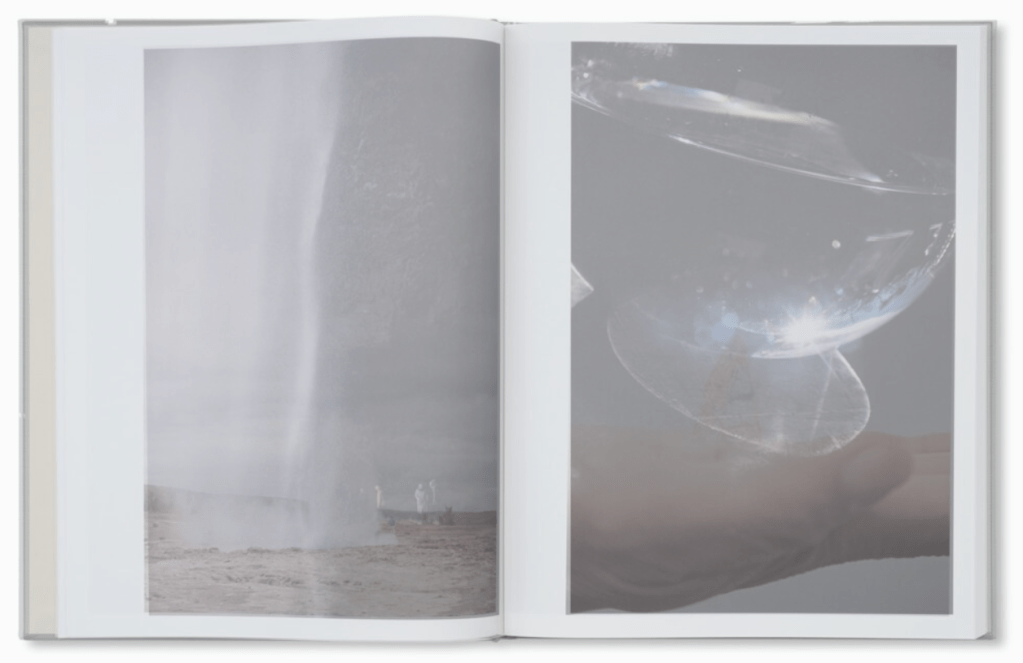
The photographs below are from Kawachi’s website and are part of her M/E series (Mother / Earth)
At the core of her practice is her exploration into the relationship between humans and the rest of the natural world. Her work tends to present a sympathetic view, the images are very gentle and she discusses in an interview that her books are a very important part of her work, recognising that to see work in a gallery requires a viewer to enter a prescribed space whereas a book can be picked up and put down whenever desired and without distraction.
Another compelling point she makes concerns her explanation of why her latest book, Halo, brings together subjects that initially appear unrelated. Rather than emphasising an obvious or direct relationship between them, she asks the viewer to consider their broader place in the world. Kawachi suggests that everything in the book is connected through her personal love of nature and the world around her, even if those connections are not immediately clear. This makes the work seem deeply personal as I wonder whether it is more of a representation of artists inner thoughts, as well as the subjects themselves.
This raises the question of whether conventional expectations about what is and is not considered “connected” should be challenged when assembling a book, or creative work more broadly. My own rigidity over making things uniform or having the conventional belief that there must be obvious connection in my work, perhaps should be challenged.
I note my thoughts and feelings about the image below: ‘I see what could at first glance be a person but I realise is more likely a building. A church perhaps. Obviously there is glass between the viewer and the scene, as the rain tells us that. I notice tiny dots on the raindrops which almost create comical faces in them. As though they are looking back at me saying ‘let us in’! This amuses me. It feels cold, as the image is blue, the light is low and this is synonymous with a damp and dreary English Autumn or winter day. I find it both brooding and melancholy. Were there a light somewhere on the building, this would change the sensation of the image completely, I would see this as hopeful.
She uses photography as meditation. Her approach being to sit with her surroundings for a while, noticing the various sensations that appear; this might be to do with the sound and temperature or the damp weather as in the photo above. In the rain, she would have had added distraction from the water hitting her head and body, which may have made it more difficult to ‘tune in’ to her surroundings. What is clear though is that no matter the situation, by employing some mindfulness discipline, its possible, using creativity, to extract meaning from the chosen environment regardless of ‘distractions’ in this case, rain fall.
There is much to admire about her practice and work. Although aesthetically Kawauchi’s work doesn’t align with my personal taste, her methods and subject matter are highly relevant and interesting. I would like to view her work up close and I am looking out for any exhibitions so that I can visit. I can imagine some of these works being quite thought provoking seen up close and on a different scale.
The FMP process is a module which enables the opportunity to begin relying on my own experience and instinct when it comes to direction and analysis of work and ideas. As the transition from the secure and supportive environment of university into creative independence begins, it is necessary to build a separate network of people that can provide the critical feedback and support as I embark on my professional career. In light of this, I had a meeting with friends, both of who are creative, talented business owners and importantly, able to be professionally critical. These women, among others, have contributed greatly to my creative practice since its inception at BA level. Thanks to Julie Birch and Sally Guibert
The purpose of the session was to discuss ideas beyond university, to look at my current work for my FMP and to ascertain how best to provide ongoing support and ensure accountability.
We talked about the importance and relevance of galleries, entering competitions and collaborative opportunities. Additionally, we discussed the merits of a gallery style website as a priority to remove over reliance on social media platforms, thus stepping into a more ‘professional’ practitioner role.
Key points:
Examples of places to contact for selling work include the Curated Store in Stow on the Wold, they have a strong social media presence and strong brand appeal (aligned with my own creative style)
Blockely Art collective – shared exhibition space
Spring and Sixteen gallery in Cheltenham. Ask for 12 month schedule to see if any opportunities
Wilson Gallery. Contact friend who is now CEO of Cheltenham Trust to discuss potential opportunities to develop a themed exhibition, collaborating with other artists / photographers.
Momentum. Meet monthly to share ideas and to stay accountable. Consider workspace opportunities for collaborative working.
Have a large roll of paper or flip chart in my workspace so that I can detail tasks and ideas, then they are clearly visible and act as reminders.
Target fixed number of hours per week to stay on task. I find unless I do this, the week can become overwhelming with other non-creative tasks and I stop making it a priority. This is hugely frustrating and stifles my progress. Prioritising my creative ambitions over a very busy homelife is psychologically difficult as it isn’t a paid 9-5 job. This mindset is something I am challenging as I realise its a key barrier to my future success.
We have planned to meet quarterly to discuss these ideas (my friends have creative projects of their own) so that we can offer support and feedback to one another. Working independently can be quite a lonely scenario and it is usefel to have feedback from people who are honest and critical.
Here I give more information about the key texts I have read during my MA, those which have had the most influence and given me the change of direction I needed, with which to help me identify my true interests in my practice. Although there is a lot of critical theory that I have studied over the course of this MA, these contemporary writers and experts combine many of the older philosophical views that I’ve researched already, therefore, I have chosen to expand on these, rather than unnecessarily repeat myself. I have listed other key influences on my page, to demonstrate my knowledge and sources in my post titled ‘Landscape Mindfulness & Photography‘
Tim Ingold
Landscape as seen as a temporal ‘taskscape’ by Tim Ingold. Regarded as ‘the familiar domain of our dwelling…and through living in it, the landscape becomes a part of us, just as we are a part of it. His book The Perception of The Environment (Ingold, 2022) has been essential reading in helping me to understand the concepts of landscape, dwelling, space and place. Ingold adopts the dwelling perspective, having been influenced by the philosophy of Martin Heidigger (p190) Like Heidigger, Ingold argues that humans are not simply detached observers of the world but are already deeply involved in it.
This reminds me of a book I read called Braiding Sweetgrass, written by Robin Wall Kimmerer (2013) She is a member of Citizen Potawatomi Nation, an indigenous tribe, originally from the Great Lakes area of the USA, and who are well known for their cultural resilience. The book demonstrates a culture of reciprocity and of being ‘in’ nature, not separate to it. In doing so, there is no objectification, just an unquestionable sense of being part of the land, alongside all the other elements. Her work is predominantly focussed on “restoration of ecological communities and restoration of our relationships to land“. I recognise aspects of this culture running through the ideas presented by Ingold/ Heidigger. They both reject the idea that people first think about the world and then act on it, instead emphasising lived experience and practical engagement. For both, meaning comes from dwelling in the world through everyday activities rather than from abstract thinking or viewing the world from a distance. This research does emphasise how the Potawatomi relationship to land and nature is much more connected and instinctive than our own.
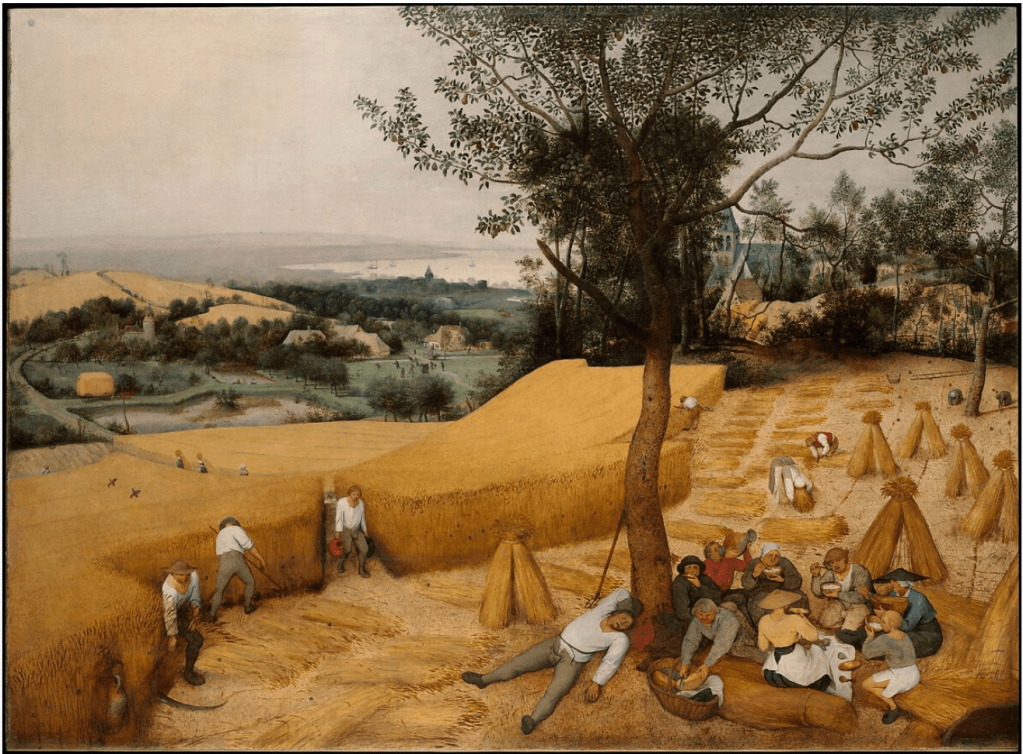
In the chapter ‘The Temporality of the Landscape’ (p234:258) Ingold uses the example of a painting, ‘The Harvesters’ by Pieter Bruegel the Elder (fig 1), to illustrate his views in the essay (p250) This was especially useful to visualise his key points. He dissects each landscape element into their individual components; the hills and valley, paths and tracks, the tree, the corn, the church and, the people. He demonstrates how each of these elements is measured by time and has been shaped by the lives present and past.
Fig 1. ‘The Harvesters’ Pieter Bruegal the Elder, 1565
Key points to be made about the painting:
The land is not an abstract surface or property but a worked ‘lived’ ground
It has evidence of historical labour – paths, hedgerows etc
shaped by repeated human engagement
Trees show a different temporal rhythm to humans and coexist, they are not background scenery but active elements of the landscapes becoming
grain represents seasonal growth and the rhythms of agriculture, they show the interdependence of labour and natural cycles
The painting shows a specific moment within the year (late summer harvest)
The church indicates long term habitation and along with other buildings signal ongoing dwelling
The harvesters are shown working, resting and eating, in different phases of carrying out their tasks, which forms the basis of the ‘taskscape’
People are not separate but part of the landscape
Ingolds book altered the way I understand my surroundings, in so far as I could validate my personal response to it. I have used his method of describing the painting below when I initially try to immerse myself in my environment, as a way to distract myself from my usual thoughts. I sense the lives before me embedded in the landscapes I document, especially related to Ingold’s concept of taskscape; my grandfathers work in Guiting and surrounding area is particular resonant here, plus the stories I’ve heard and photographs I’ve seen relating to my stepfathers ancestors and the gradual creation of their personal landscape at Dacha. In seeking to understand my visceral response to significant places, his writing is probably most significant.
Christopher Tilley
In his book ‘A Phenomenology of Landscape: places paths and monuments’ (Tilley, 1994) Tilley argues for landscape being an embodied experience – our body is the primary way that we engage with the world. Slightly differing from Ingold’s perspective, who emphasises more of a ‘doing over sensing’ approach. Tilley’s philosophy proposes we engage with it through being in it; through perception (seeing, hearing, touching), bodily actions and movements, and intentionality, emotion and awareness residing in systems of belief and decision making, remembrance and evaluation’ (p12) So, landscape then, is an experience, not just an observation, as far as Tilley is concerned. It becomes known through sequences of movement and memory with its past shaping its present and future in our minds. Tilleys arguments mirror the philosophy of Merleau-Ponty , whose emphasis is on perception, movement and being in the world.
To show my understanding of his book, I have included my entry for the annotated bibliography I completed for 7802, to view in its original context, refer to p32 in my Notions of Home Essay:
“This book by Professor of Anthropology, Christopher Tilley, combines insights from phenomenological discourse in ‘philosophy, ..anthropology, human geography and..archaeology’ (Tilley, 1994, p1) At the starting point of the book he interrogates ‘theoretical perspective on the significance of spaces, places and landscapes’(Tilley, 1994, p1) referencing well established phenomenological research (Heidegger, Merleau-Ponty) to establish the significance of the topic, then for the second half of the book Tilley examines an ancestral relationship & perception of place within landscape, using evidence from civilisations in Wales and Southern England. He illustrates with examples of Mesolithic material finds as evidence of those ancestors identifying with place in relation to its setting and conversely, the Neolithic understanding of landscape was in terms of relationship, shown with the setting of monuments. The spatial relationships and topographical aspects discussed in this book, offer rational explanation of my own interest and sense of place within the area I work. It is an area that is rich with cultural heritage and an informed understanding of these sites will provide a fundamental aspect of understanding my own practice in relation to landscape photography” (Taylor, 2024: p32)
There is an overwhelming amount of information and inspiration relating to mindful practices, online and in print. I have tried to be specific in my research. The key readings, terms, critical theory listed here, have all influenced my work and offer some explanation for how I have arrived at this point for my final major project. My hope is that the project will be a clear culmination of all my research and practice so far. Much of the critical theory I have researched and written about before and therefore I won’t repeat myself, although I have detailed my previous essays and blog entries where relevant below, as these writings continue to inform my practice.
Key readings and terms:
Miksang: Tibetan term, meaning ‘pure eye’ in relation to contemplative photography – to see without overlays of meaning and value. Without judgement or opinion, ie no association or preconception
Epoché – Edmund Husserls word for a suspension of judgment, a pause in our habitual thinking, the aim being to see things just as they are. This term is often debated but regardless, it serves me well in trying to remove the thoughts crowding my mind
John Berger Ways of Seeing (in relation to Magritte’s Key of Dreams) ‘Cultural Construction’ Sense of sight: seeing comes before words. We are culturally conditioned to see the world with descriptions. I have used this to demonstrate what I am trying to push back against.
Wabi Sabi – Japanese philosophy that celebrates the beauty and simplicity of imperfection and transcience
Henri Cartier Bresson – The Decisive moment. described the act of photographing as an intuitive and contemplative gesture.
Jon Kabat Zin – Mindfulness based stress reduction (he introduced mindfulness practices into medical, educational and personal conexts in the West)
Herman Hesse ‘Siddhartha’ – a novel about a man on a spiritual journey of self discovery, themes of religion (buddhism) and mindfulness throughout.
Notions of Home – Lucinda Taylor. (see file below and also in seperate post) This is my autoethnographic essay for Research and Context. I have added it here as it contains much of the critical theory that has informed my practice to this point. Although I have referenced some of this theory again (below, in other areas of the blog and in my reflective essay) I’ve avoided repeating too much of what I have done previously.
Critical writings (ongoing study and analysis) essential reading for my theme
The Perception of the Environment – Tim Ingold – Previously studied for 7801 and 7803, section on The Temporality of the Landscape – he determines that Landscapes are not things we look at but worlds we live in. They are shaped by movement, memory, work, and natural processes over time. To understand a landscape, we must attend to its temporality—the rhythms and practices through which it continually comes into being.
Christopher Tilley – A Phenomenology of Landscape: places paths and monuments – Tilleys work aligns with the views of Ingold, in so far as he argues for landscape being an emodied experience – we engage with it through being in it; walking, seeing, sensing & hearing. Landscape is an experience, not just an observation, it becomes known through sequences of movement and memory with its past shaping its present and future in our minds. These ideas validate my own experiences and I know that the photographs I am making, are my attempt to convey this view.
Martin Heidigger
Buttimer and Seamon
Edwards Relph
Yi Fu Tuan
Maurice Merleau-Ponty – phenomenological idea that we perceive the world not from a detached point of view but from the centre of it, through our moving, sensing, breathing selves (it is clear to see where Tilley has been inspired) The body is simply a bridge between self and world.
In relation to how an otherwise unconnected space becomes something more personal, Yi Fu Tuan states that space becomes place through experience, memory, and attachment (ref). By understanding that identity is created through repeated encounters of places, i.e. the landscape that I grew up in, I have some explanation for my initial question of why I am so drawn to the landscapes described above.
Landscape is an ideal construct in which to analyse the self. ‘…the most optimal occasion for meditating on the unity of the self . . . Landscape, in this way of thinking, is an exemplary encounter with subjectivity’ (DeLue and Elkins 2008:103)
To further this, in ‘Place and Placelessness’ Edward Relphs writes ‘Home is the foundation of our identity as individuals and members of a community, the dwelling-place of being. Home is not just the house you happen to live in, but an irreplaceable centre of significance’ (Relphs online)
Using simple but well known methods to ground ourselves in a subject, utilising the well know Buddhist philosophy of a ‘beginners mind’ enables us to notice beauty and close out the world around and be authentically present, recognising the simplicity.
Example of Phenomenological writing – ‘I sat on a rock and ate cheese sandwiches – and thought I was perfectly happy, It was so huge. And so wild and so empty and so free.…And there, quite suddenly and unexpectedly, I slipped a gear, or something like that. There was not me and the landscape, but a kind of oneness; a connection as though my skin had been blown off. More than that – as though the molecules and atoms that the rest of the world is made of. I felt absolutely connected to everything. It was very brief, but it was a total moment…. This ‘gift’ is experienced as both integrative – the whole self engaged and known to itself, to the subject, in quite a new way – and as connecting that self to something larger’ (Maitland: 2008, p63)
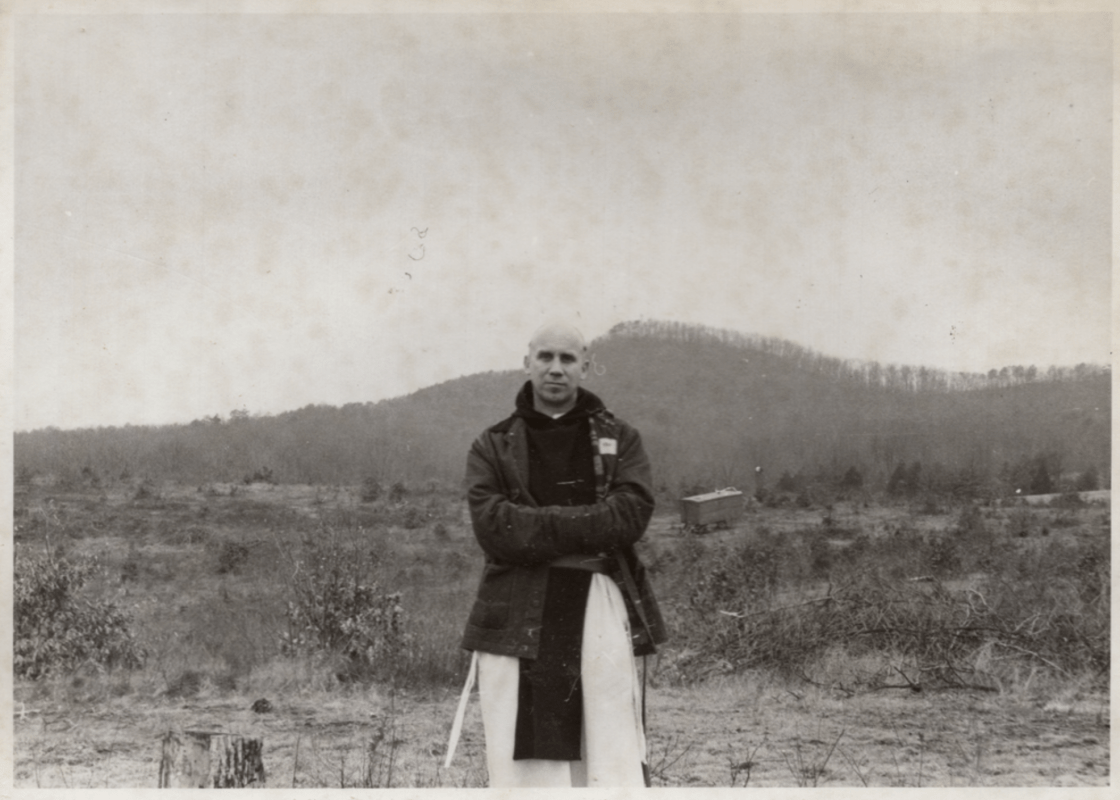
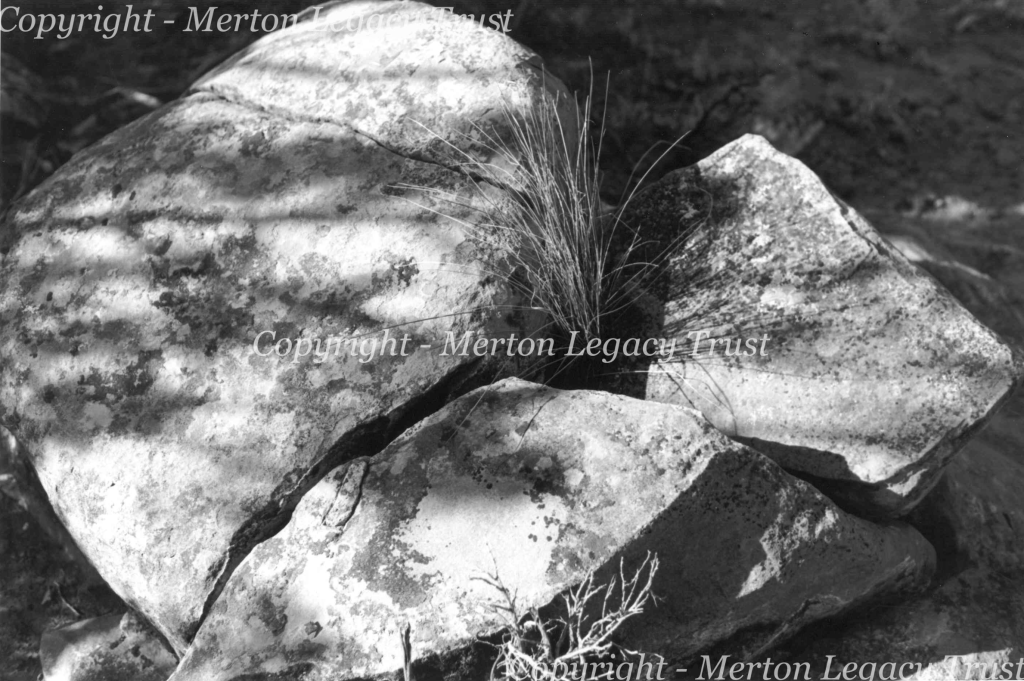
I have researched Thomas Merton because of his methodology in photography and his unique way of seeing and understanding the world. This piece of research has helped me understand the key principles behind contemplative, mindful creative practice and how it can be inter disciplined, combining writing, art and physical activity such as walking. He was a Trappist monk, based at Gethsemani in Kentucky and discovered photography in the last decade of his life, on the back of his prolific production of books (50 in 27 years) He paradoxically, perhaps, took up photography as a way to satisfy his need for simplicity and stillness.
Because he would have taken a vow of stability, he would have been limited to contemplate subjects in the hermitage and the immediate vicinity, his search for photographs was part of a highly developed visual awareness that revealed itself when in an intense contemplative state of mind. It is perhaps unsurprising that photography became a tool with which to study his world in fine detail.
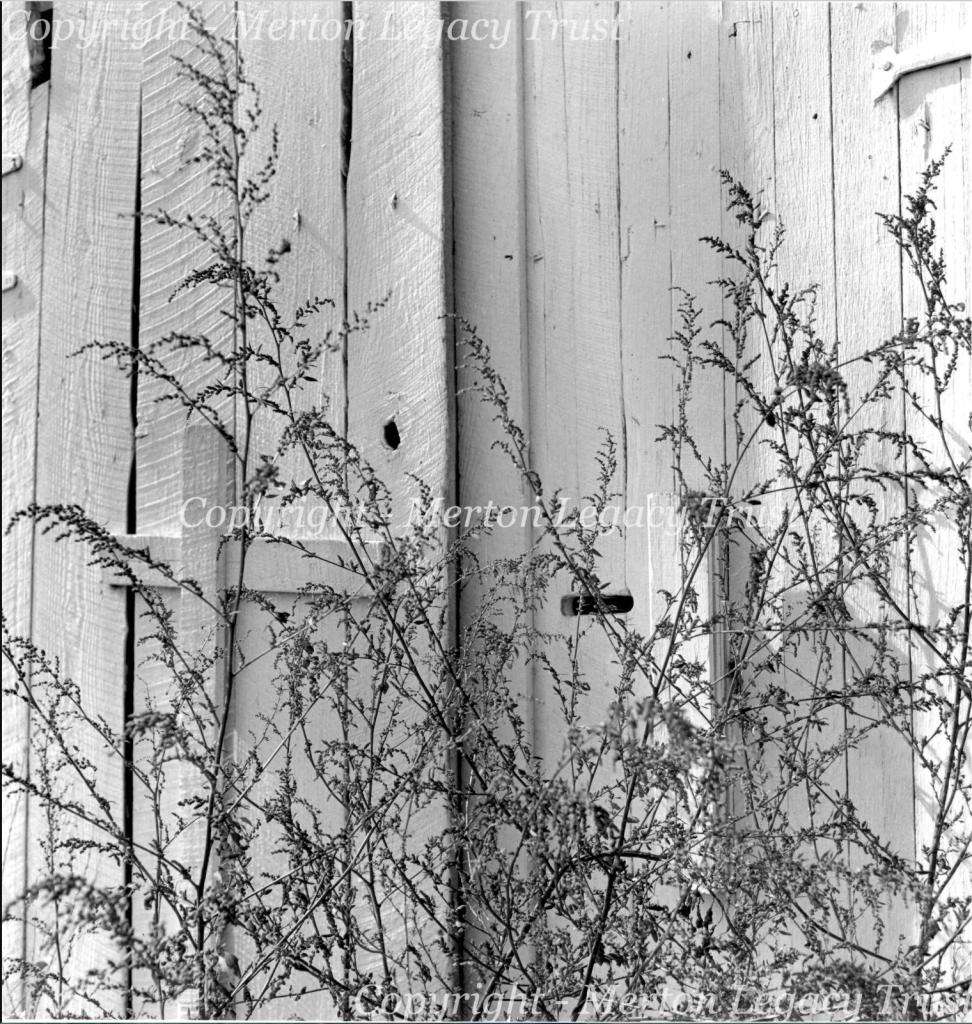
He continued his journaling and writing alongside his photographic practice which means that there is a wealth of insight into his thoughts and wonderings directly related to this. I find this useful because where I have read plenty from nature writers, they are not typically engaged in a related pursuit. For example, in one journal entry, he details that instead of reading a Zen anthology, he was too distracted by his ‘dream camera’ as he kept seeing curious things to shoot instead. he said ‘the whole place is full of fantastic and strange subjects – a mine of zen photography‘ (Hamrick, 2020: online) further to this in another entry, he says “Marvelous, silent, vast spaces around the old buildings…Cold, pure light, and some grand trees…. How the blank side of a frame house can be so completely beautiful I cannot imagine” (Hamrick, 2010) so we can garner from these words just how invested he was in paying close attention to his surroundings.
Paul Pearson is the director of the Thomas Merton centre at Bellarmine University in Kentucky. He has edited a book ‘Beholding Paradise, The Photography of Thomas Merton’ (Pearson, 2020) In this he discusses how Merton is ‘inseeing‘ which is a concept by Rilke, inspired by Rodin and interpreted by Merton as ‘an inner event in the person who sees it, and it takes place in this encounter with something else, not just a subjective thing…our own existence is revealed to us, along with the meaning of our own life’ (p133) It seems to me that this description epitomises the act of mindful, contemplative thinking. Mertons words summarise this a ‘Visio Divinia’ meaning seeing, rather than just looking so that the essence of the thing is revealed to the viewer.
For anyone seeking to absorb themselves in the simplicity of things, the book provides a fascinating insight into a man who as well as being a master at contemplation and mindful practice, had plenty of humour, liked a beer or two and mused and wondered about the marvel of life. Many of his poems and essays are thought provoking, although obviously plenty of reference to a God that I don’t believe in does sometimes detract from the enjoyment for me, so I do read his work through a slightly different lens to the one he may have intended.
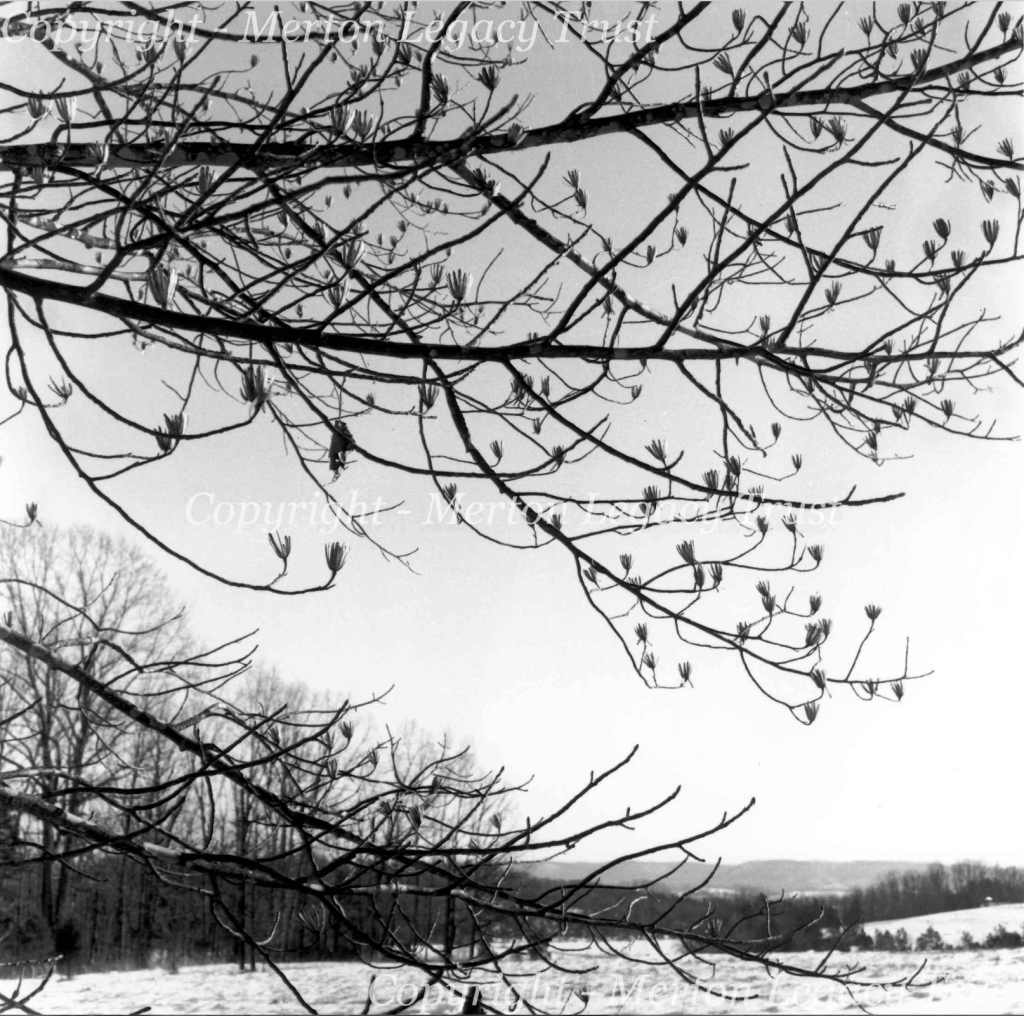
NB all images displayed are for analysis under the terms of fair useand belong to Merton Legacy Trust
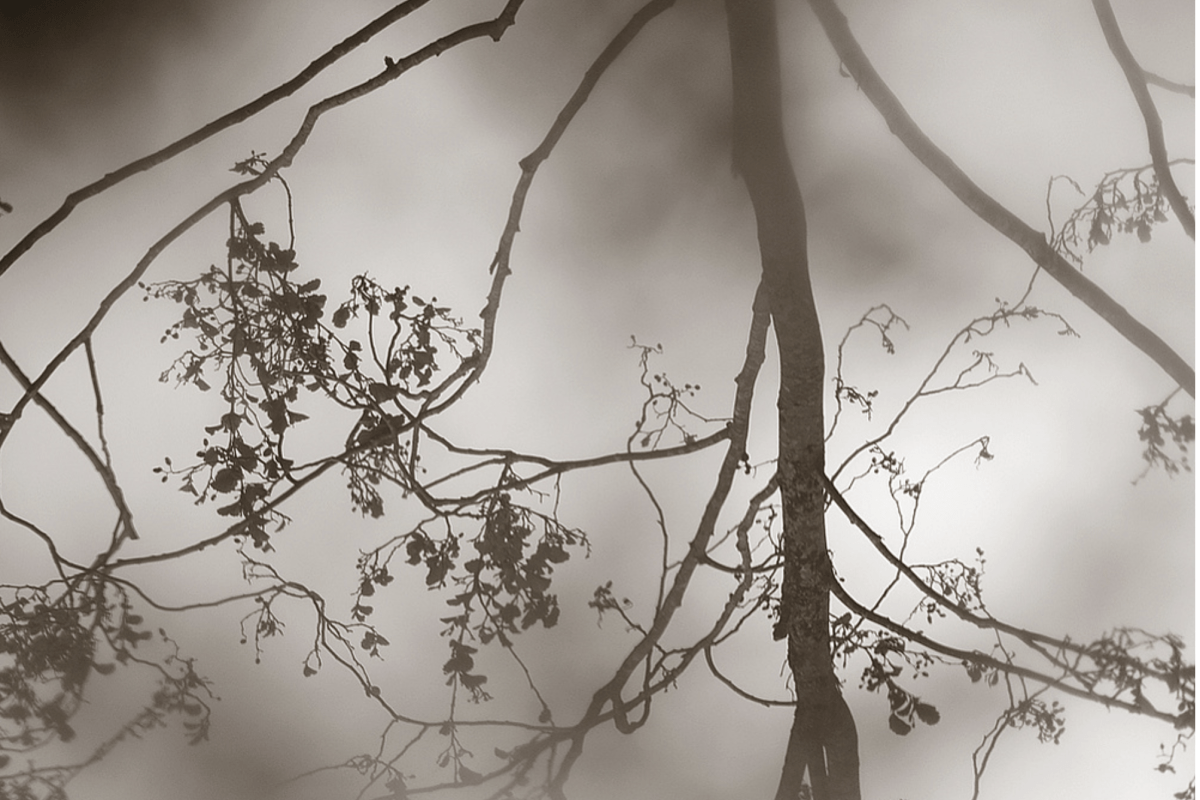
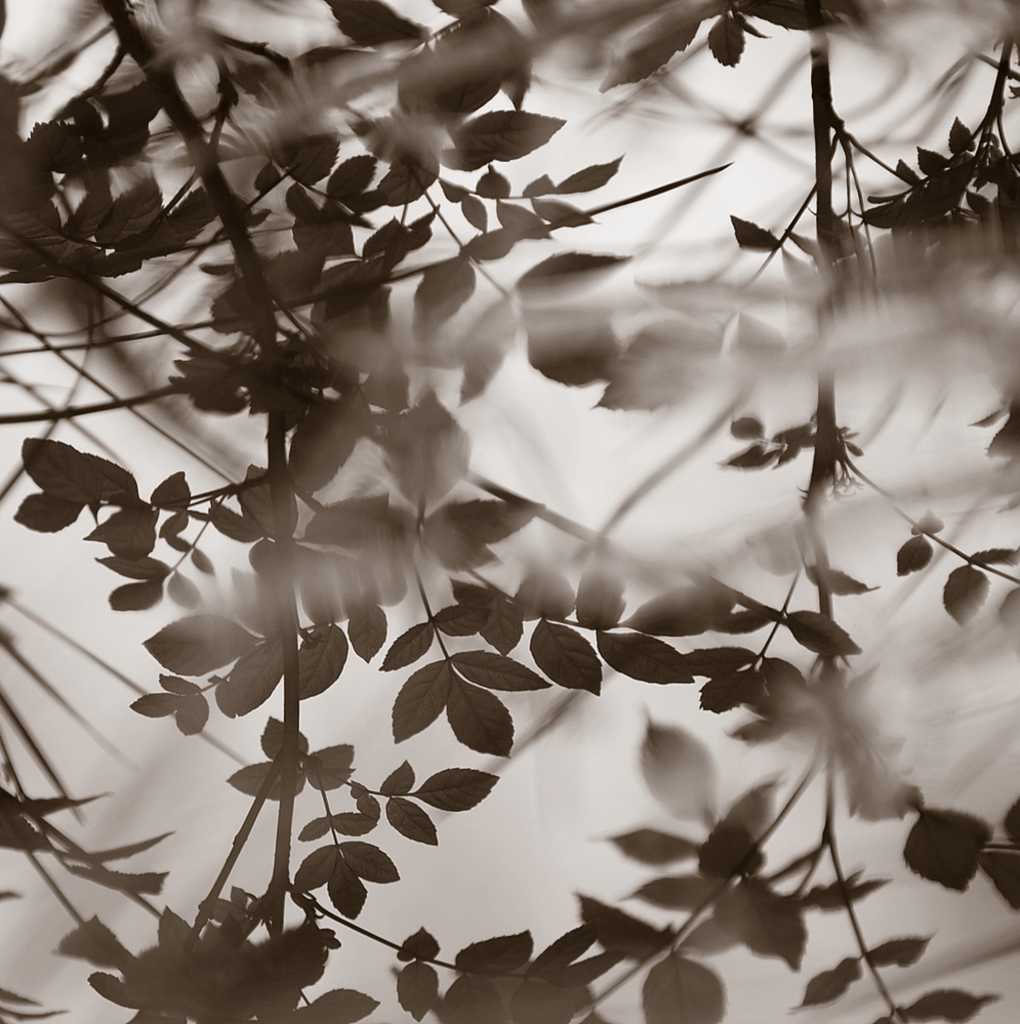
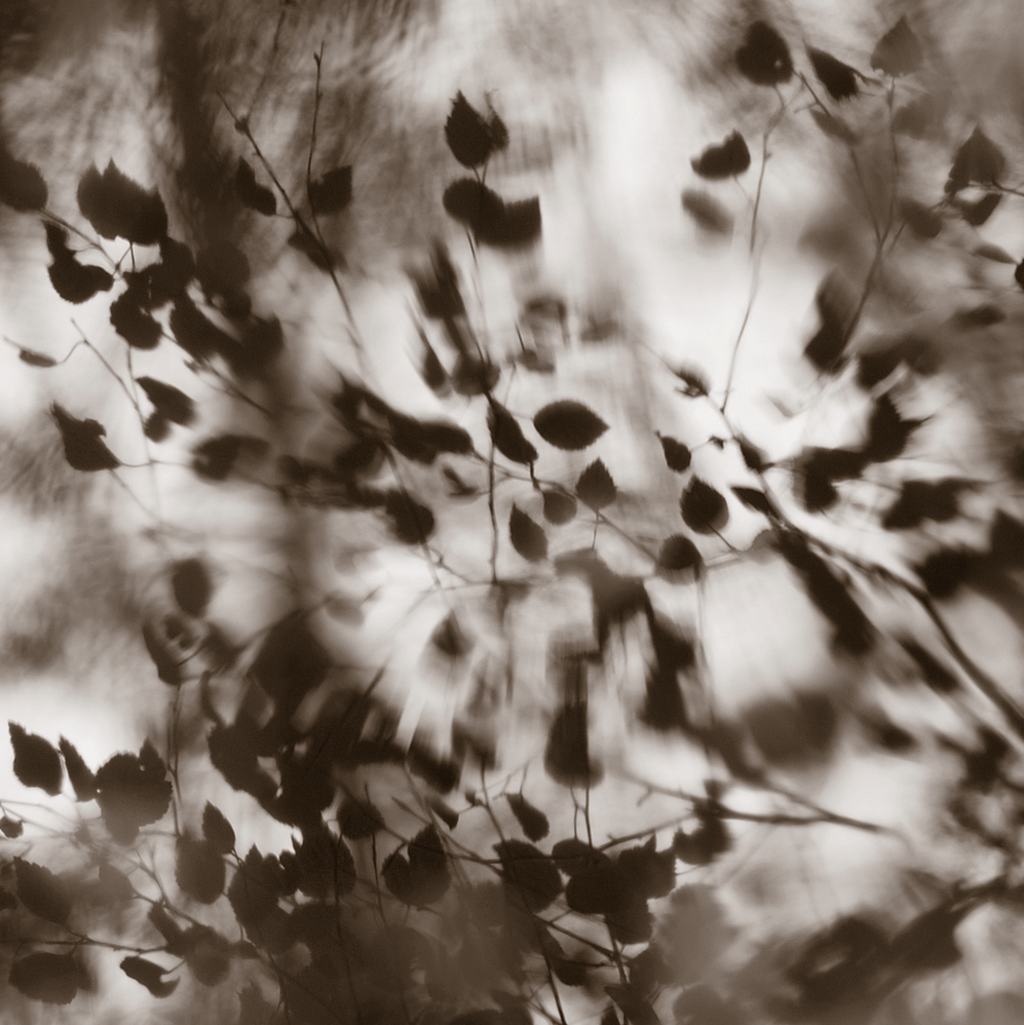
Iain Sarjeant’s project ‘The Pool’ centres around a small pond in his garden. The body of work he produced from this, are a series of close, detailed shots of selected elements of the pool. I think he successfully presents his subject beyond the ordinary by giving time and patience to his process.
The resulting photographs are like a labyrinth of flora, with a mix of sharply detailed leaves & branches, sometimes shown in shadow or as reflections, some elements are very blurry within the frame as his shallow depth of field emphasises his close proximity to his subjects. You feel he has nestled himself in to his environment, which creates a sense of immersion and a meditative aspect to the work. He says himself that ‘By singling out and focusing on individual elements, these complex and competing patterns are simplified and a sense of depth created‘ (https://iain-sarjeant.format.com/the-pool) which is a useful quote to think about when making my own work.
I recall the work of Nicholas Hughes and Susan Derges, both of whom I researched for 7803. I was immediately drawn to the ambiguity in their work. Both very different; Hughes photographs beautiful scenes of trees, undergrowth and foliage, then overlays the image with a nightsky for example. Derges makes photograms by submerging photosensitive paper in her local river at night, releasing a flash, resulting in a photograph of the ‘underneath’ ie just below the surface of the water. I see similarities between all three in these photographs by Sarjeant. I think it is the way that the light on the surface picks up the ripples in the water and the patterns made by the leaves and grasses seem to resemble Hughes’ work. It is difficult to know which way is up, which makes them ambiguous. I like this work a lot, it is an aesthetic and working method (contemplative, repeated study of a place) that resonates.




 Lucinda Taylor