As I keep in mind that this final major project can be a springboard into a more fully realised body of work, I am looking at how other practitioners work to help me to be less constrained by conventional thinking. I’ve discussed before, in previous modules, how I have to let go of the notion that I need a realised idea in mind. This is something I find hard, to do when I have a project to complete, a need to control all aspects can be a hindrance! In this scenario, I look towards other practitioners and how they approach their work.
As I intend to create an accompanying book, it is interesting to read how many of the practitioners whose work I am drawn to, often use the construction of an artist book as a tool for organising their photographs and to ultimately to link their images together into a coherent theme.
On Todd Hido’s work ‘A Road Divided’ he explains to writer Katya Tylevich how he uses book making as a way to present his work coherently, stating that“Without the book-making process . . . I wouldn’t know where to start.” This is a relatable comment as I often look at an image that I particularly like but struggle to understand where it might fit with my theme, if at all. Hido says that a book or show often “comes together much later in his process” having thoroughly sifted through his photographs to identify the connections and threads that run through them, describing this process as “constructing maps from large bodies of photographs.” In regarding the process in this way, I see how it would be a useful method in helping me make decisions on whether to retain, or eliminate a photograph perhaps for consideration in another project.
On a slightly seperate note, I like this quote given by Hido in an interview for Ahorn Magazine with Daniel Augschoell and Anya Jasbar “I believe that all those signs from your past and all those feelings and memories certainly come together, often subconsciously, and form some kind of a fragmented narrative. Often, you’re telling your own story, but you may not even know it.” I think that this accurately describes the mental process of creating a particular body of work, especially in my case for this FMP. It highlights how we are heavily influenced by our own stories and experiences, whether we know it or not, affirming that we are individually capable of creating our own authentic, unique work.
Similarly, Alec Soth discusses how he will often photograph the subjects he wants and then collate everything into a large ‘mess’ before seeking out a series to form a story. Raymond Meeks is another photographer who prefers to be driven by a need to photograph rather than have a preconceived idea.
Meeks is well known for his artist books, I was fascinated by them during an earlier module as he uses repurposed paper, often from old books. In a conversation with Stanley Wolukau-Wanambwa he describes how he tends to look for his narrative once he has reached a natural end of photographing a subject. “It’s a process of looking at a current archive; contact sheets and digital files–and trying to understand the common thread that underlies and unites my interests” (hcponline, 2016) He says he uses bookmaking as a ‘channel for formal expression’ when it comes to creating a body of work. Frequently photographing near his home, he does not always carry a camera. Instead, he observes and absorbs his immediate environment before deciding whether he might return to photograph any particular aspect, aiming to understand why he feels drawn back to a particular subject. Unfettered by his camera and using patience, this approach encourages a greater sense of presence.
John Gossage’s response to a question over whether the concept for his book ‘The Pond’ came first or the photographs themselves, reiterates this as he describes his process. The idea that the world will offer up something that you can’t preplan is certainly something that resonates for me: For me, it has always been that the world suggests far more subtle and interesting variations than I could ever come up with. At a certain point in each project, you get an idea and you investigate it. But I always take my prompting from the work being done. And back then, I had some pictures and I thought, yes. And then I filled it out. (Smithsonian: online, 2010)
Tacita Dean also refers to how she finds her way through, just by working. Similar I think to Gossage’s approach, just by doing and not to overthink.
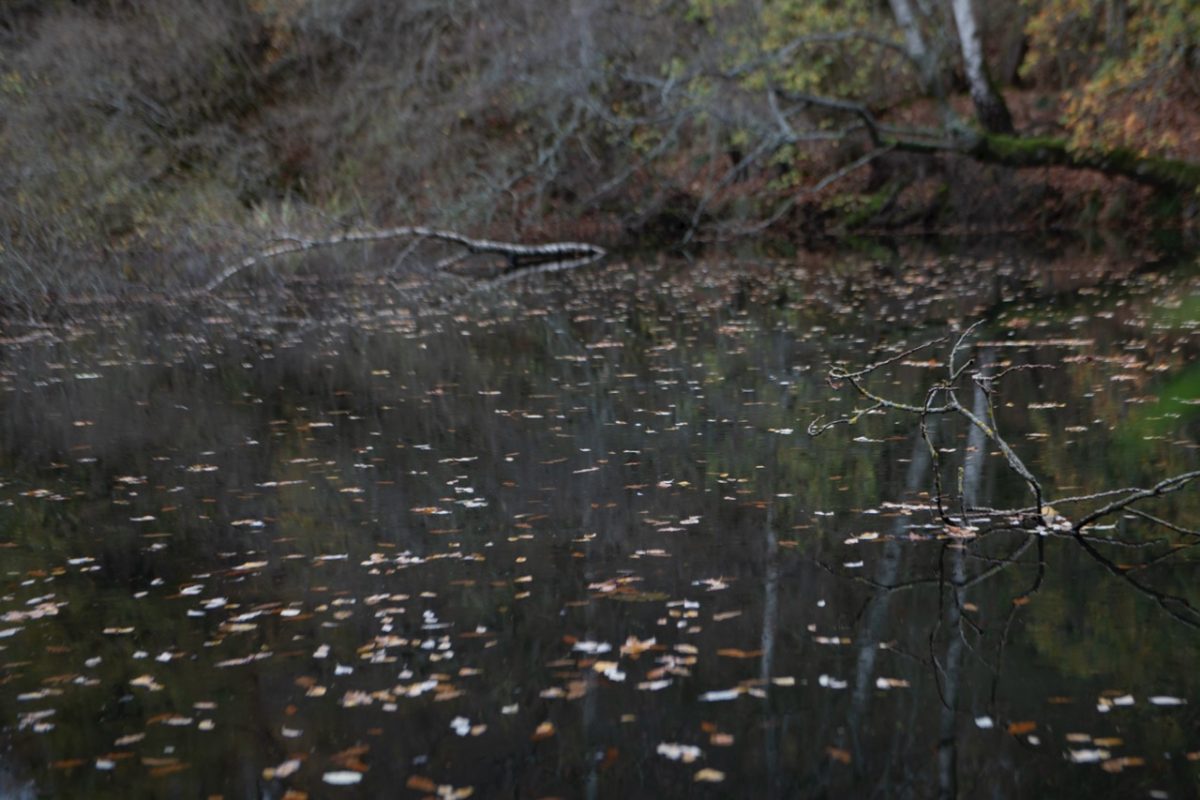
This quote holds great resonance for me: “The lake is a landscape’s most beautiful and expressive feature.” — Henry David Thoreau. or any body of water but a lake (or pond) has a stillness and therefore more shifting features as it is either a mirror or an abstract painting, the ice will soften the sky, a still & clear night sky delivers a mystical onyx effect and a bright winter day can be so clearly reflected as to make us think we are upside down. I will never not marvel at the images in water.
I am going to try and resist confining myself to a self imposed, overly prescribed brief. Of course, I need some parameters to work with but I think my work will be better for a more relaxed and instinctive approach, such as that used by the photographers mentioned above.
 Lucinda Taylor