
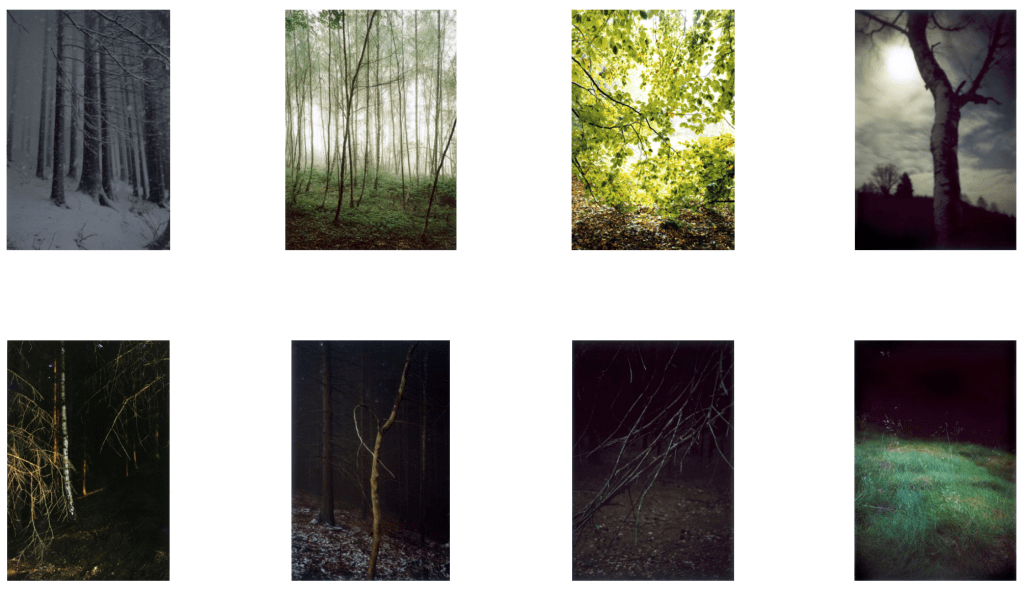
Images above, all Jitka Hanzlova from her series ‘Forest’
Tim Ingolds book ‘The Perception of the Environment’ is a book I’ve researched before, for critical research in other modules. In the chapter ‘The temporality of the landscape’ he discusses and illustrates what he terms ‘the dwelling perspective’ arguing that we are immersed in the world, shaping it through practical engagement over time; the result of memory, work and natural processes. However, the landscape is not shaped by humans alone, we are acting alongside plant growth, animal movement, weather, erosion etc. This persepctive places us as part of landscape, rather than outside masters of it. It seems to me to be this is relevant to the work of Hanzlova, in her experience of photographing for ‘Forest’
I am revisiting the work of Jitka Hanzlova for my FMP. Her practice is rooted in self reflection and exploration of personal history. I have written about her project ‘Forest’ in a previous module, there is a section in John Bergers ‘Understanding a Photograph’ in which he discusses the forward that he wrote for Hanzlova’s book. There is a highly evocative passage in which he discusses how Hanzlova found that sitting in the forest of her childhood home, she is hearing the usual sounds of birdsong, leaves and branches rustling, seeing the woodland elements moving in the wind and feeling the air on her skin, just as you might expect. After a period of time as she concentrates, the sounds disappear, the wind seems to rush out and she describes what sounds to me like entering a meditative state, almost like crossing into another realm, becoming part of the forest instead of just being in it. This becomes a much more deep sensory experience, with the surroundings being something you are suddenly a participant rather than observer. As though being invited in, by the environment itself.
In my explorations of Guiting and Dacha, I have experienced this other worldliness. It is a sensation of absolute belonging, which is a powerful and overwhelming feeling. I believe that this is where therapeutic benefit happens, a moment where it has been possible to leave behind the noise, stress and anxiety and to see with clarity & feel as though there is nothing else other than being in this place at this moment. It is fleeting but I imagine its this which is spoken about when ideas of meditation are presented. Interestingly, I have been successful in meditation in the traditional sense, I don’t like feeling out of control, it makes me feel quite vulnerable. However it is interesting that being surrounded by an environment which has positive personal historical significance (generations of family having lived and worked here) as well as my own memories and experiences makes this an easier or perhaps more likely environment to experience a meditative state.
Links to my earlier research on JH:
https://lucindataylorphotography.co.uk/2025/06/10/forests/
Tim Ingold DOI reference https://doi.org/10.4324/9781003196662 (original page numbers 234:258)
 Lucinda Taylor