Anna Albarran and Angel Cabrerra
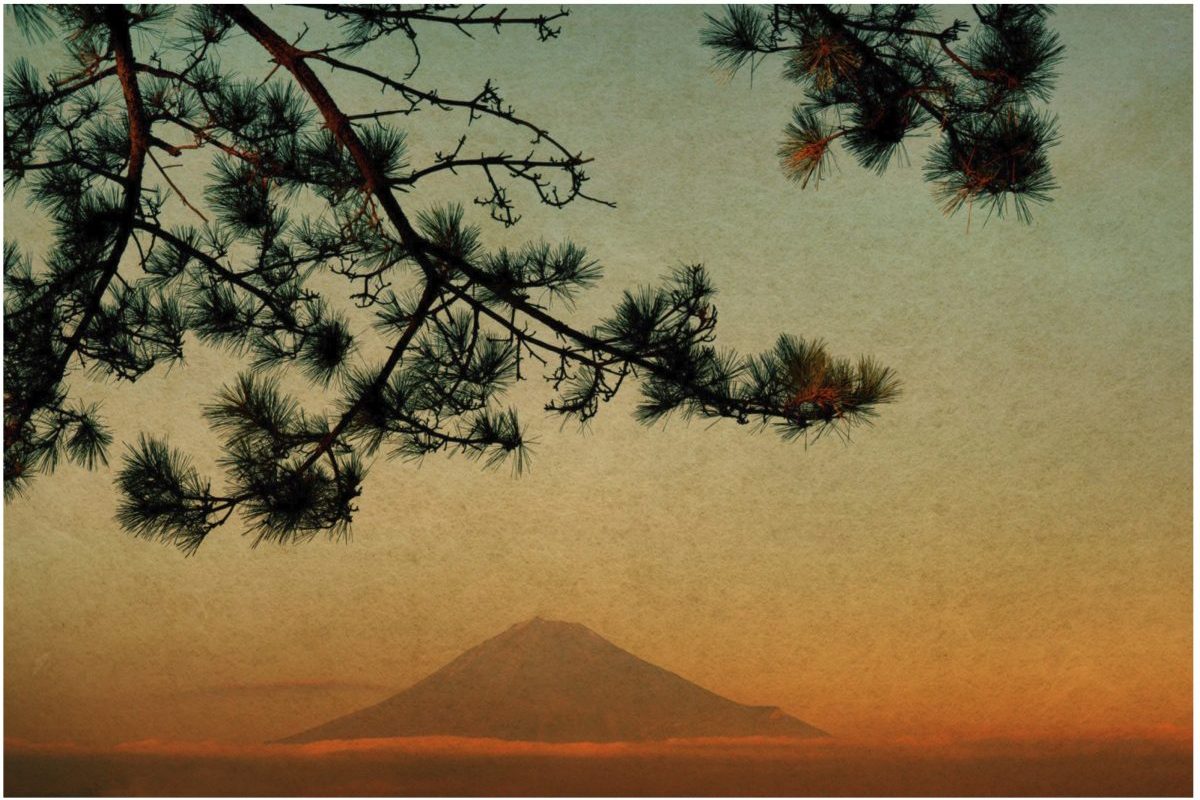
Lisa Lavery in the uni library recommended this book by the Spanish artist duo, Anna Albarran and Angel Cabrerra. There are so many elements to their work and process that resonate with me that their influence is likely to become a feature in the consideration of decisions in my own practice.
Albarran and Cabrera’s interest lies in the relationship between time, reality, existence, identity and empathy. They have chosen photography as a way to convey complex subjects, as recognition of the fact that linguistics are difficult when considering different ‘cultures, understanding, references and experiences. The viewer seems to be a central consideration to their process, as they seek to ‘play with the viewers memory’ This is an interesting consideration, all to often I do think of a viewer but only in the sense of them considering my work to be ‘good’ or ‘not good’ which of course is a doomed approach, given the subjectivity of art. Additionally, my approach could make my work too broad and cautious. Whereas, I understand Albarran and Cabrerras technique to be more of a reciprocal exchange, in that they invite a viewer to play along somehow. For them, photography has become a tool to understand the world and their images are a byproduct of that investigation, ‘the notebooks of our research.’
There is a short video on lensculture, where they talk about this in more detail. A line in this really resonated, in the context of working out what to photograph, ‘forget what you want to photograph, to get what you want’ and I think that to hold that thought in mind when I shoot, I may achieve what I feel I haven’t been able to quite reach yet. The process is in the waiting, observing, sensing everything around, for this to happen. This video has given me huge insight into my own practice and even validates some of my ideas. Their description of photographs as cherished objects highlights the importance of physical work as it is something to hold dear and have some connection to.
Production process
This excerpt here describes their process of using a combination of old and new processes, as well as ones they’ve themselves ‘invented’ such as ‘the one we use for our colour prints: pigments, Japanese paper and gold leaf’. They say that this is to serve the single purpose of having more parameters to play with the viewer, beyond just the image.
The texture, colour, finishing, tones; even the border of a print can give extra information to the viewer. And you can have a better control over this information just using the correct process and materials for a specific image’
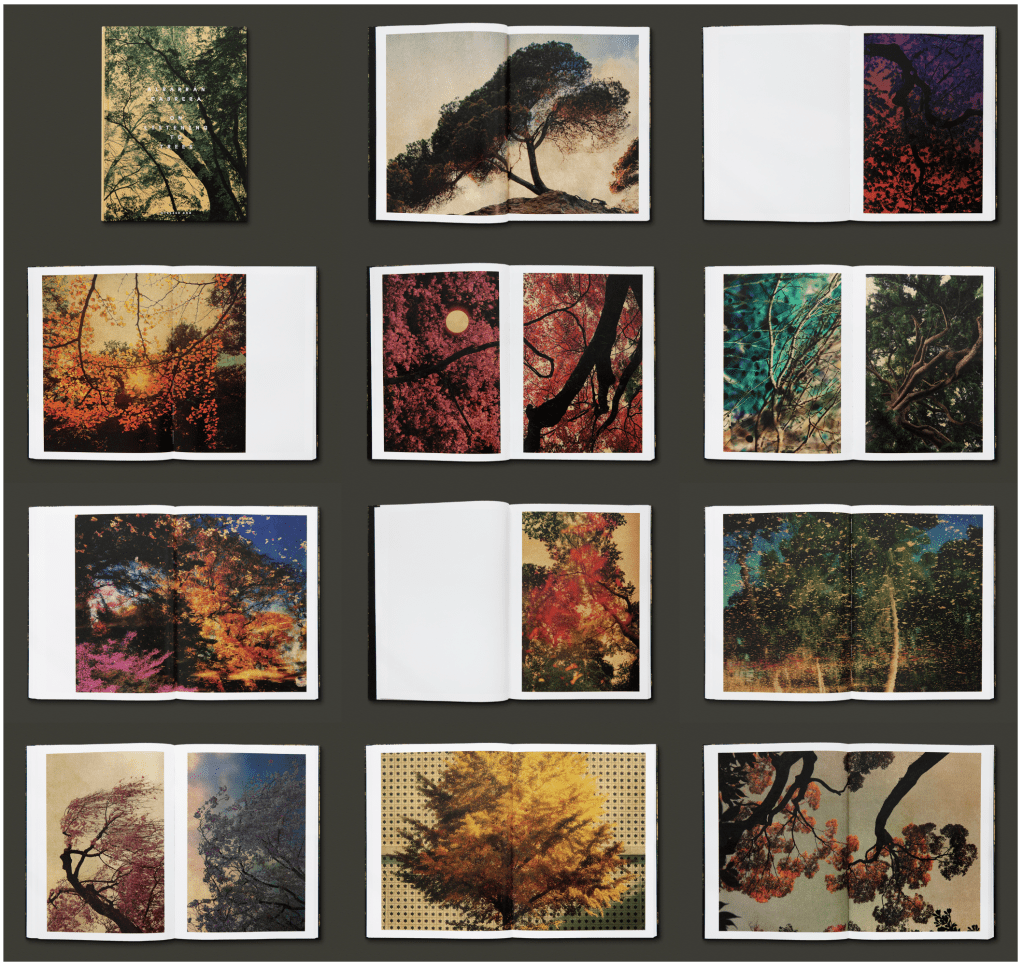
In their book ‘On Listening to Trees’ (image above) there is a diverse number of prints, with some almost abstract whilst others are monochromatic & melancholy. They are heavily influenced by Japanese art and this is clear throughout the book, especially in the vivid coloured examples. I am interested in how they’ve curated a body of work which is constructed from a broad range of different processes and textures. I wonder if I have been too structured with my own work. I think I am guilty of being too conventional in presenting my work, mixing up styles and media even, could be really interesting. The images in the book clearly show how their technique of layering their own created pigment on specialist papers, utilising additional materials such as gold leaf, means that they are creating the ‘cherished’ object that they described above. I recall seeing a photographers work at Broadway Arts Festival (Lucinda Batchelor) several years ago and I was surprised at how impactful her use of heavily textured paper was on the finished work. I recall thinking how important it is to free our photographs of a computer screen and let the world see them in a more textural way. The way the light lands and the ink is absorbed, makes for a transformative piece of work.
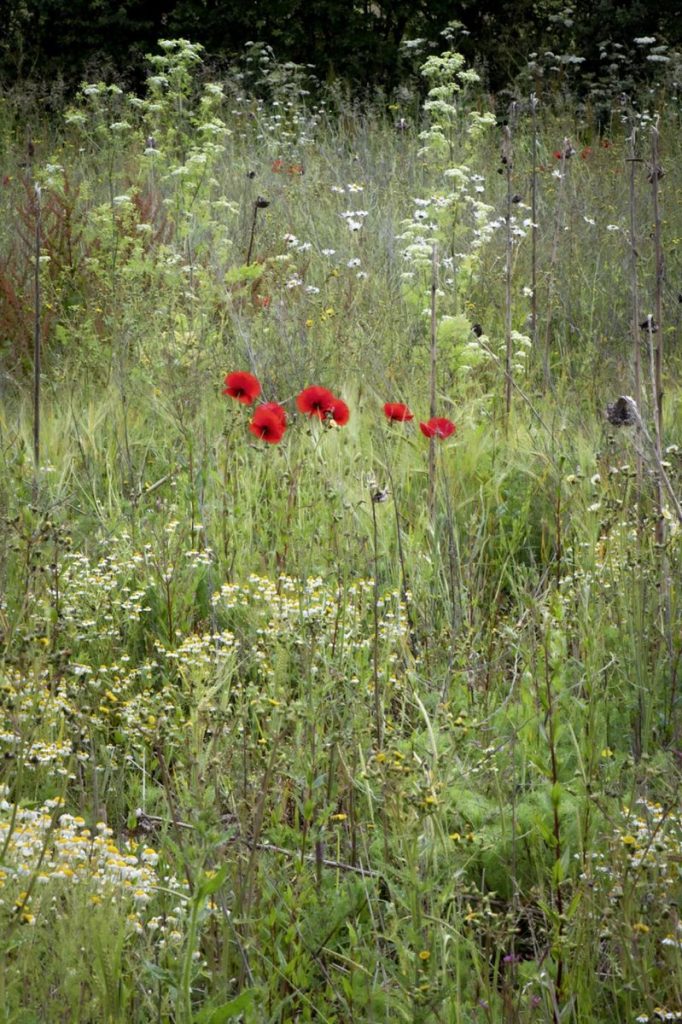
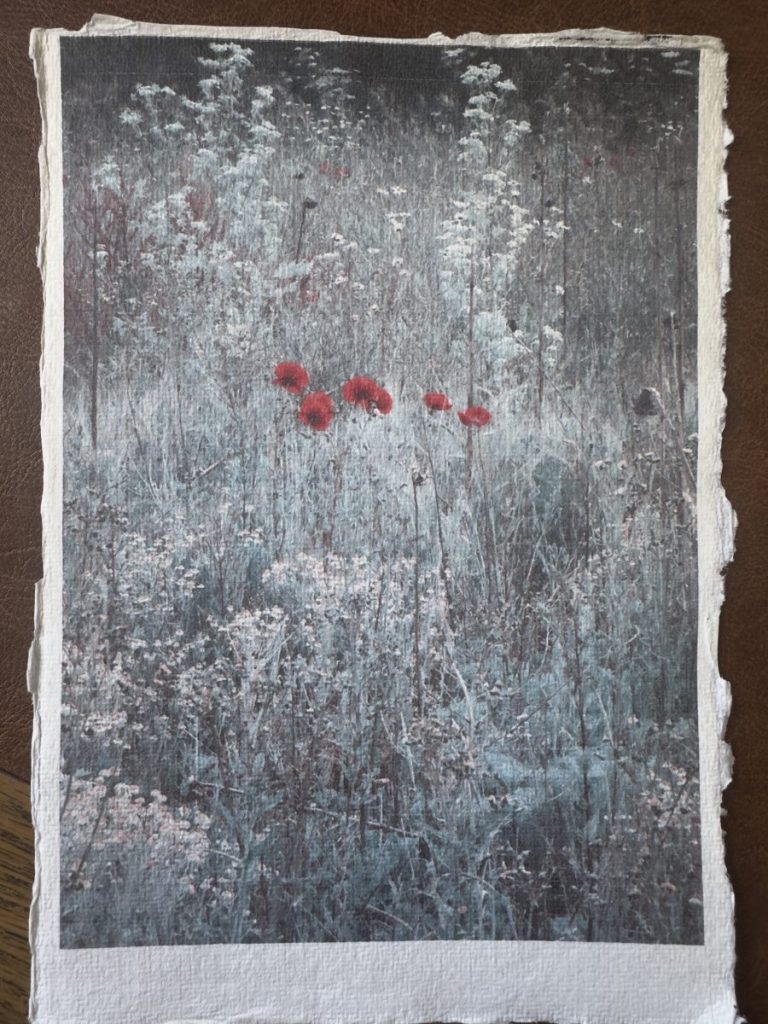
Taking on board the methods and motivations of the photographers, I tried printing on Khadi paper (see both images below) which is very rough and hand made. I recently photographed some wild flower fields on local farm land and I liked the bright red poppies in amongst the green and yellow. I printed to see how this might come out.. the colours are very muted but I suspect that is down to my skills and understanding of photoshop and printer set up! I will need to try and find an ICC profile to download to improve results, for a paper which is similar. Even then, having looked into this, an inkjet printer will always struggle to render the colours particularly well with papers such as this. It will be better to test on laserjet once I have access to one.
Original digital image (jpg) Inkjet print on khadi paper
Sources Used:
- https://www.lensculture.com/articles/albarran-cabrera-in-the-mood-for-beauty
- https://www.lensculture.com/articles/albarran-cabrera-the-mouth-of-krishna
- https://www.artdoc.photo/books/on-listening-to-trees
- https://albarrancabrera.com/on-listening-to-trees
- Alves, J. (2023) On listening to trees. Paris: Atelier EXB.
- Conversation with Lisa Lavery @ University of Gloucestershire
 Lucinda Taylor