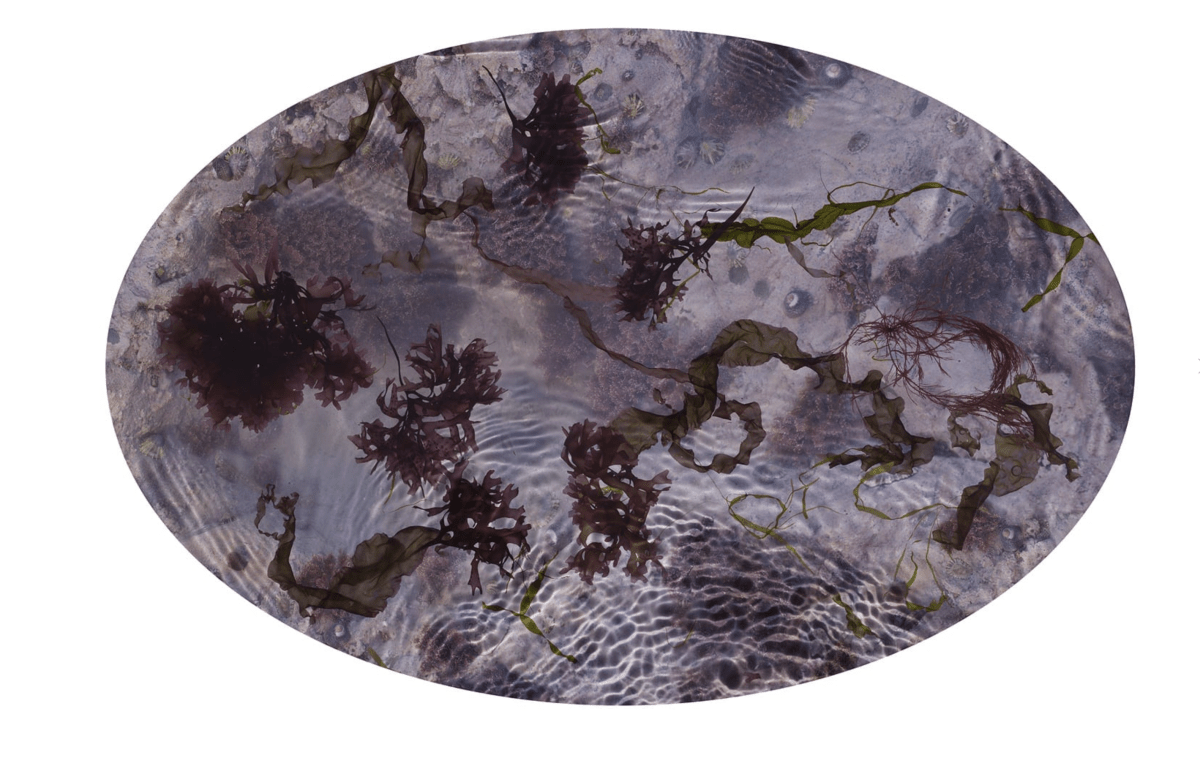
Susan Derges’ work with water at night, exposing photosensitive paper in water, then using a very brief flashlight to expose the image, are well known. I am interested in how I could utilise some of her methods to expand my own practice, especially given some of the similarities with my own themes. One of the considerations for my FMP is based on a family owned lake, which has played a significant role in my children’s and their friends childhood adventures. I am wondering if creating a multi disciplined body of work could be viable, for which this could be a part. Having researched her process, I am keen to see how the lake might be used in this way. I am thinking of some of the overhanging willow that might cast a shadow on the paper as I fire a flash. I will have to try this after the module once I have picked up some unfogged paper.
“Within seeming chaos, Derges conveys a sense of wonder at the underlying orderliness. She examines the threshold between two interconnected worlds: an internal, imaginative or contemplative space and the external, dynamic, magical world of nature”(vam.ac.uk)
She talks about her use of water being a metaphor for transformation.. this isn’t the first time I’ve heard someone talk about water in this way. Although Derges is referring to her practice and results, Amy Jane Beer, author of ‘The Flow’ discusses this as she felt its transformative power following her revisiting the place on the river where her close friend died, having been caught in the rapids.
Her question of ‘what underlies the invisible?’ seems to be an ongoing enquiry throughout her work.
In the film above Derges discusses her work with the Exmoor Society, talking them through the different images she has made from the river Bovey through to a waterfall and finally the sea. It is useful to hear her discuss differences depending on moon phases as I had wondered how this might impact the results. She mentions a type of paper that she used ‘Ilford Chrome’ as producing good results however it looks as though that may not be available anymore, I need to find alternatives, if I decide to push things further with this I could try that out. I have a pack of A5 ilford paper that I can use for this, during initial experiments. She doesn’t give much away regarding exposure time – in effect she has a multiple exposure because she initially uses ambient light (from nearby town or from the moon) then follows by finishing the exposure by using a flashlight. I am not clear on how / why this works as I would’ve assumed any ambient light would ruin the paper.
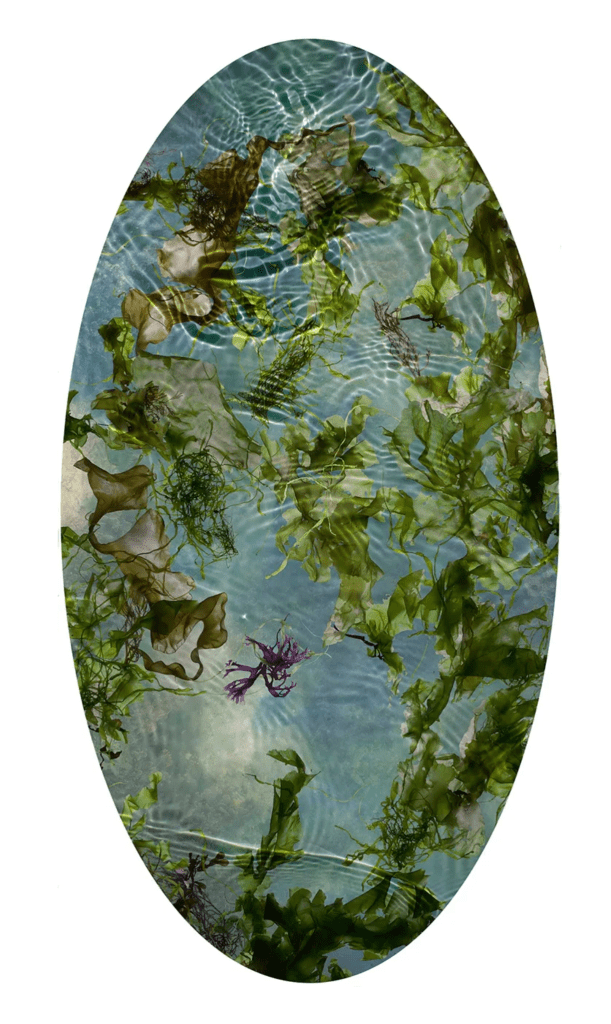
Tide Pool 26, Derges, S. 2014-2015
With the assistance of a marine biologist, Derges used a large saline solution filled tank in which to create a simulation of tidal surges for her series Tide Pools. This has given me the idea of experimenting with her methods from home. I could perhaps use my bath to experiment with.
Relative to my practice:
I am about halfway through a novel called ‘Rivers in the Sky’ by Elif Shafnak. It is a tale which covers many centuries, beginning in the Assyrian Empire and the reign of Ashurbanipal in 669bc, through to present day. Within the story, she subtly weaves the journey of a single drop of water as it travels through the centuries, reappearing as a raindrop, a tear, part of a river, the sea etc, as if to show how nothing us ever gone, it is always in a process of change (I’ve not finished the book so I don’t know how it will finish up!) essentially, it follows the theory that water retains memories from all the forms it has ever taken. In Derges work, she talks about nothing remaining in a state of being or dissolution out of being, it is always on the move. The common theme throughout my work is that nothing stays the same and that nothing is fully gone, our memories remain in some material way, within the environment and ourselves, as dust, water etc. It is this that I hope to hone in on and amplify. Especially when I think of the places where I’ve spent the most time and feel a physical ‘pull’ towards.
Resources:
- https://www.vam.ac.uk
- https://www.susanderges.com
- https://www.danzigergallery.com/exhibitions/susan-derges3
- ‘Shadow Catchers’ book by Martin Barnes, available through VAM.org.uk
- ‘The Flow’ by Amy-Jane Beer, available in bookshops
- “Rivers in the Sky’ by Elif Shafnak, available in bookshops
 Lucinda Taylor