
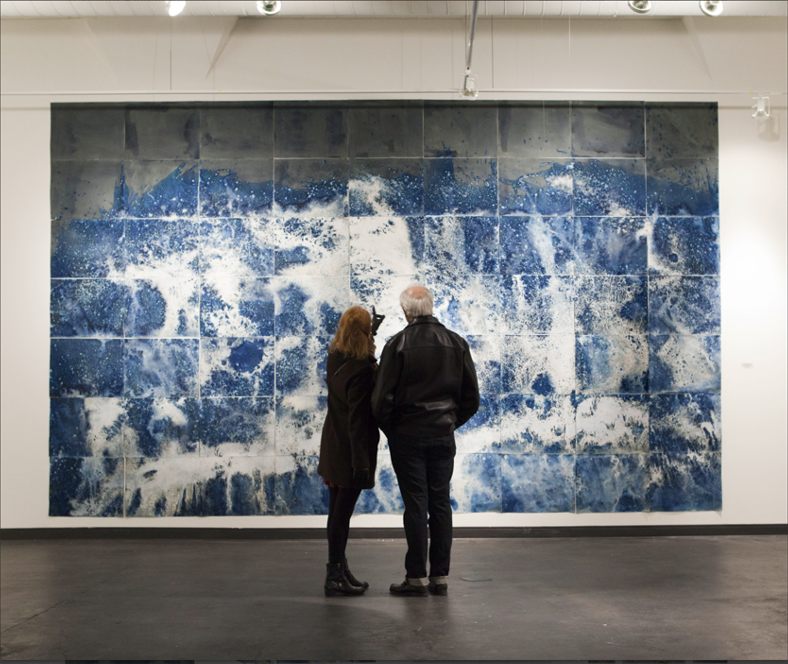
Littoral Drift, Riepenhoff, M. 2016
This body of work is the result of Riepenhoffs interaction with the sea. She typically creates very large cyanotypes, on location and uses the sea shore to form a print.
Having seen some footage of her process I can see that this often requires several participants, especially for the tiled piece (below) where many sheets of paper are attached side by side to create one large canvas. This gives the effect of that particular work being an installation piece. To create this, she rolled the prepared sheet into a light tight tube and then along with her assistants, unrolled it and walked into the sea to hold it in place (more on this further down)
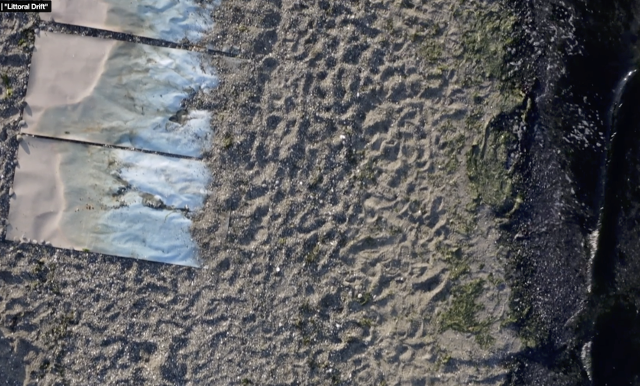
Once the water had washed over it, she & her team placed the paper on the shore and added further layers in the process by throwing sand, stones and other elements from the shore onto the work.
From watching a video in which she discusses her motivation for the work, its clear that she spends a tremendous amount of time refining and honing her skill. Relentless experimentation, working in ever changing conditions; the weather shifts constantly and the sea shore changes with every wave. This will have been time consuming and likely frustrating at times but this is what separates her work from something more simplistic. Its uniqueness is in its unpredictability and inconsistency.
I think that this is a practice in which one has to give up the idea of perfection or idealism. To collaborate with landscape and the elements that go with it, means surrendering to chance and accepting that there will be indeterminable factors, such as topography, wind, sunlight, tides etc. Waves are surely like thumbprints in that no two can be the same. I like the idea that working with natural surroundings means freeing one’s own need to control and predict. This could be a very freeing practice, connecting with the natural world and its rhythms. As Riepenhoff describes it, the sea is part of the subject and the process, a collaborator.
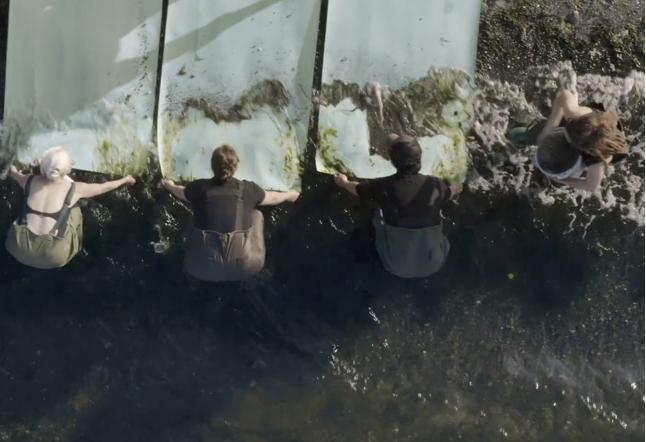
I’ve screen shot the above to show her work process, you can see in the top image how her team hold the sheets of coated paper and allow waves to wash over, collecting the sand and other minerals as they ebb and flow.
In the lower shot, I have shown the sheets semi buried in the sand, being exposed to the sun.
There is so much to consider here, re exposure, which sections will reveal detail, will any be washed away completely. How does she balance her process? Also, there is a time restricting factor here so she must have experimented a lot to determine best practice to achieve the results she is after. In relation to my own practice, I am fascinated with the idea of producing contact cyanotypes of this scale in such variable conditions. As with many practitioners I’ve looked at, I am mindful of how we rarely see their failures and it is easy to miss some of the fine tuning aspects of the process. With work such as Riepenhoffs, whilst she has to surrender to chance, there are clearly some disciplines that she adheres to and when I think about building my own working practices, it is useful to be reminded of this balance. For work of this scale, she has needed assistants to work side by side, creating a consistent, aligned piece. Therefore, although she is the artist, it has involved more than just her own skill, I personally view this as more collaborative.
 Lucinda Taylor